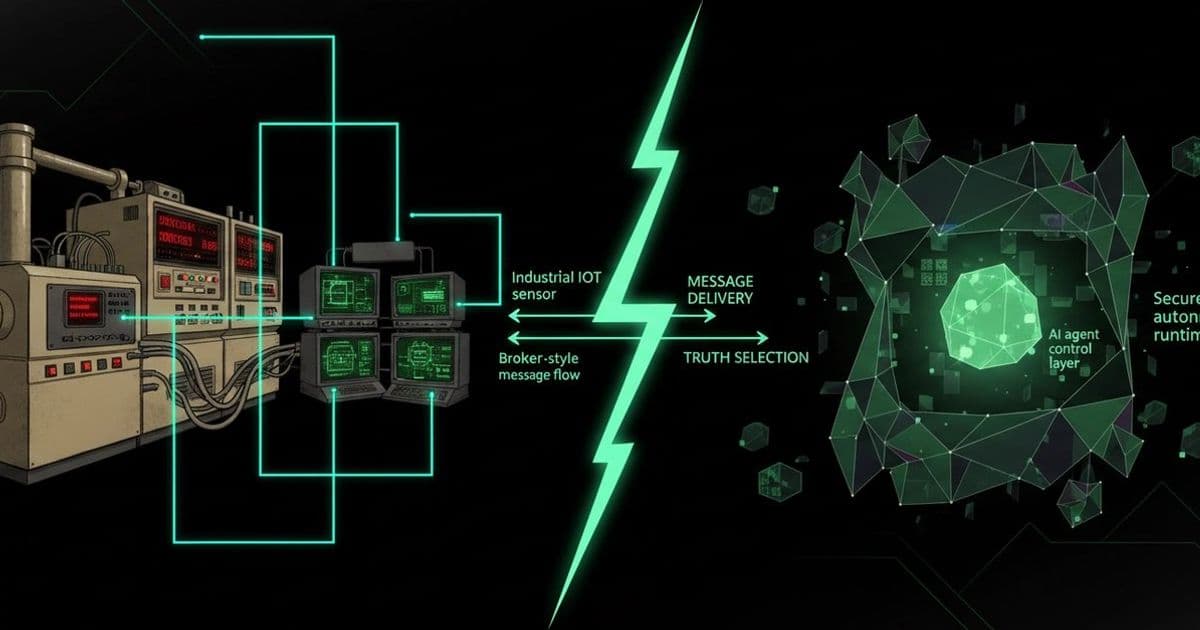
The hardest part of connected systems is not moving data, but deciding what is actually true when the system is under stress. NemoClaw reveals a fundamental truth: IoT needs state arbitration, not just better messaging.
The recent discussions around NemoClaw highlight an architectural pattern that extends far beyond autonomous agents into the core of IoT systems design. The most persistent operational pain in IoT deployments stems from a fundamental misconception: treating device state as a messaging problem rather than a truth problem.
The Messaging Fallacy in IoT
For years, IoT teams have approached device state management through the lens of message delivery. A device disconnects, a reconnect arrives later, and the system assumes arrival order is sufficient to infer reality. This approach works well in controlled environments but collapses under real-world stress conditions.
AWS IoT's own documentation explicitly states that lifecycle messages might arrive out of order and may be duplicated. This is not an implementation flaw; it's a fundamental property of distributed systems operating over unreliable networks. The platform itself warns users that message arrival cannot be treated as a trustworthy proxy for physical truth.
The parallel to NemoClaw becomes clear here. Just as autonomous agents need a secure, governed runtime to operate safely over time, IoT devices require a state layer that can arbitrate truth under uncertainty. In both cases, the critical challenge is not transport—it's decision-making in the face of incomplete or conflicting information.
The Hidden Failure Mode: Confident Wrongness
The most dangerous failure mode in IoT is not message loss but systemic confidence in incorrect state. A reconnect event can arrive before a disconnect event. Device timestamps can drift. Sequence numbers preserve local order without proving physical causality.
Consider an industrial monitoring system that receives a device reconnect message before the corresponding disconnect. The broker performs exactly as designed, yet the system concludes the device was never offline when, in reality, it was. This confident wrongness propagates through the system, potentially triggering incorrect alerts, unnecessary maintenance dispatches, or missed critical events.
AWS's recommended handling for lifecycle events—wait and verify that a device is actually offline before taking action—acknowledges this fundamental limitation. This is not a trivial implementation detail; it's an admission that state decisions must incorporate confidence metrics, verification delays, and probabilistic reasoning.
Telemetry vs. State: A Critical Distinction
Most IoT architectures continue to treat state as merely telemetry with semantic labels. This mental model fails under stress conditions. Telemetry reports what was observed; state arbitration determines what is most likely true.
In pristine environments, these concepts converge. Under network latency, RF interference, clock skew, or reconnect storms, they diverge rapidly. A timestamp from a device that has been disconnected for hours might arrive after a newer reading from a different sensor. Simple arrival-based logic cannot resolve such conflicts.
The economic stakes make this distinction critical. McKinsey estimates IoT applications could create between $3.9 trillion and $11.1 trillion annually by 2025, with potential maintenance cost reductions of up to 25% and unplanned outage reductions of up to 50%. These benefits materialize only if systems act on trustworthy state, not merely on message streams.
Scale Amplifies the Problem
The economic impact of incorrect state decisions scales dramatically with deployment size. Siemens' 2024 analysis shows unplanned downtime costs the world's largest companies approximately $1.4 trillion annually. In automotive manufacturing, an idle production line can cost up to $2.3 million per hour. ABB's research found 83% of decision makers report unplanned downtime costs of at least $10,000 per hour, with 76% estimating costs up to $500,000 per hour.
These figures reveal a fundamental truth: the cost of confident wrongness is not theoretical—it's operational, financial, and repetitive. As IoT deployments grow from thousands to millions of devices, the frequency of conflicting signals increases, amplifying the need for robust state arbitration.
Architectural Evolution: From Transport to Truth
A mature IoT stack must evolve beyond asking "Did the message arrive?" to addressing more nuanced questions:
- Is the timestamp trustworthy given the device's connection history?
- Does the sequence number reflect physical causality or just local ordering?
- Is the signal environment degraded, increasing the probability of corrupted data?
- Is this reconnect genuinely newer than the disconnect, or merely delayed in transit?
- Should downstream systems act immediately, confirm first, or only log for later analysis?
These questions separate transport concerns from truth selection. The most valuable addition to IoT architectures is not another dashboard or broker, but a decision layer capable of evaluating multiple signals, assigning confidence metrics, and returning verdicts that downstream systems can act upon with appropriate certainty.
The NemoClaw Parallel
NemoClaw illustrates a broader pattern in modern systems design: autonomous agents require governed runtimes that can manage trust across time, context, and privilege boundaries. IoT faces an analogous challenge, with the added complexity that consequences manifest in the physical world rather than digital conversations.
In both domains, the architectural shift moves away from naive event trust toward explicit state governance. A long-running autonomous agent cannot act on a single signal; it must maintain context and verify conclusions over time. Similarly, IoT devices cannot rely on individual messages to determine state—they need mechanisms to reconcile conflicting information and determine the most probable reality.
Implementation Considerations
Implementing state arbitration requires careful consideration of several factors:
Confidence Metrics: Each state transition should include a confidence score based on signal quality, recency, and corroboration from other sources.
Temporal Reasoning: Systems must account for time delays in message delivery and potential clock drift between devices and servers.
Context Awareness: State decisions should incorporate environmental factors known to affect signal reliability.
Action Thresholds: Different downstream systems may require varying levels of certainty before taking action, allowing for appropriate risk management.
Fallback Mechanisms: When confidence remains low, systems should default to safe states rather than risk incorrect actions.
The Path Forward
The NemoClaw conversation matters because it represents a fundamental shift in how we think about system design. The same transformation is overdue in IoT. The industry has spent years optimizing transport protocols, delivery guarantees, and visualization dashboards, but perfectly delivered messages do not equate to correct real-world state.
Solutions like SignalCend address this gap by implementing device state arbitration as a foundational infrastructure layer. This approach recognizes that IoT workflows must operate on the most accurate information possible, especially under harsh and unpredictable conditions.
The architectural shift worth paying attention to is not about moving more data or building faster brokers. It's about better truth—systems that can distinguish signal from artifact and evidence from assumption. As IoT deployments continue to scale and the economic stakes grow, this distinction will separate successful implementations from costly failures.
The future of IoT lies not in more connected things, but in systems that can confidently determine what is actually true about the physical world they monitor and control.
Comments
Please log in or register to join the discussion