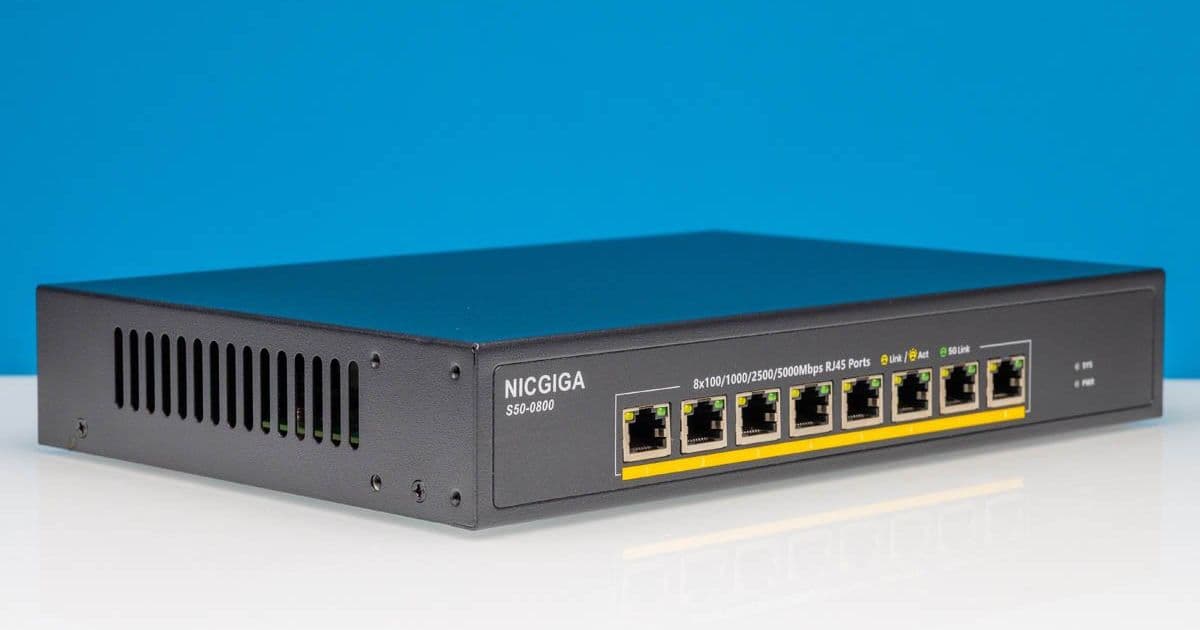
The NICGIGA S50-0800 offers an accessible entry point to 5GbE networking at $169-199, using the same Realtek RTL9303 chip found in higher-end switches, though with some design compromises.
The networking landscape continues to evolve, and 5GbE is emerging as a practical middle ground between traditional gigabit and more expensive 10GbE deployments. The NICGIGA S50-0800 represents one of the most affordable options in this space, priced between $169 and $199 depending on market fluctuations.
Hardware Overview
The S50-0800 follows a conventional 1U form factor that will be familiar to anyone who has worked with enterprise networking equipment. The front panel features eight RJ45 ports clearly labeled for their capabilities: 100M, 1G, 2.5G, and 5G auto-negotiation. This flexibility allows the switch to accommodate a wide range of client devices without requiring manual configuration.
 )
)
One minor design oversight is the port numbering scheme. White digits on a yellow background create insufficient contrast, making the numbers difficult to read in certain lighting conditions. This is a small but notable usability issue that could be easily addressed in future revisions.
Physical Design and Build Quality
The switch's exterior is functional but shows evidence of cost optimization. The sides feature ventilation slots for passive cooling, while the rear panel houses only the AC power input and a grounding point. The top surface is a flat metal panel, and the bottom includes raised metal feet instead of rubber ones, which could potentially scratch desk surfaces during desktop deployment.
Rack mounting is supported through included ears, which is a welcome feature. Some competing switches in this price range omit rack ears entirely or include ones that don't conform to standard rack widths.
 )
)
Internal Architecture
Opening the switch reveals a relatively straightforward internal design. The power supply occupies the upper portion of the chassis, while the main switch PCB sits below. A prominent heatsink runs along the length of the board, cooling the physical layer (PHY) chips responsible for the actual data transmission.
 )
)
The most interesting component is the ESMT chip adjacent to the main heatsink, which serves as the switch's control processor. However, the real star of the show is the Realtek RTL9303 chip, which handles the switching functions.
The RTL9303 Connection
Here's where things get particularly interesting: the RTL9303 is the same switch chip found in the QNAP QSW-L3208-2C6T, TRENDnet TL2-F7080, and several other switches in the market. This is noteworthy because the RTL9303 is actually an 8-port 10GbE switch chip, not a 5GbE-specific component.
 )
)
This architectural choice suggests that NICGIGA is leveraging existing, proven silicon rather than developing a dedicated 5GbE solution. The chip's 10GbE capabilities are likely being rate-limited through firmware to achieve the 5GbE speeds, which could have implications for performance and future firmware updates.
Market Context
The S50-0800 enters a market where 5GbE adoption is accelerating, driven by increasing home internet speeds and the need for better local network performance. By using a widely available chip like the RTL9303, NICGIGA can offer competitive pricing while maintaining compatibility with established networking standards.
This approach mirrors what we've seen in other networking segments, where manufacturers use the same underlying hardware but differentiate through software features, build quality, and pricing strategies. The use of the RTL9303 also means that the switch benefits from the maturity and stability that comes with a chip that has been deployed in numerous other products.
Performance Considerations
While we haven't completed full performance testing at this point, the RTL9303's pedigree suggests the switch should handle typical 5GbE workloads competently. The chip's 10GbE origins mean it has headroom for handling traffic bursts and maintaining low latency, even when operating at reduced speeds.
The eight-port configuration provides ample connectivity for most home and small office scenarios, allowing users to connect multiple high-speed devices without bottlenecks. The auto-negotiation feature ensures that each port operates at the maximum speed supported by connected devices, whether that's 100M, 1G, 2.5G, or 5G.
Conclusion
The NICGIGA S50-0800 represents an interesting entry in the affordable 5GbE switch market. Its use of the Realtek RTL9303 chip connects it to a broader ecosystem of networking products, while its competitive pricing makes 5GbE more accessible to a wider audience. The design compromises are understandable given the price point, though the port numbering visibility issue should be addressed in future versions.
For users looking to upgrade their home or small office networks to 5GbE without breaking the bank, the S50-0800 offers a compelling option backed by proven technology. As we continue our testing and comparison with other 5GbE solutions, including adapters like the BrosTrend 5GbE PCIe Adapter, we'll gain a clearer picture of how this switch performs in real-world scenarios.
Comments
Please log in or register to join the discussion