The NixOS community faces a governance crisis after discovering a Steering Committee member joined defense contractor Anduril without disclosure, triggering debates about conflict-of-interest policies and ethical boundaries in open-source foundations. This incident reveals systemic flaws in how technical communities manage corporate influence and transparency.
Undisclosed Ties: When Open Source Governance Meets Defense Contracts
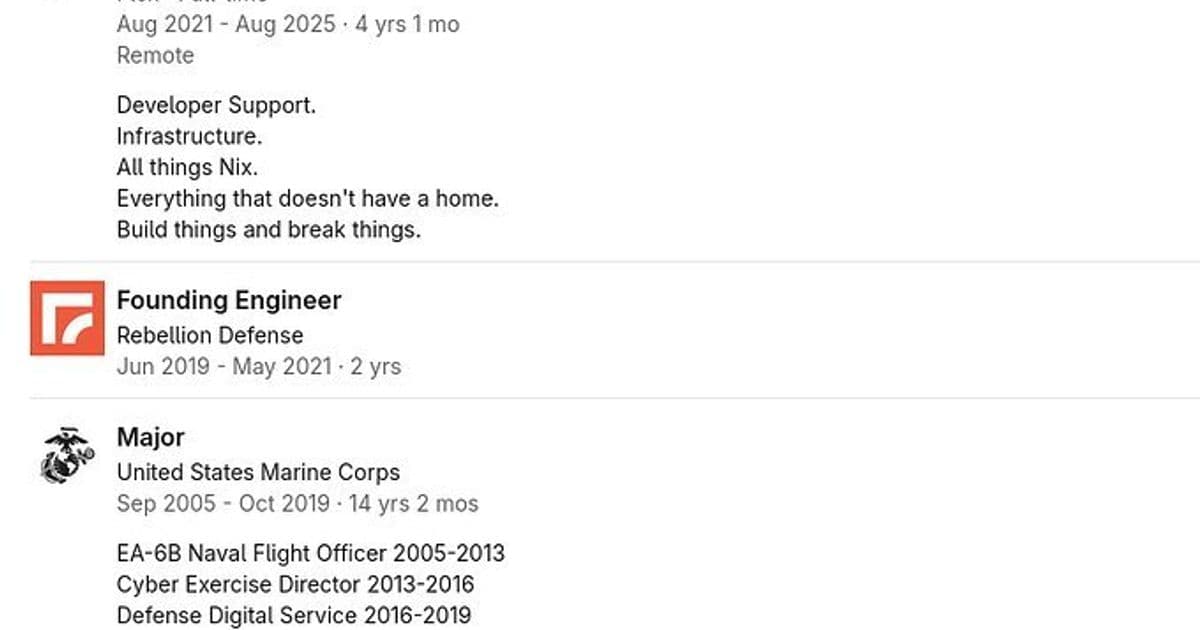
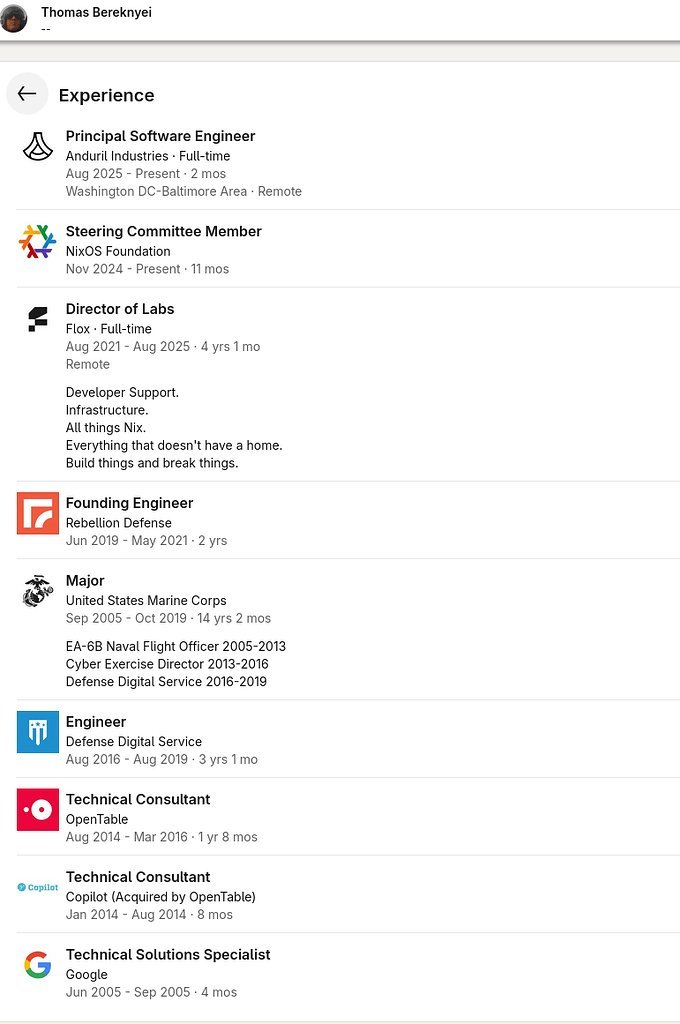 A LinkedIn profile revealed Tom Bereknyei's employment at Anduril since August 2025, undisclosed to the NixOS community. (Source: Discourse/NixOS)
The discovery that NixOS Steering Committee (SC) member Tom Bereknyei (@tomberek) has been employed by defense contractor Anduril since August 2025—without official disclosure—has ignited a firestorm in the open-source community. The revelation, surfaced through community sleuthing on LinkedIn rather than official channels, strikes at the heart of governance transparency for the infrastructure-critical project.
The Core Conflict: Undisclosed Interests in Governance
Community members expressed outrage that Bereknyei's employment at Anduril—a major military technology contractor with significant U.S. government ties—wasn't disclosed despite:
- Prior Ethical Stances: Bereknyei previously positioned himself as "anti-MIC" (Military-Industrial Complex) during his SC election
- Community Precedent: An open letter had previously protested Anduril's sponsorship of NixOS events
- Governance Requirements: SC candidates originally disclosed conflicts during elections, setting transparency expectations
"This trust cannot be restored if you choose to sweep unpleasant facts under the rug," commented one Discourse user, highlighting how the lack of proactive disclosure undermined the SC's legitimacy.
Governance Mechanics Under Stress
The incident exposed critical gaps in NixOS's conflict-of-interest framework:
- Recusal vs. Disclosure: While SC members recuse themselves from votes involving their employers (as confirmed by member @winter), disclosure remains inconsistent
- Policy Ambiguity: No mechanism exists for updating conflicts during tenure, despite election-time disclosure requirements
- Enforcement Limits: SC removal requires a supermajority vote—an impractical solution for transparency failures
Gabriella439 noted on Discourse: "If it's a matter of community interest to the point that it's part of the election, then it remains so throughout the term."
The Defense Contractor Dilemma
The debate intensified around whether open-source communities should exclude defense industry participants:
- Pluralism Argument: Some defended inclusion, citing historical examples like Ford/GM aiding anti-fascist efforts
- Ethical Boundaries: Others countered that military contractors' work contradicts open-source ethics, referencing prior community objections to Anduril sponsorships
- Corporate Influence: Concerns mounted about defense contractors gaining governance influence in critical OSS infrastructure
Constitutional Crisis
The Nix Governance Constitution currently lacks provisions for ongoing conflict disclosure. The SC's belated acknowledgment—only after community exposure—highlighted this gap. Proposed solutions include:
1. Require SC members to publicly disclose employment changes during tenure
2. Eliminate conflict disclosure requirements entirely to avoid hypocrisy
The Way Forward: Transparency or Tribalism?
As the next SC election approaches, this incident forces a reckoning: Can open-source governance bodies maintain community trust while navigating corporate employment realities? The resolution will set precedents for how technical communities manage:
- Evolving contributor affiliations
- Defense industry participation
- Transparency versus operational pragmatism
With infrastructure projects increasingly becoming geopolitical battlegrounds, NixOS's policy response may well become a blueprint—or cautionary tale—for open-source governance everywhere.
Source: Discourse thread "SC member @tomberek works for Anduril" with community commentary and official SC responses.
Comments
Please log in or register to join the discussion