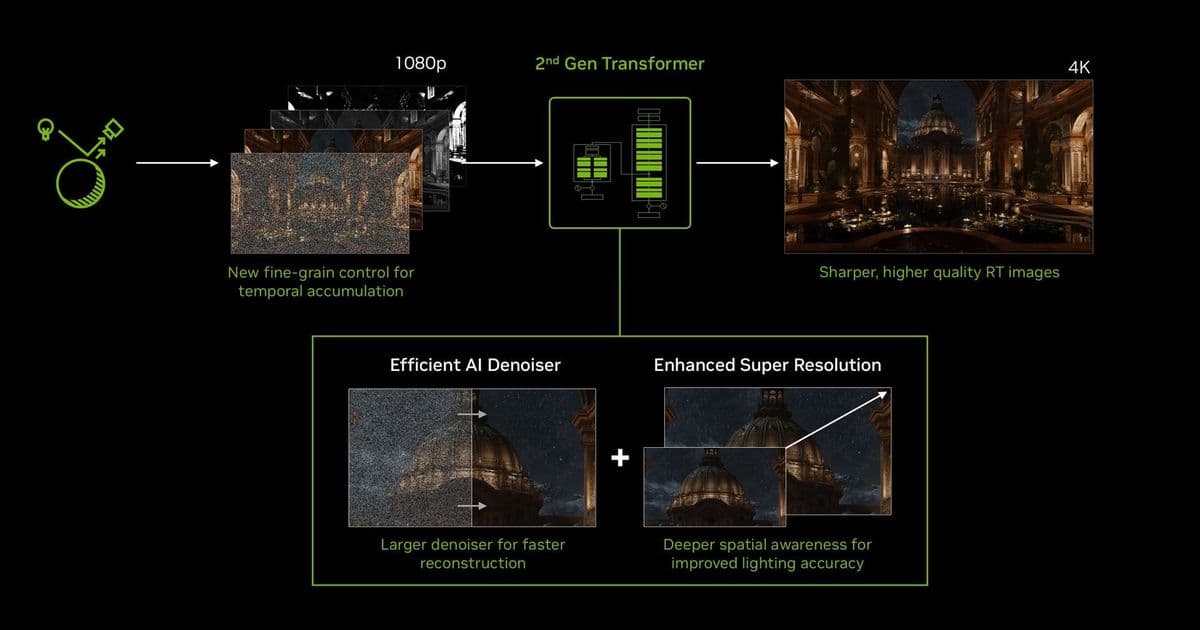
At Computex 2026 Nvidia announced DLSS 4.5 Ray Reconstruction, a new neural denoiser that processes 35 % more input data and adds 20 % more model parameters while staying within the same compute budget. The update, shipping in August for 27 titles, promises sharper lighting, steadier motion and full support for every GeForce RTX GPU, from the 20‑series to the upcoming Blackwell‑based RTX Spark.
Announcement
Nvidia used its Computex 2026 stage to unveil DLSS 4.5 Ray Reconstruction, the latest iteration of its neural‑rendering pipeline aimed at improving ray‑traced and path‑traced visuals. The company said the feature will land in August 2026 for a curated list of 27 games, including Cyberpunk 2077, Hogwarts Legacy, Pragmata and Resident Evil Requiem. Unlike the earlier DLSS 4.5 Super‑Resolution update, which still taxed older RTX 20‑ and RTX 30‑series silicon, Ray Reconstruction is billed as 100 % compatible with every GeForce RTX GPU on the market today.
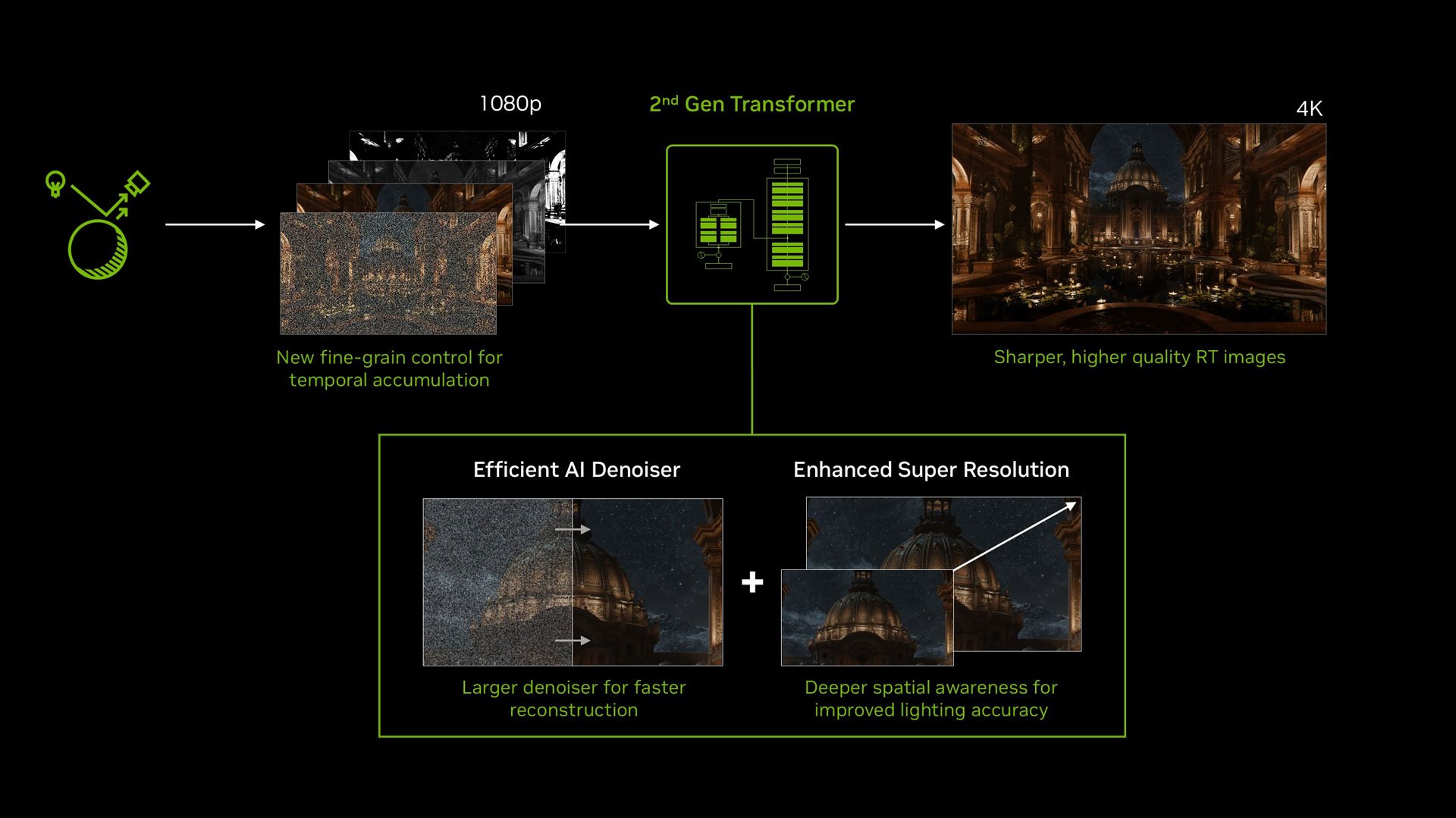 Caption: DLSS 4.5 Ray Reconstruction delivers finer lighting and less flicker (Image credit: Nvidia)
Technical specifications
| Metric | DLSS 4.5 Ray Reconstruction (new) | DLSS 4.5 Super‑Resolution (prev.) |
|---|---|---|
| Input data processed | 35 % more spatial + temporal samples | baseline |
| Model parameters | +20 % (≈ 2.4 B → 2.9 B) | ≈ 2.4 B |
| Compute budget | Same FP16 tensor throughput as previous transformer | Same |
| Compatibility | RTX 20‑series, RTX 30‑series, RTX 40‑series, Blackwell‑based RTX Spark | RTX 40‑series only (full performance) |
| Training set size | ~12 M rendered frames from 45 titles | ~9 M frames from 30 titles |
The core of the update is a second‑generation transformer architecture. By widening the attention window and adding an extra feed‑forward layer, the network can ingest 35 % more raw data from the game engine—both the current frame’s depth/normal buffers and a longer temporal history of motion vectors. Despite the larger receptive field, the model stays within the same tensor‑core budget because Nvidia re‑balanced the matrix‑multiply layout, swapping a few 64‑bit accumulators for faster 32‑bit paths where precision loss is negligible.
Two practical consequences follow:
- Improved spatial awareness – the model now distinguishes subtle light‑bounce differences across adjacent surfaces, reducing haloing around high‑contrast edges. In Pragmata the laser‑trap flicker shown in the demo video becomes a clean, non‑strobing glow.
- More stable temporal accumulation – developers receive an API knob to tune the weight of past frames, allowing them to suppress ghosting in fast‑camera moves while preserving the denoising benefit in static scenes.
Nvidia also expanded the training data set from roughly 9 million to 12 million frames, adding a broader mix of indoor, outdoor and volumetric lighting scenarios. The larger corpus helps the transformer learn better priors for indirect illumination, which translates into crisper reflections on CRT‑style TV screens in Alan Wake II.
Market implications
Immediate impact on GPU demand
Because Ray Reconstruction runs on the same tensor‑core budget as the previous DLSS model, performance penalties are minimal on older RTX silicon. Early benchmarks from Nvidia’s internal lab show a 3–5 % frame‑rate hit on an RTX 2070 Super in Cyberpunk 2077 compared with native ray tracing, versus a 12–15 % hit for the original DLSS 4.5 Super‑Resolution on the same hardware. This modest cost‑to‑benefit ratio should encourage gamers with legacy cards to enable the feature, potentially extending the useful life of two‑year‑old GPUs.
Software ecosystem expansion
The rollout includes integration with Blender’s viewport denoiser via the Nvidia OptiX SDK. Artists will see a reduction in viewport latency from ~1.2 s to ~0.6 s when moving the camera in complex scenes, because the neural denoiser replaces the traditional Monte‑Carlo filter that waited for multiple samples per pixel. This move signals Nvidia’s intent to push Ray Reconstruction beyond gaming into content creation, where time‑to‑feedback is a critical metric.
Competitive pressure on AMD and Intel
AMD’s FidelityFX Super Resolution 3 (FSR 3) currently relies on frame‑generation rather than neural denoising for ray‑traced content. Intel’s XeSS 2.0 introduced a lightweight denoiser, but it still trails Nvidia’s transformer‑based approach in visual fidelity, especially in low‑light bounce scenarios. With a fully compatible, higher‑quality denoiser now available across the entire RTX lineup, Nvidia reinforces its dominance in the premium ray‑tracing segment and forces rivals to accelerate their AI‑denoising roadmaps.
Supply‑chain considerations
The update does not require new silicon, but it does increase demand for high‑bandwidth GDDR6X memory on RTX 30‑series cards to feed the larger tensor streams. Forecasts from Jon Peddie Research suggest a modest uptick—approximately 1.2 million additional RTX 3060‑Ti units could be ordered in Q4 2026 to meet the expected surge in DLSS‑enabled titles. This aligns with Nvidia’s broader strategy of extracting more value from existing fab capacity rather than launching a new process node.
Outlook
DLSS 4.5 Ray Reconstruction demonstrates how incremental AI improvements—more data, a slightly larger model, and a refined transformer—can deliver noticeable visual gains without sacrificing compatibility. As developers adopt the new API controls, we can expect a wave of patches that fine‑tune temporal accumulation for specific gameplay styles, further narrowing the gap between real‑time ray tracing and offline rendering.
For studios, the dual‑benefit of higher image quality and retained performance on legacy hardware could translate into broader market reach, especially in regions where RTX 20‑series GPUs remain prevalent. For Nvidia, the move solidifies the value proposition of its RTX ecosystem and keeps the DLSS suite as a decisive factor in GPU purchase decisions.
Follow the official Nvidia DLSS page for driver updates and the full list of supported titles.
Comments
Please log in or register to join the discussion