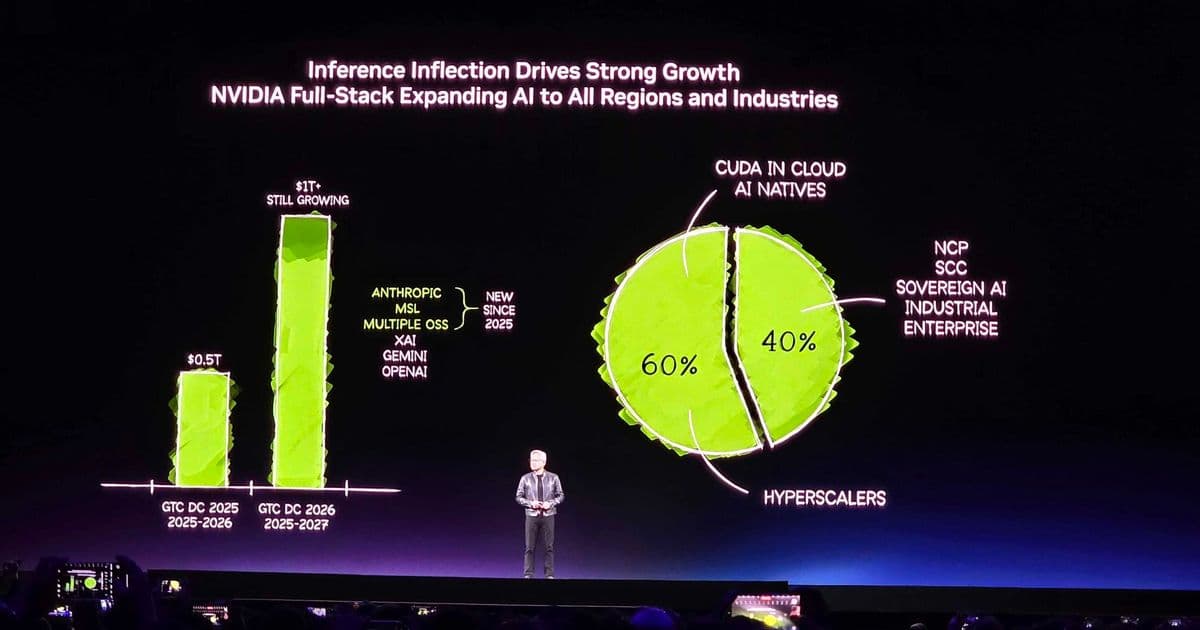
Jensen Huang projects $1 trillion in AI hardware sales by 2027, but supply chain constraints and market dynamics raise questions about whether this ambitious goal is achievable.
Nvidia CEO Jensen Huang has set an audacious target for his company: selling $1 trillion worth of AI hardware through 2027. The projection, revealed during his keynote at GTC 2026, would make Nvidia the first company in history to reach this milestone through AI hardware sales alone, cementing its position as the undisputed leader in the AI chip market.

Huang's projection comes at a time when the AI industry is experiencing explosive growth. Nvidia's fiscal year 2026 revenue hit $215 billion, up from $130.5 billion in FY2025. For the first quarter of fiscal 2027, the company projects revenue of $78 billion, representing a staggering 164% year-over-year growth. If this growth rate continues, Nvidia's revenue would reach approximately $578 billion in fiscal 2028.
However, the path to $1 trillion in AI hardware sales faces significant headwinds. The global AI infrastructure buildout is already straining multiple systems simultaneously. Data centers are experiencing cooling challenges as power densities increase, energy supplies are being squeezed by massive AI facility construction, and interconnection technologies like Ultra Ethernet are being pushed to their limits.
Supply Chain Constraints: The TSMC Bottleneck
The most critical question surrounding Nvidia's trillion-dollar projection isn't demand—it's supply. Nvidia's AI GPUs are manufactured by TSMC, and the Taiwanese foundry's capacity expansion plans appear conservative relative to the ambitious targets being set by its largest customer.
TSMC has been expanding its advanced packaging and chip manufacturing capacity, but the semiconductor industry's growth is inherently constrained by the massive capital investments required for new fabrication facilities. Each new fab requires billions of dollars and several years to construct, creating a natural ceiling on how quickly production can scale.
Nvidia's upcoming Rubin Ultra AI GPU will increase its compute chiplet count from two in the Blackwell and Rubin generations to four, potentially driving up both performance and price. The Feynman GPUs are expected to retain this quad-chiplet design, suggesting that high-end AI GPU pricing is here to stay. This architectural evolution could help Nvidia achieve its revenue targets even if unit volumes don't scale as aggressively as hoped.
Market Context: How Big Is $1 Trillion?
To put Nvidia's target in perspective, no company currently generates $1 trillion in annual revenue. Walmart, the world's largest company by sales, earned $681 billion in its most recent fiscal year. Amazon generated $638 billion, while Apple earned $391 billion. If Nvidia were to reach $1 trillion in revenue by 2027, it would surpass Apple and Amazon's combined 2025 revenues.
Some analysts believe Nvidia could reach $1 trillion in annual revenue by around 2030 if global AI infrastructure spending continues its current trajectory and expands into the multi-trillion-dollar range. However, this assumes several factors align perfectly: continued exponential growth in AI model sizes, sustained enterprise adoption of AI technologies, and the ability of the supply chain to keep pace with demand.
The Agentic AI Factor
The projection comes as Agentic AI—AI systems capable of autonomous decision-making and action—begins to take hold across industries. This represents a potential inflection point in AI adoption, as businesses move beyond using AI for analysis and content generation to deploying AI agents that can execute complex workflows independently.
If Agentic AI adoption accelerates as expected, it could drive the massive infrastructure investments necessary to support Huang's $1 trillion target. However, the technology is still in its early stages, and widespread enterprise deployment faces challenges including reliability concerns, integration complexity, and regulatory uncertainty.
Technical Evolution: The Rubin to Feynman Transition
Nvidia's product roadmap provides some clues about how it might achieve its ambitious revenue targets. The Rubin Ultra's transition to four compute chiplets per GPU represents a significant architectural shift that enables both performance scaling and price increases. This modular approach allows Nvidia to maintain competitive performance advantages while potentially increasing average selling prices.
The retention of the quad-chiplet design in the Feynman generation suggests Nvidia sees this architecture as sustainable for the medium term. This consistency could help stabilize supply chains and manufacturing processes, though it also means Nvidia must continue finding ways to differentiate its products as competitors like AMD and Intel push their own AI accelerator offerings.
The Bottom Line
Nvidia's $1 trillion AI hardware target through 2027 represents both an ambitious vision and a potential reality check for the AI industry. While the company's growth trajectory and market position suggest it could approach this milestone, achieving it will require overcoming significant supply chain constraints, sustaining unprecedented demand growth, and successfully navigating the transition to next-generation AI architectures.
The coming years will reveal whether Huang's projection was a bold strategic statement or an achievable target. Either way, it underscores the central role Nvidia plays in the AI revolution and the massive scale of infrastructure investment required to support the industry's ambitions.
Comments
Please log in or register to join the discussion