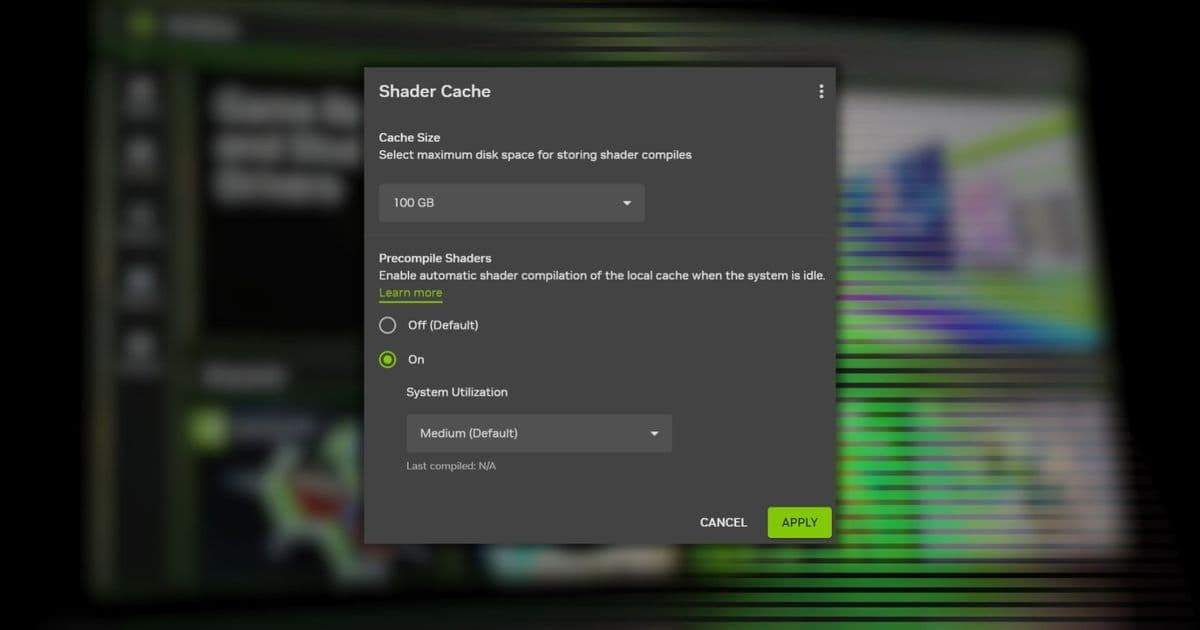
Nvidia's new Auto Shader Compilation feature in the Nvidia App automatically recompiles game shaders in the background after driver updates, potentially saving gamers minutes of waiting time per game launch.
Nvidia has introduced a new beta feature in its Nvidia App that could significantly reduce game loading times by automatically handling shader compilation in the background. The feature, called Auto Shader Compilation (ASC), addresses a long-standing pain point for PC gamers: the wait time required for shaders to recompile after GPU driver updates.
The Problem: Shader Compilation Delays
Every time a new graphics driver is released, your GPU must recompile shaders for games you've already installed. This process occurs when you launch a game and can take anywhere from seconds to several minutes, depending on your hardware specifications. For gamers with limited playtime, these delays represent precious minutes wasted before gameplay can begin.
How Auto Shader Compilation Works
The ASC feature automatically compiles these shaders in the background, eliminating the need to wait during game launch. Once activated, the next time you sit down to play a game after a driver update, you won't experience the typical shader compilation delay.
However, there's an important limitation: ASC only works for titles that have already completed their initial shader compilation. New games you install will still require manual shader compilation the first time you run them. After that initial process, though, the Nvidia App will handle subsequent compilations automatically following each driver update.
Configuration and Performance Settings
Since ASC is currently in beta, it's disabled by default. Users can enable it through the Global Settings menu under "Shader Cache." The feature offers several configuration options:
- Storage limits: A 100 GB cache size can store shaders for approximately 20 modern AAA titles, though typical usage requires less space
- Resource allocation: Users can set system utilization levels to low, medium, or high for the compilation process
These settings allow gamers to balance the benefits of faster load times against storage space and system resource usage during background compilation.
The Bigger Picture: Advanced Shader Delivery
Nvidia positions ASC as "the first step into optimizing shader compilation for GeForce gamers," suggesting this is just the beginning of more comprehensive solutions. The company is likely hinting at Advanced Shader Delivery (ASD), a technology Microsoft introduced last year on the ROG Xbox Ally and recently integrated into the DirectX SDK.
ASD represents a more ambitious approach to eliminating shader compilation delays entirely. By leveraging precompiled shaders stored in the cloud, GPU manufacturers could prepare games ahead of time for users without any manual intervention. The vision is that shaders would already be compiled according to your specific hardware configuration and distributed over the network when needed, eliminating even the initial compilation wait time.
Intel has already launched a similar feature called "Precompiled Shader Distribution," though it doesn't yet build on Microsoft's ASD framework. With all major industry players set to adopt these technologies, the future of gaming could involve virtually no shader compilation delays whatsoever.
Current Impact and Future Potential
While ASC doesn't completely eliminate wait times, it represents a meaningful improvement for PC gamers. By handling shader compilation work ahead of time, at least after the initial compile, the feature helps users maximize their limited gaming time.
The beta nature of ASC means it's still evolving, and Nvidia will likely refine the feature based on user feedback. As shader compilation technology advances toward cloud-based solutions like ASD, features like ASC serve as important stepping stones toward a future where game loading times are dramatically reduced across the board.
For now, PC gamers can enable ASC in the Nvidia App to start experiencing faster load times after driver updates, marking another step forward in Nvidia's ongoing efforts to optimize the gaming experience.
Comments
Please log in or register to join the discussion