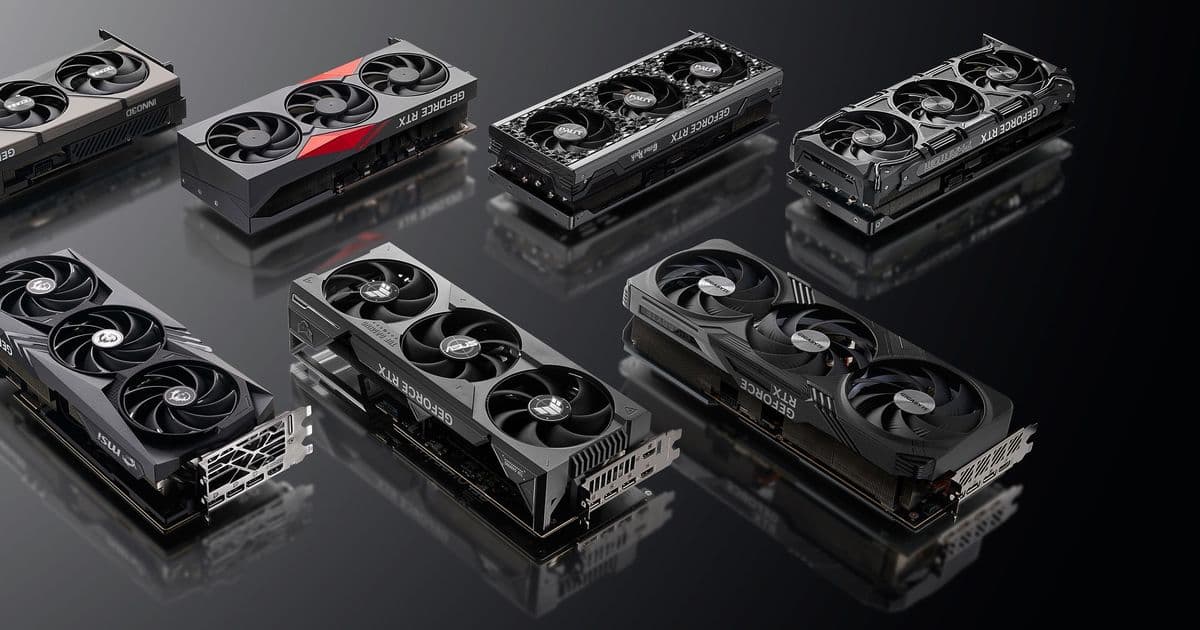
Nvidia controls 95% of the gaming GPU market as AMD's Radeon sales hit record lows, with desktop graphics card shipments surging to 44.28 million units in 2025.
Nvidia's stranglehold on the discrete graphics card market has tightened to unprecedented levels, with the company now commanding a staggering 95% share of the desktop GPU market, according to new data from Jon Peddie Research. This dominance comes as AMD's Radeon sales have plummeted to their lowest point in history, dropping to just 5% market share in the fourth quarter of 2025.
The graphics card industry as a whole experienced a significant rebound in 2025, with total shipments reaching 44.28 million units compared to 34.7 million in 2024—a year-over-year increase of nearly 10 million units. This surge was primarily driven by Nvidia's launch of its GeForce RTX 50-series graphics processors based on the Blackwell architecture, which reinvigorated the gaming GPU market.
Market Dynamics and Sales Patterns
Traditionally, graphics card sales for desktop PCs peak in the fourth quarter as gamers prepare for new game releases and holiday shopping seasons. However, 2025 bucked this trend, with Q3 sales reaching their zenith at 12 million units before slightly declining to 11.48 million units in Q4. Despite the sequential drop, this still represented a substantial year-over-year increase from 8.4 million units in the same quarter of 2024.
Dr. Jon Peddie, president of Jon Peddie Research, attributes the unusual sales pattern to multiple market pressures. "The AIB market, largely supported by gamers, is being squeezed from the bottom by powerful new notebooks and CPU integrated graphics, and from the high end by rising pricing due to competition (supply and demand), memory prices, and Trump administration tariffs that bounce around," Peddie explained.
Nvidia's Market Share Expansion
Nvidia's market dominance grew steadily throughout 2025, starting the year with a 92% share in Q1 and ending with 94% in Q4. The company gained an additional 1.6% market share in the fourth quarter alone, demonstrating the accelerating pace of its market consolidation.
By contrast, AMD's market position deteriorated significantly. The company entered 2025 with an 8% share as it prepared to launch its Radeon RX 9000-series GPUs but exited the year with just 5% share. This represents the lowest market share for AMD or its predecessor ATI Technologies since the company entered the discrete graphics market decades ago.
AMD's Struggles and Market Position
AMD's decline to 5% market share reflects several challenges. The Radeon RX 9000-series products, while technologically competitive, failed to gain traction among the target audience. Early lifecycle scarcity at recommended prices likely contributed to the poor market reception, as gamers and enthusiasts turned to readily available Nvidia alternatives.
Unit shipments for AMD dropped from 740,000 in Q1 to just 570,000 in Q4, marking the lowest quarterly sales figures in the company's history for standalone graphics cards. This decline occurred despite AMD's strong position in the integrated GPU market, where nearly all Ryzen desktop processors include integrated graphics. However, Peddie notes that the integrated GPU market is "far less loyal or lucrative than the market for standalone graphics cards for desktops."
Intel's Market Position
Intel's Arc graphics cards, based on the Battlemage architecture, saw some new releases in 2025. However, these products were primarily targeted at select niches rather than the mainstream gaming market. As a result, Intel failed to gain any meaningful market share during the year, remaining a distant third in the discrete GPU market.
Future Market Outlook
Looking ahead, the graphics card market faces significant headwinds. Due to constrained GPU supply, high GDDR memory prices, and ongoing geopolitical uncertainties, Jon Peddie Research projects a 10% year-over-year decline in desktop graphics card sales for 2026.
"Customers who would, and in some cases should, be replacing their PCs and AIB are holding off," Peddie added. "We think because of these unstable conditions, the PC and AIB market will decline almost 10% in 2026."
This projected decline suggests that the 2025 surge may have been a temporary market correction rather than the beginning of sustained growth. The combination of high prices, supply constraints, and economic uncertainty is causing consumers to delay upgrades, potentially creating a challenging environment for all GPU manufacturers in the coming year.
The data from Jon Peddie Research paints a stark picture of the current graphics card market: a near-monopoly for Nvidia, a historic low for AMD, and a challenging road ahead for the entire industry. As gaming technology continues to evolve and integrated solutions improve, the traditional discrete graphics card market may face an existential crisis that extends beyond the current economic pressures.
Comments
Please log in or register to join the discussion