Nvidia faces fundamental physical limits as AI chip demand explodes, forcing the company to innovate beyond traditional Moore's Law scaling.
Nvidia's dominance in the AI chip market has created an unprecedented challenge: the company must now innovate beyond the physical limits of semiconductor manufacturing to meet exploding demand from tech giants racing to build ever-larger AI models.
The Physics Problem
The core issue is deceptively simple. As AI models grow exponentially in size and complexity, they require exponentially more computing power. Nvidia's GPUs have been the primary engine driving this growth, but the physical constraints of silicon manufacturing are becoming impossible to ignore.
Each new generation of chips has traditionally delivered better performance through smaller transistors and more efficient designs. This progression, often described by Moore's Law, has held true for decades. But we're approaching fundamental physical barriers where quantum effects and heat dissipation make further miniaturization increasingly difficult and expensive.
The Market Reality
Tech companies are building AI systems that require thousands of Nvidia's most advanced GPUs working in concert. Meta, Google, Microsoft, and OpenAI are all racing to develop the next generation of AI models, and each new model requires significantly more computing power than the last.
This creates a paradox for Nvidia. The company's business is booming - its data center revenue grew 217% year-over-year in the most recent quarter. But the physical constraints of chip manufacturing mean Nvidia can't simply produce more chips to meet demand.
Innovation Beyond Moore's Law
Nvidia is pursuing multiple strategies to overcome these limitations. The company is developing new chip architectures that can perform AI computations more efficiently. It's also creating sophisticated software that optimizes how AI models run on existing hardware.
One particularly promising approach involves specialized AI accelerators that can handle specific types of computations more efficiently than general-purpose GPUs. These chips are designed from the ground up for AI workloads, potentially offering performance improvements that would be impossible to achieve through traditional chip scaling alone.
The Energy Challenge
There's another constraint that's becoming increasingly important: power consumption. Data centers running AI workloads already consume enormous amounts of electricity, and this consumption is growing rapidly. Nvidia's challenge isn't just making chips faster - it's making them more energy-efficient.
The company is investing heavily in technologies that reduce power consumption while maintaining performance. This includes advanced cooling solutions, more efficient power delivery systems, and architectural innovations that minimize wasted energy.
What This Means for the Industry
The limitations Nvidia faces aren't just its problem - they're an industry-wide challenge that affects every company building AI systems. If Nvidia can't continue to deliver performance improvements at historical rates, it could slow the entire AI revolution.
This has led to increased investment in alternative approaches to AI computing. Companies are exploring everything from specialized AI chips to entirely new computing paradigms based on quantum computing or neuromorphic architectures.
The Competitive Landscape
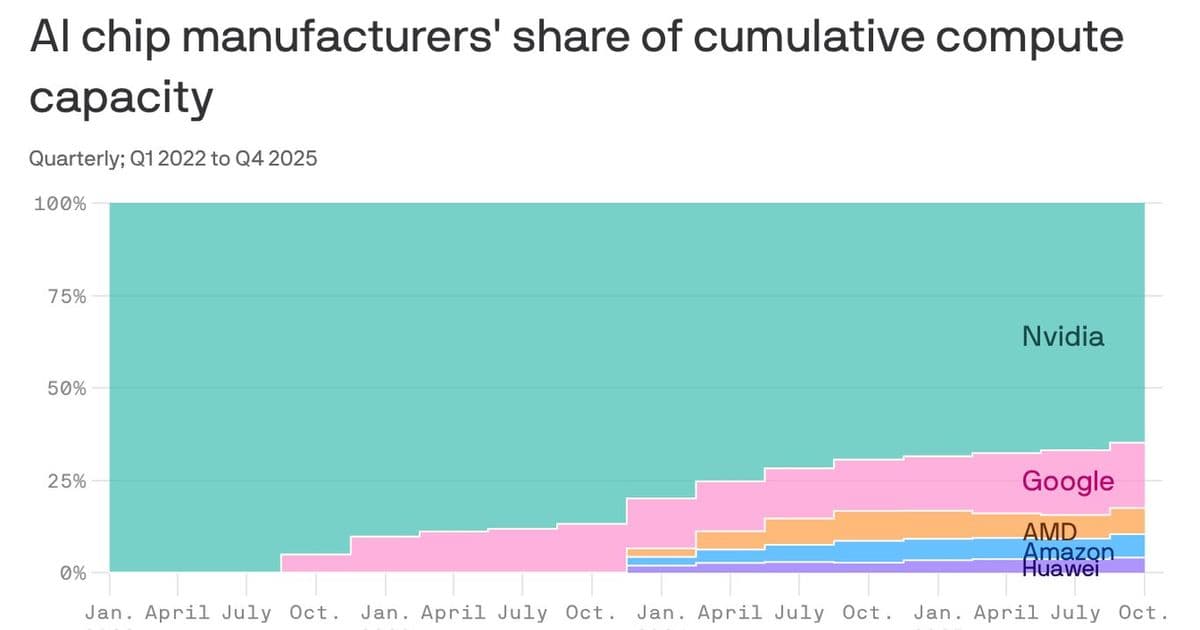
Nvidia's challenges have created opportunities for competitors. Companies like AMD, Intel, and a host of startups are developing their own AI chips, hoping to capture market share as Nvidia potentially struggles to meet demand.
However, Nvidia's lead in both hardware and software ecosystems makes it difficult for competitors to gain traction. The company's CUDA platform has become the de facto standard for AI development, creating a powerful network effect that's hard to overcome.
Looking Ahead
The next few years will be critical for Nvidia and the broader AI industry. The company's ability to innovate beyond traditional physical limitations will determine whether the current AI boom can continue at its current pace.
If Nvidia succeeds, we could see another decade of exponential growth in AI capabilities. If it fails, the industry may need to fundamentally rethink how we approach AI computing.
The Bottom Line
Nvidia's race to outpace physics represents one of the most important technological challenges of our time. The outcome will shape not just the future of AI, but the future of computing itself.
The company's success or failure in this endeavor will have profound implications for every industry that relies on AI, from healthcare to finance to entertainment. As Nvidia pushes against the boundaries of what's physically possible, it's not just building better chips - it's determining the trajectory of technological progress for years to come.
Comments
Please log in or register to join the discussion