
An analysis of current market pricing reveals that 8 TB NVMe SSDs now cost more per gram than gold, with 4 TB models rapidly approaching the same threshold. The shortage, driven by AI infrastructure demand, has caused prices to spike sharply in the past two months, with performance models commanding premiums that push them well beyond the value of precious metals.
A recent observation on social media sparked a deeper investigation into the current state of high-capacity NVMe SSD pricing. The premise was simple yet startling: in the midst of the ongoing silicon shortage fueled by AI infrastructure buildout, have consumer SSDs become more expensive than gold by weight? The data confirms this is true for 8 TB drives, and the trend is accelerating for 4 TB models.
To quantify this, pricing data was compiled from major retailers including Newegg, Microcenter, Best Buy, and Walmart. The analysis focused on PCIe 4.0 and 5.0 NVMe SSDs with 4 TB and 8 TB capacities, sold directly by the retailers and in stock. Enterprise drives were excluded as their pricing models are fundamentally different and would skew the comparison. Over a hundred data points were collected to establish a reliable average.
The physical weight of these drives is a critical variable. The average weight for an 8 TB NVMe SSD is approximately 8.2 grams, while 4 TB models average around 8 grams. This weight does not increase significantly for dual-sided, higher-capacity drives, and models with heatsinks were excluded to maintain consistency. With gold currently trading at approximately $148 per gram, an 8-gram SSD would need to cost $1,184 to match gold's value. The average price for an 8 TB consumer drive is approximately $1,476, decisively surpassing the gold benchmark. Performance-oriented models command even higher premiums.
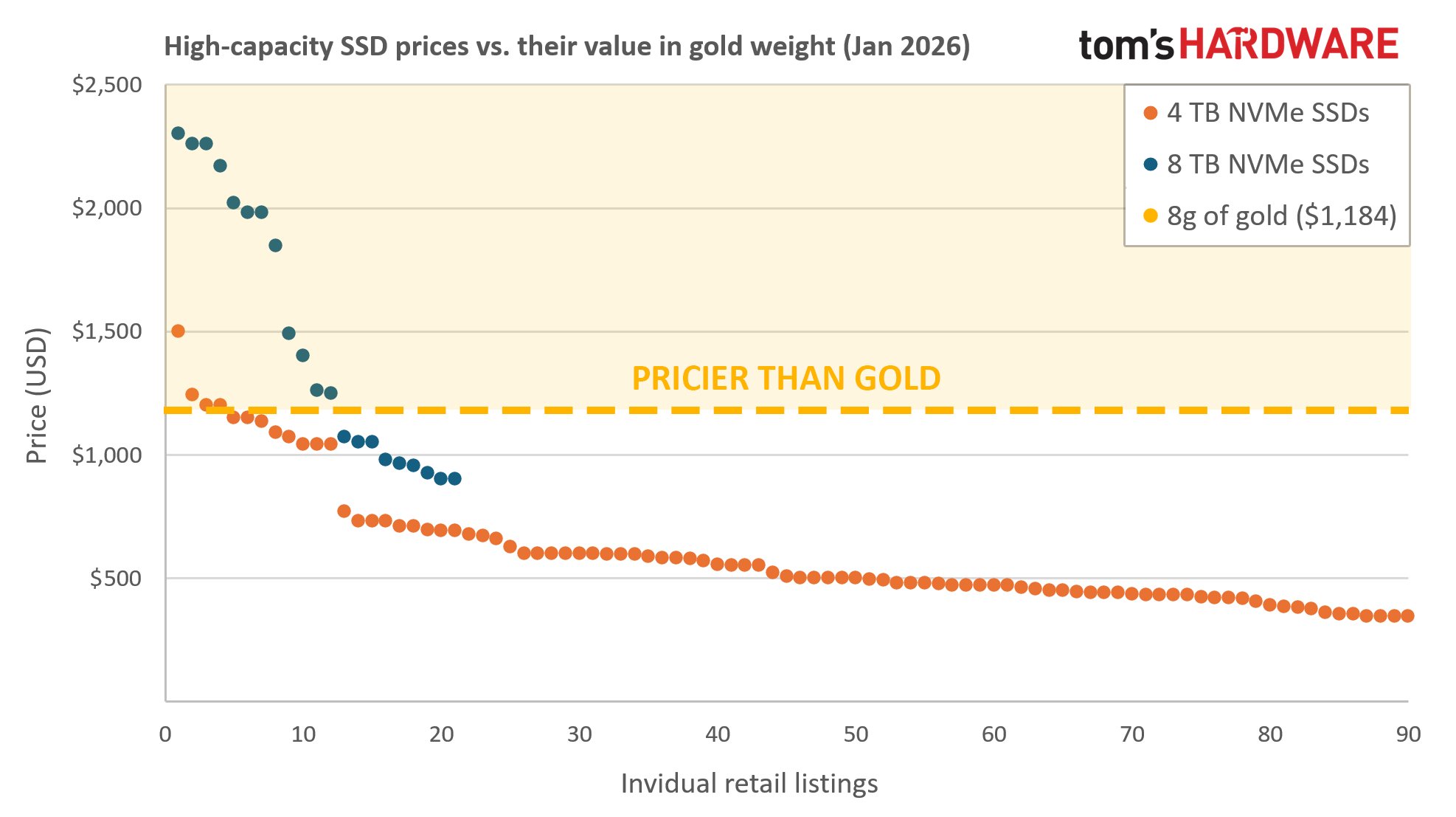
8 TB SSD prices (USD) (Image credit: Future)
The 4 TB segment is following a similar trajectory. While some models remain below the gold-equivalent price, a significant portion now approaches or exceeds it. The market is clearly bifurcating. The sub-$800 space is dominated by mass-storage models, which prioritize capacity over peak performance. For users seeking both high capacity and top-tier performance, the cost escalates sharply. A notable divide exists by manufacturer as well; the upper price echelons are populated almost exclusively by Western Digital (SanDisk) models, with fewer offerings from competitors. This could indicate either a strategic pricing decision by WD or a reflection of exceptionally high demand and constrained supply for their new stock.
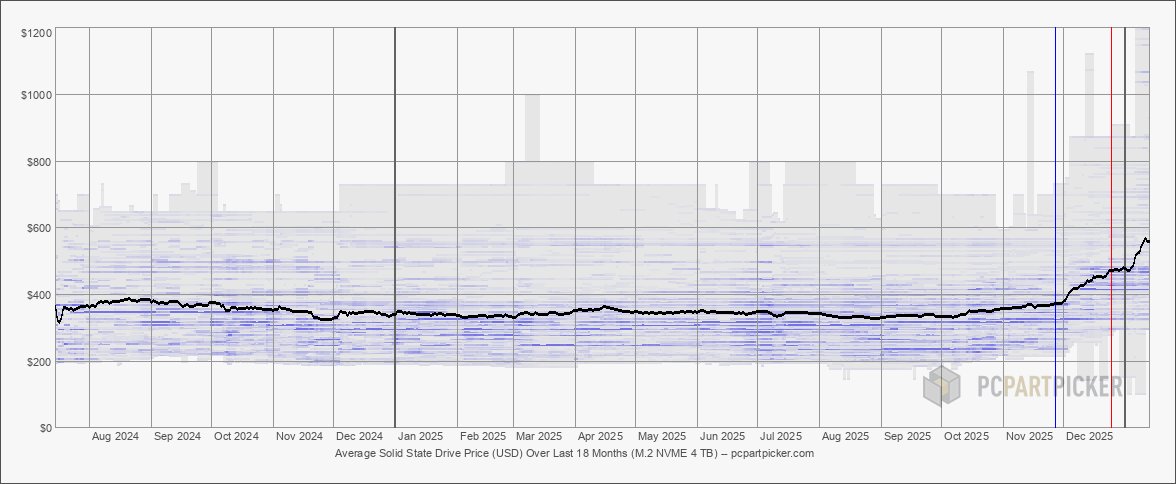
PCPartPicker - 4 TB NVMe drive pricing trends (Image credit: PCPartPicker)
The price trend for 4 TB drives is starkly visualized by tracking data from PCPartPicker. The graph shows an exceedingly sharp rise over the past two months. The wider price distribution (the gray area in the chart) suggests a transition period where older, lower-priced inventory is being depleted and replaced by new stock at significantly higher costs. Currently, it is still possible to find high-performance 4 TB drives, such as the Corsair MP700 Elite or Samsung 9100 Pro, in the $600-$800 range. However, the market momentum suggests this availability is temporary.
The implications for the market are significant. For consumers and professionals requiring large, fast storage—such as video editors, data scientists, or AI developers—the cost of entry has risen dramatically. The shortage is not merely a pricing issue but a supply chain constraint. The rapid depletion of existing stock and the sharp upward trend in pricing indicate that the window to purchase these drives at current prices is closing. Those on the fence for a high-capacity NVMe SSD are advised to act quickly, as the available stock at lower price points is likely to disappear soon. The situation underscores the profound impact of AI infrastructure demands on the broader semiconductor supply chain, affecting even consumer-grade components.

Gold bars (Image credit: Getty Images)
Comments
Please log in or register to join the discussion