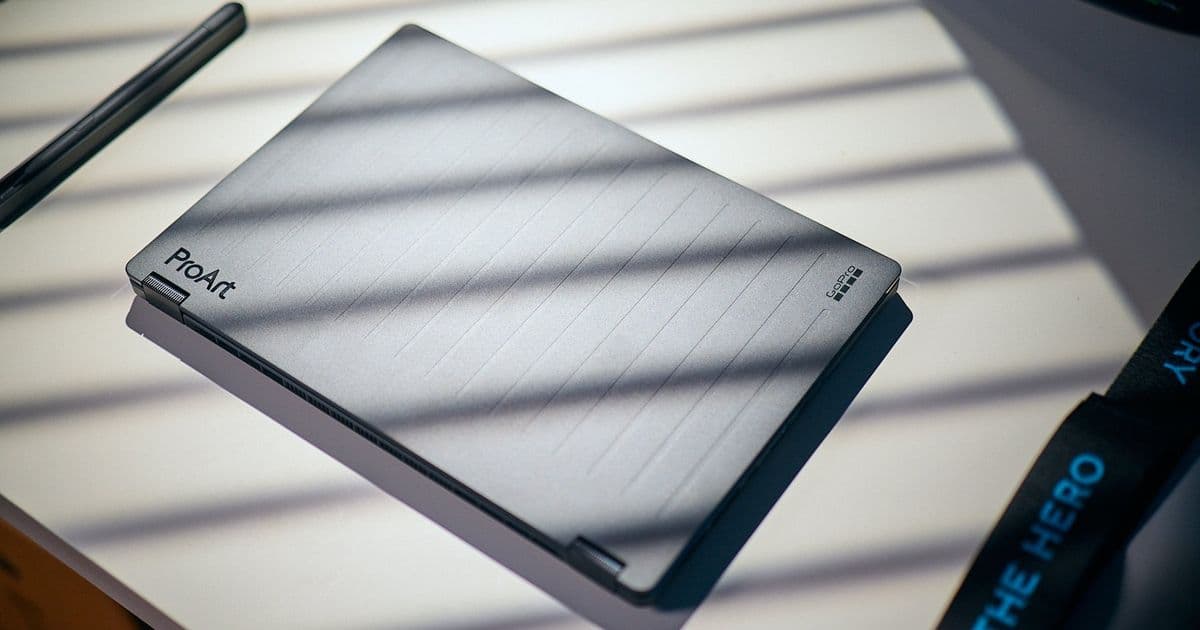
Asus's 2026 ProArt PX13 ditches Nvidia for AMD's Strix Halo, trading dedicated GPU power for massive shared memory and multi-core gains.
The Asus ProArt PX13 has been a standout in the creator laptop space since its 2024 debut, pairing AMD's Ryzen AI 9 HX 370 with Nvidia's GeForce RTX 4070 Laptop GPU in a compact 13-inch convertible. For 2026, Asus has launched a new "GoPro edition" that makes a bold hardware shift: replacing the RTX 4070 with AMD's Ryzen AI Max+ 395 (Strix Halo) and its integrated Radeon 8060S GPU. While the chassis remains unchanged, this swap has significant implications for performance and workflow suitability.
What's new under the hood
The headline change is the move to AMD's Strix Halo platform. The Ryzen AI Max+ 395 brings 16 Zen 5 CPU cores—four more than the previous HX 370—paired with the powerful Radeon 8060S iGPU and up to 128 GB of unified memory. This configuration promises substantial multi-core performance gains, with benchmarks showing 30-50% improvements over the HX 370 in threaded workloads. For creative professionals working with video editing, 3D rendering, or complex image processing, these gains could translate to meaningful time savings.
However, the single-core performance remains essentially unchanged since both chips use Zen 5 architecture. Users upgrading from the previous model won't notice improvements in everyday tasks like web browsing, office applications, or most creative software that isn't heavily multi-threaded.
Graphics performance: A step sideways
Here's where the upgrade becomes more nuanced. The Radeon 8060S iGPU delivers only marginally better raw graphics performance compared to the RTX 4070 Laptop GPU it replaces. More concerning for gamers and some creative professionals, the new configuration doesn't surpass the outgoing model's gaming capabilities—and the current RTX 5070 would actually be faster still.
The key differentiator is memory architecture. While the RTX 4070 and RTX 5070 are limited to 8 GB of dedicated VRAM, the Strix Halo's iGPU can access the system's unified memory pool. With configurations supporting up to 128 GB RAM, this means the GPU can potentially utilize far more memory for large projects. This could be transformative for video editors working with 8K footage, 3D artists handling complex scenes, or anyone dealing with massive texture files.
Nvidia still maintains an edge in certain creative workloads, particularly those leveraging CUDA for CGI and specialized rendering tasks. The choice between these platforms increasingly depends on specific software requirements and workflow preferences.
Who benefits from this change?
This new ProArt PX13 configuration makes the most sense for:
- Video editors working with high-resolution footage who need massive memory bandwidth
- 3D artists whose scenes exceed traditional VRAM limitations
- Photographers processing extremely large RAW files in batch operations
- Developers running virtual machines or complex development environments
- Users prioritizing battery life and thermal efficiency over peak gaming performance
It's less ideal for:
- Gamers seeking the best possible frame rates
- Professionals heavily invested in CUDA-dependent workflows
- Users whose work doesn't benefit from the additional CPU cores
- Those who need the absolute fastest GPU performance regardless of memory constraints
The bigger picture
The ProArt PX13's evolution reflects a broader industry trend toward powerful integrated solutions. AMD's Strix Halo demonstrates that for many creative workloads, the bottleneck isn't raw GPU power but rather memory capacity and bandwidth. By eliminating the GPU-memory divide, AMD offers a compelling alternative to traditional dGPU configurations.
However, this transition isn't universally beneficial. The marginal graphics performance improvement means users must weigh the advantages of unified memory against the loss of dedicated GPU power and CUDA ecosystem support. For some workflows, the RTX 4070 or newer RTX 5070 would still be the better choice.
Asus's decision to maintain the same chassis while dramatically changing the internal architecture is both pragmatic and limiting. The compact 13-inch form factor remains ideal for portability, but it also constrains thermal performance for both the powerful CPU and iGPU. Users pushing these systems to their limits should expect the fans to spin up accordingly.
Bottom line
The 2026 Asus ProArt PX13 with Strix Halo isn't a straightforward upgrade for everyone. It's a specialized tool that excels in memory-intensive creative workflows while potentially underperforming in GPU-bound tasks compared to its predecessor. The choice between this model and the previous RTX-equipped version ultimately depends on whether your work benefits more from massive unified memory or dedicated GPU power.
For creative professionals whose projects are limited by VRAM rather than raw GPU performance, the new configuration could be transformative. For everyone else, the previous model might still be the better choice—or waiting for the next generation of dedicated mobile GPUs might be worthwhile.
[IMAGE:1]
The featured image shows the new GoPro edition of the Asus ProArt PX13, highlighting its compact convertible design that houses the powerful Strix Halo platform.
Comments
Please log in or register to join the discussion