
PCI-SIG has released the first major draft of the PCIe 8.0 specification, targeting 1 terabyte per second of bi-directional bandwidth by 2028, a development that will shape how organizations handling GDPR and CCPA-regulated personal data meet mandatory technical security requirements.

The PCI Special Interest Group (PCI-SIG) has released draft 0.5 of the PCI Express (PCIe) 8.0 specification, setting a target of 1 terabyte per second of bi-directional data transfer across a 16-lane configuration, doubling the bandwidth of the upcoming PCIe 7.0 standard. The draft incorporates feedback from member organizations following the release of draft 0.3 in 2025, with a full final specification still on track for release in 2028. Hardware supporting the standard will not reach the market until years after that, following the pattern of previous PCIe generations.
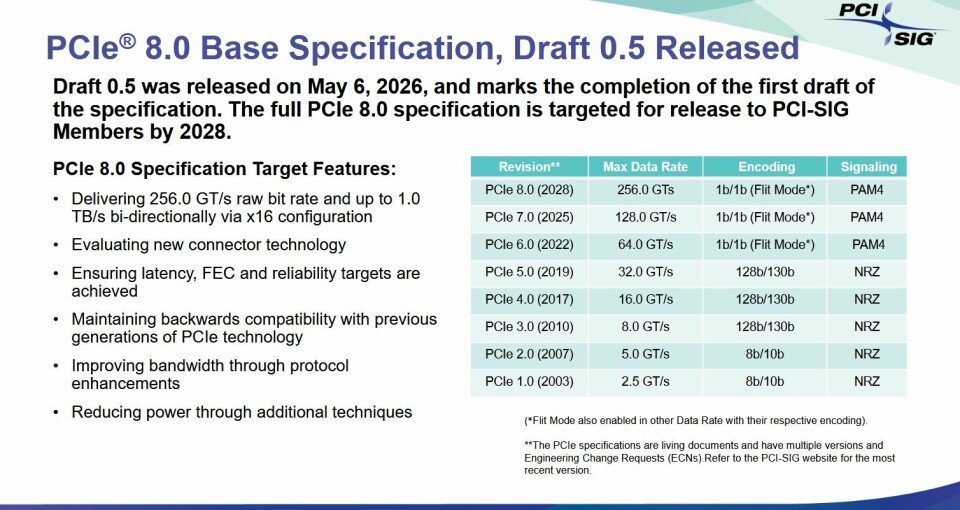
PCIe 8.0 is designed to deliver a raw bit rate of 256 gigatransfers per second (GT/s), up from 128 GT/s for PCIe 7.0, which is itself not expected to appear in shipping hardware before 2027. The standard maintains the PAM4 (Pulse Amplitude Modulation with four levels) signaling and Flit-based encoding first introduced in PCIe 6.0. Flit, short for Flow Control Unit, uses 256-byte packets with forward error correction (FEC) to balance low latency and high efficiency, features critical for the data-hungry workloads the standard is designed to support.
These workloads include artificial intelligence training and inference, datacenter infrastructure, high-speed networking, edge computing, and quantum computing. PCI-SIG has also integrated Unordered I/O (UIO), an enhancement first added in the PCIe 6.1 specification, to reduce latency for AI workloads and compete with proprietary interconnects such as Nvidia's NVLink that currently dominate AI datacenters.
Legal Basis for Compliance
Under the General Data Protection Regulation (GDPR) Article 32, all organizations processing the personal data of EU residents must implement appropriate technical and organizational measures to ensure a level of security appropriate to the risk. This includes protecting personal data against unauthorized or unlawful processing, accidental loss, destruction, or damage. The California Consumer Privacy Act (CCPA) and its amendment, the CPRA, impose similar requirements for businesses handling California residents' personal information, mandating reasonable security procedures and practices.
Technical measures under these regulations explicitly include hardware-level security features. PCIe interconnects have long supported I/O Memory Management Unit (IOMMU) functionality, which restricts direct memory access (DMA) for connected devices to prevent unauthorized access to system memory. DMA attacks, where a malicious PCIe device reads or writes to system memory without permission, are a well-documented privacy risk that can expose vast amounts of personal data. Failure to implement appropriate technical measures can lead to significant penalties: GDPR fines can reach up to 4% of a company's global annual revenue or 20 million euros, whichever is higher, while CCPA violations carry fines of up to $7,500 per intentional infraction.
Impact on Users and Companies
The primary corporate adopters of PCIe 8.0 will be datacenter operators, cloud service providers, AI hardware vendors, and enterprise SSD manufacturers. These organizations process and store petabytes of personal data subject to GDPR, CCPA, and other global privacy regulations. Faster PCIe 8.0 interconnects will speed up critical compliance-related tasks, including encryption of stored data, anonymization of datasets for analytics, and erasure of user data upon request under GDPR Article 17 (the right to erasure) or CCPA's right to delete.
For end users, the impact is largely indirect but meaningful for digital rights. Faster, more efficient hardware reduces the latency of AI-powered services that process user data, while improved IOMMU and encryption support in PCIe 8.0 devices lowers the risk of data breaches that could expose personal information. Consumers will not see PCIe 8.0 in personal laptops or desktops for many years, as even a single PCIe 4.0 x1 lane provides sufficient bandwidth for 10 GbE networking, and most consumer GPUs do not benefit from the full bandwidth of a 16-lane slot.
Affected parties also include PCI-SIG member organizations, which will develop compatible hardware, and enterprise buyers that must plan multi-year upgrade cycles. Micron, for example, announced mass production of the first PCIe 6.0 SSDs in February 2026, four years after the PCIe 6.0 specification was finalized in 2022, and compatible CPUs from Intel and AMD are not expected until late 2026, meaning the new SSDs must run in PCIe 5.0 systems at reduced speeds. This pattern will repeat with PCIe 8.0: the full specification will release in 2028, but the first compatible SSDs and accelerators will not ship until 2029 or later, with widespread adoption in datacenters not expected until the early 2030s.
What Changes for Compliance and Hardware
The release of PCIe 8.0 draft 0.5 confirms that PCI-SIG will maintain its cadence of doubling data rate with each generation, a pace that ensures the standard keeps up with the exponential growth in data processing demands for AI and datacenter workloads. For companies subject to data protection regulations, the key change is the need to evaluate new PCIe 8.0 hardware as it becomes available to ensure it meets technical security requirements.
This evaluation will require updating data protection risk assessments to account for new hardware features, revising vendor contracts to require compliance-ready devices with up-to-date IOMMU and encryption support, and training IT staff on the security implications of the new standard. Organizations that fail to adopt hardware with appropriate technical measures risk regulatory fines, while those that proactively integrate PCIe 8.0 into their infrastructure can reduce compliance risk and improve the efficiency of data processing tasks.
PCI-SIG confirms that the final PCIe 8.0 specification remains on track for 2028, with no changes to the target bandwidth or release timeline. As with previous generations, the first devices to market will be enterprise SSDs, followed by AI accelerators and high-speed networking cards, with consumer hardware remaining a low priority for the standard.
Relevant Resources
- Official PCI-SIG website for specification updates and member information
- PCIe 8.0 draft overview with technical documentation
- GDPR Article 32 text on GDPR Info
- CCPA compliance guidance from the California Attorney General
- Micron's PCIe 6.0 SSD announcement on Micron's website
Comments
Please log in or register to join the discussion