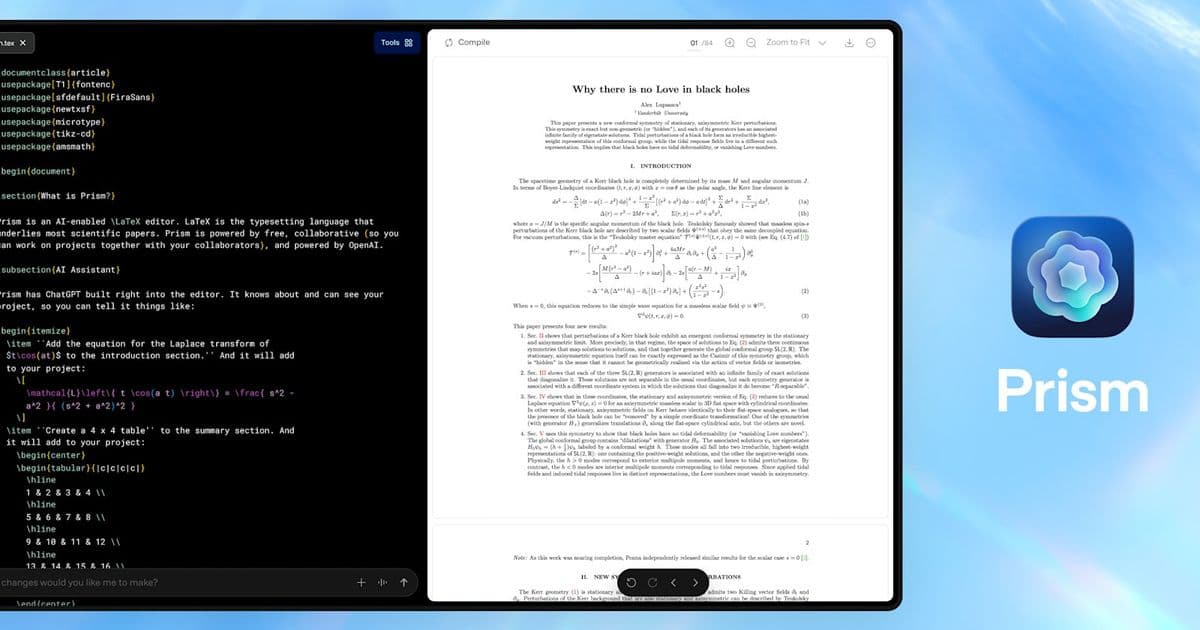
OpenAI introduces Prism, a free cloud-based LaTeX workspace powered by GPT-5.2 that integrates AI directly into scientific writing and collaboration workflows.
OpenAI has unveiled Prism, a new free platform designed to accelerate scientific research by integrating AI directly into the writing and collaboration process. Built on GPT-5.2, Prism offers researchers a unified workspace where they can draft papers, manage equations and citations, search literature, and collaborate with unlimited co-authors—all within a cloud-based LaTeX environment.
The Problem: Fragmented Scientific Workflows
Despite rapid advances in AI, much of scientific research still relies on tools that haven't fundamentally changed in decades. Researchers typically juggle multiple disconnected applications—text editors, PDF viewers, LaTeX compilers, reference managers, and separate chat interfaces. This fragmentation forces constant context-switching and interrupts focus during critical thinking and writing phases.
Prism addresses this by bringing everything into a single workspace where AI understands the full context of a research paper, including its structure, equations, citations, and figures.
What Makes Prism Different
Unlike traditional scientific writing tools that operate alongside AI as separate utilities, Prism integrates GPT-5.2 directly into the workflow. The AI has access to the entire document structure and can reason across different elements of a paper simultaneously.
Key capabilities include:
- Contextual Chat: Researchers can explore ideas, test hypotheses, and reason through complex problems with AI that understands the surrounding document context
- Literature Integration: Search and incorporate relevant papers from sources like arXiv directly within the manuscript, then revise text based on newly identified related work
- Equation and Figure Management: Create, refactor, and reason over mathematical content with AI that understands how equations and citations relate across the paper
- Voice-Based Editing: Make simple changes without interrupting writing flow
- Real-Time Collaboration: Unlimited collaborators can work together with edits and comments reflected immediately
Built on a Strong Foundation
Prism evolved from Crixet, a mature cloud-based LaTeX platform that OpenAI acquired. This acquisition provided a solid foundation of a proven writing and collaboration environment, which OpenAI has enhanced with AI capabilities that fit naturally into scientific workflows.
The platform eliminates the need for local LaTeX installation or environment management, making it accessible to teams regardless of their technical setup.
Free Access and Future Plans
Starting today, anyone with a ChatGPT personal account can use Prism for free with unlimited projects and collaborators. There are no subscriptions or seat limits, making high-quality scientific tools broadly accessible across institutions, disciplines, and career stages.
OpenAI plans to introduce more advanced AI features through paid ChatGPT plans over time, while maintaining the core free offering.
The Bigger Picture
OpenAI sees Prism as part of a broader shift in how AI will transform scientific discovery. Just as AI fundamentally changed software development in 2025, the company expects a comparable transformation in science during 2026. By reducing friction in day-to-day research work, Prism aims to help science move faster while maintaining the collaborative nature essential to scientific progress.
Researchers can start using Prism immediately at prism.openai.com with just a ChatGPT account.
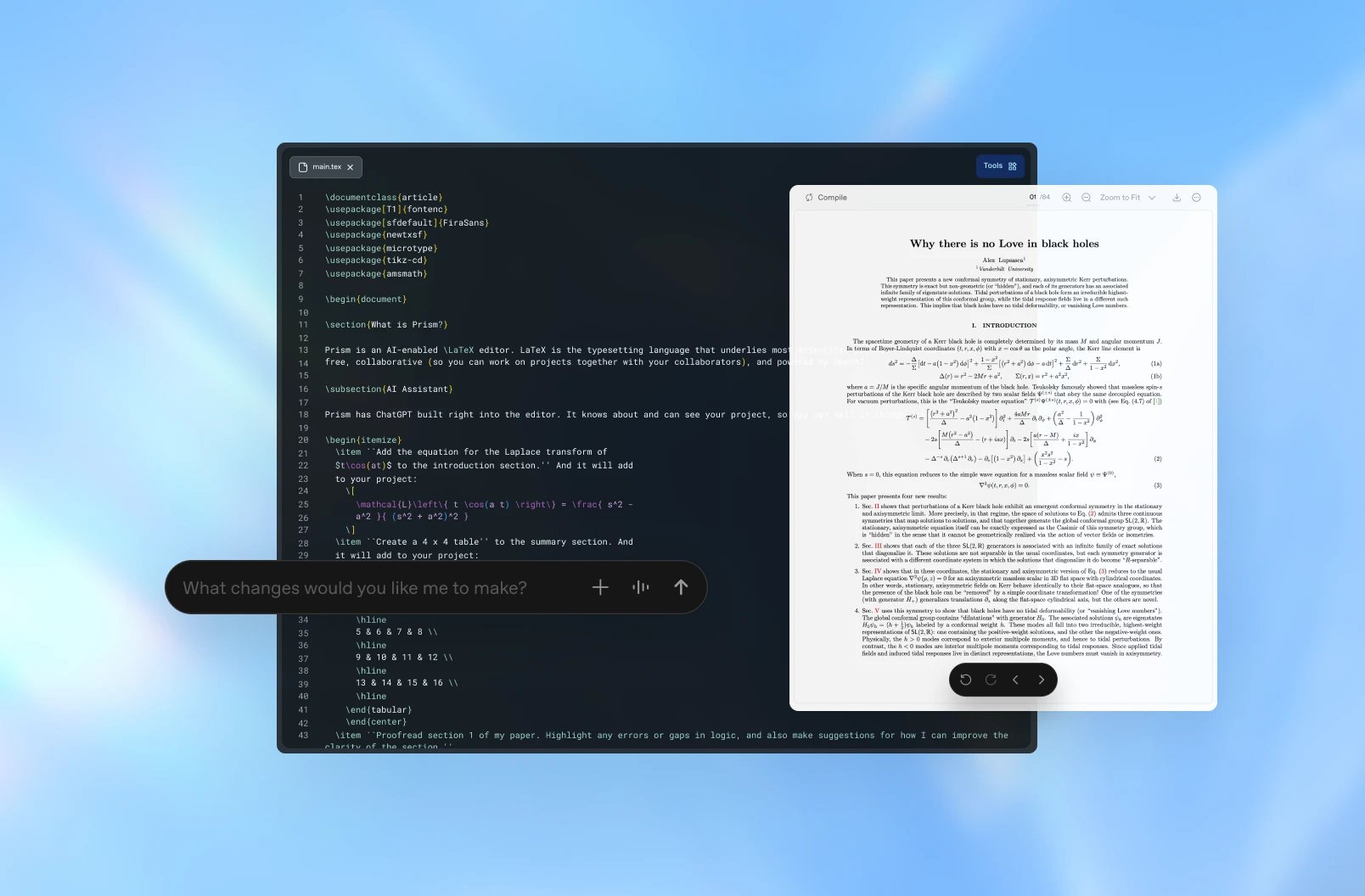
Wide view of Prism LaTeX editing interface showing source code on the left and a compiled academic paper preview on the right, with a floating ChatGPT prompt asking what changes to make, displayed against a light blue gradient background.
Comments
Please log in or register to join the discussion