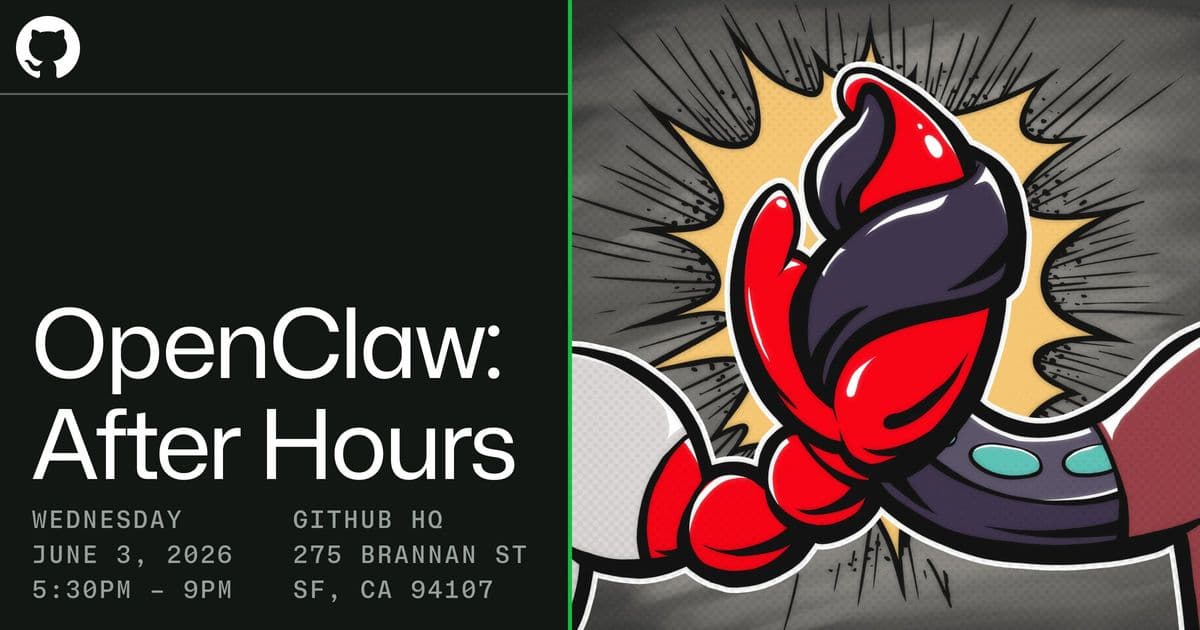
The rapidly growing OpenClaw open source project has surpassed 350,000 GitHub stars and is set to host its first community gathering at GitHub HQ during Microsoft Build 2026, highlighting the framework's approach to building production-ready agentic systems.
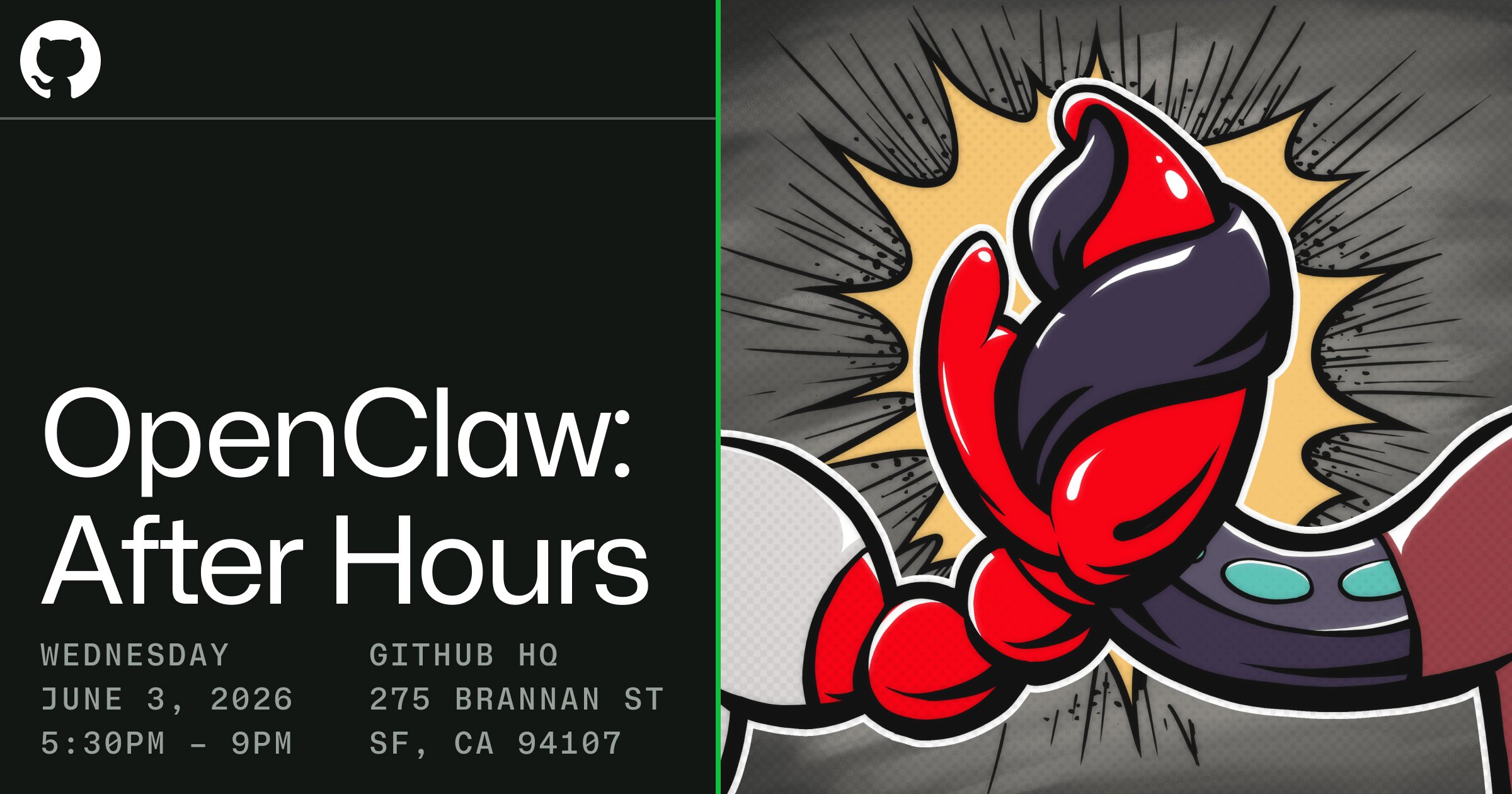
The OpenClaw framework has rapidly established itself as a significant player in the emerging agentic systems space, accumulating over 350,000 GitHub stars in what appears to be a remarkably short timeframe. This momentum has culminated in the announcement of OpenClaw: After Hours, a community event scheduled for June 3, 2026 at GitHub's San Francisco headquarters, coinciding with Microsoft Build 2026.
OpenClaw represents a pragmatic approach to building agentic systems that moves beyond the typical proof-of-concept demonstrations common in the AI space. The framework provides developers with core components for orchestrating tools, managing state across complex workflows, and handling long-running processes—essential elements for shipping systems that perform actual work in production environments.
"OpenClaw is focused on giving developers real control over how agents execute tasks in the wild," explains Peter Steinberger, the project's creator and GitHub's Senior Program Manager. This emphasis on practical control addresses a common challenge in the agentic systems space, where many frameworks prioritize flexibility at the expense of predictability and reliability.
The upcoming event will bring together the OpenClaw community for an evening of technical exchange, featuring a fireside conversation with Steinberger (affectionately known as the "ClawFather"), followed by a panel discussion with maintainers and ecosystem builders. The panel will explore what approaches have proven successful—and which have not—when deploying real agentic systems in production scenarios.
Lightning talks throughout the evening will showcase practical implementations of OpenClaw across various domains, while a closing happy hour will provide opportunities for informal knowledge sharing and networking. The event will be livestreamed on twitch.tv/github, ensuring broader accessibility for community members unable to attend in person.
From an architectural perspective, OpenClaw fills an important gap in the agentic systems ecosystem. While many existing frameworks focus primarily on language model integration, OpenClaw emphasizes workflow orchestration and state management—critical components for building systems that can reliably execute multi-step tasks over extended periods.
The framework's design reflects a thoughtful approach to balancing flexibility with reliability. By providing structured mechanisms for tool orchestration and state persistence, OpenClaw enables developers to build systems that can recover from failures, maintain context across long-running processes, and integrate with existing infrastructure and tools.
One particularly interesting aspect of OpenClaw is its emphasis on practical deployment. The framework acknowledges that agentic systems often require specific infrastructure considerations, with community members reportedly setting up dedicated environments like Mac Minis specifically for running OpenClaw-based agents. This suggests that the framework may have particular value in scenarios where specialized execution environments are acceptable or even beneficial.
The timing of the OpenClaw: After Hours event is noteworthy. By hosting the gathering during Microsoft Build 2026, GitHub positions the framework within the broader context of enterprise AI adoption. This alignment may indicate OpenClaw's intended trajectory toward enterprise-grade agentic systems, potentially integrating with Microsoft's broader AI ecosystem.
For organizations exploring agentic system implementations, OpenClaw offers several compelling use cases. The framework appears particularly well-suited for:
Automated complex workflows: Systems that require coordinating multiple tools and APIs to accomplish tasks that would typically require human judgment and intervention.
Long-running processes: Applications that need to maintain state and context over extended periods, such as continuous monitoring systems or automated research assistants.
Tool integration frameworks: Projects that need to consistently integrate and orchestrate various existing tools and services into cohesive workflows.
However, adopting OpenClaw requires careful consideration of several trade-offs. The framework's emphasis on control and predictability may come at the cost of some flexibility compared to more experimental agentic approaches. Organizations must evaluate whether the framework's structured approach aligns with their specific use cases and risk tolerance.
The event's organizers emphasize that attendance is limited and registration does not guarantee entry, suggesting strong demand for in-person participation. This enthusiasm reflects the broader industry's growing focus on practical AI applications beyond theoretical demonstrations.
As agentic systems continue to evolve from experimental concepts to production-ready applications, frameworks like OpenClaw that emphasize reliability, control, and practical deployment will likely play an increasingly important role. The upcoming community gathering represents an opportunity for developers to share experiences, learn from early adopters, and contribute to the framework's ongoing development.
For developers interested in exploring agentic systems beyond simple prompt-based interactions, OpenClaw offers a pathway to building more sophisticated, reliable applications. The framework's growing community and upcoming event suggest that practical agentic systems may be approaching a tipping point of broader adoption and real-world impact.
Developers can learn more about OpenClaw and register for the event through the official registration page. Those unable to attend in person can follow the livestream on Twitch to access the content and participate in the conversation.

The OpenClaw framework represents an important step toward making agentic systems practical and deployable in production environments. By focusing on the technical challenges of real-world implementation rather than theoretical capabilities, the project addresses a critical gap in the current AI landscape. As more organizations move from experimenting with language models to building integrated AI systems, frameworks that provide structure without sacrificing flexibility will likely become increasingly valuable.
Comments
Please log in or register to join the discussion