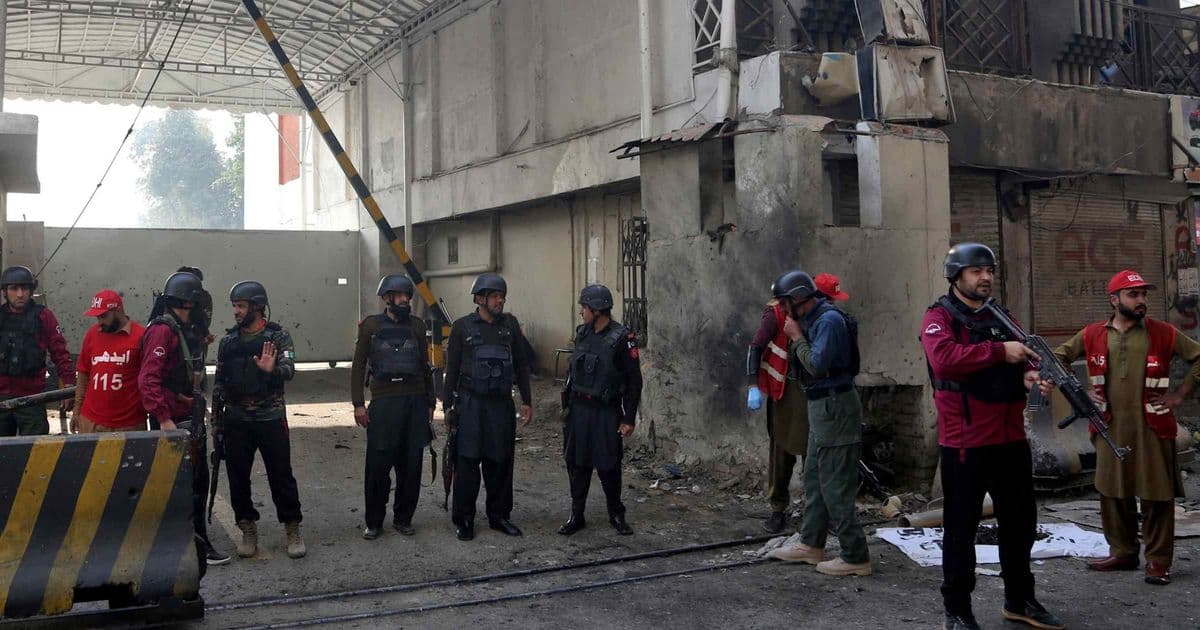
Pakistan establishes dedicated security force for copper-gold resources to attract international mining investment amid regional security challenges.
Islamabad's decision to create a specialized paramilitary force focused on protecting mineral resources in Balochistan represents a strategic pivot aimed at transforming the country's mining sector into a significant economic driver. The move comes as Pakistan seeks to capitalize on its vast untapped mineral wealth, estimated at over $6 trillion, with copper and gold deposits in Balochistan representing particularly valuable targets for international investors.
The new security initiative directly addresses long-standing concerns about militant activity in the region, which has previously deterred foreign mining companies from committing substantial capital to exploration and extraction operations. According to industry analysts, the direct and indirect costs of security incidents in Pakistani mining operations have historically increased operational expenses by 15-20%, significantly impacting project viability.
"This is not merely a security enhancement but an economic recalibration," explains Dr. Ayesha Khan, an economist specializing in resource extraction economies. "Pakistan is essentially creating a risk mitigation framework that makes its mineral resources more bankable for international financiers. The calculus is simple: reduced security premiums translate into higher potential returns on investment."
Balochistan province contains some of the world's largest untapped copper and gold reserves, including the Reko Diq deposit, which holds an estimated 5.9 billion tons of copper and gold ore worth approximately $500 billion at current market prices. The Chinese-backed China Metallurgical Corporation (MCC) has already invested $3 billion in the Saindak copper-gold project, but expansion has been constrained by security concerns.
The establishment of this specialized force follows a pattern seen in other resource-rich nations facing security challenges. Australia's mining sector developed sophisticated security protocols worth approximately $2.8 billion annually, while Canada's mining security industry has grown to an estimated $1.5 billion market. Pakistan's approach appears modeled on these successful frameworks but tailored to its specific geopolitical context.
From a market perspective, the announcement has already elicited positive responses from international mining firms. Shares of Australian-based Tethyan Copper Company, which holds rights to the Reko Diq project, rose 7.2% following the news. Similarly, London-based mining consultancy group Wood Mackenzie revised its Pakistan mining sector outlook from 'stable' to 'positive,' citing "reduced security friction points for foreign direct investment."
The economic implications extend beyond immediate mining operations. A secure mineral corridor could stimulate ancillary industries including transportation, equipment manufacturing, and mineral processing. Pakistan's mineral processing sector currently operates at only 30% of capacity, primarily due to inconsistent raw material supply chains that would benefit from improved security.
Geopolitically, the move positions Pakistan as a more attractive partner in China's Belt and Road Initiative, with mining security potentially becoming a component of broader infrastructure development agreements. The timing coincides with Pakistan's efforts to diversify its economic partnerships beyond traditional relationships, seeking to leverage its mineral resources as geopolitical bargaining chips.
However, challenges remain. The International Crisis Group reports that militant groups in Balochistan collect an estimated $150 million annually through illegal mining taxation and resource diversion. The new paramilitary force will need to establish operational dominance over a territory spanning approximately 347,190 square kilometers, a task comparable to securing the entire mineral-rich regions of Western Australia.
"The security calculus is complex," notes security analyst Imranullah Khan. "While visible military presence deters opportunistic attacks, it may also fuel nationalist sentiment against foreign resource extraction. The most effective approach combines visible security with community engagement programs that ensure local populations benefit directly from mining operations."
For Pakistan, the establishment of this specialized force represents more than a security measure—it's a fundamental repositioning of its mining sector within the global resource economy. With proper implementation, the copper-gold belt of Balochistan could transform from a security liability into the country's most valuable economic asset.
Comments
Please log in or register to join the discussion