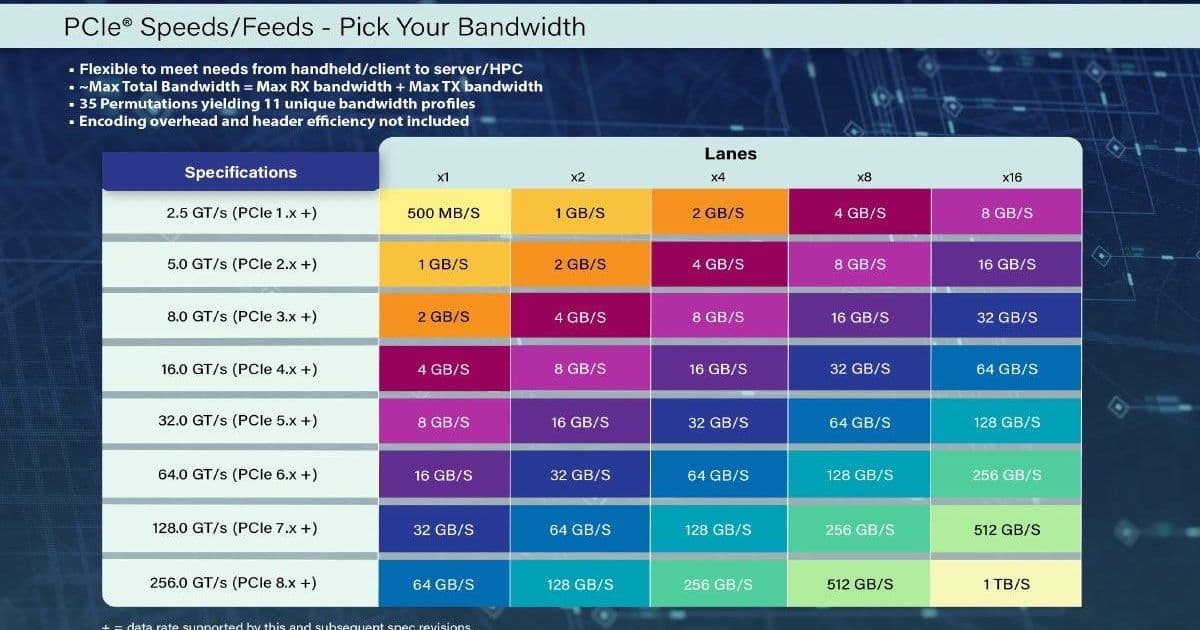
PCI-SIG has announced the availability of PCIe 8.0 specification draft 0.5, completing the first official draft ahead of schedule. The specification promises 256GT/s raw transfer rates and up to 1TB/s bi-directional bandwidth for x16 configurations, with full release targeted for 2028.
PCI-SIG has announced that the PCIe 8.0 specification draft 0.5 is now available to members, marking the completion of the first official draft ahead of schedule. This represents significant progress in the evolution of the Peripheral Component Interconnect Express standard, with the full PCIe 8.0 specification remaining on track for release by 2028. The new specification promises substantial bandwidth improvements, delivering 256GT/s raw transfer rates and up to 1.0TB/s in bi-directional bandwidth for a x16 configuration. 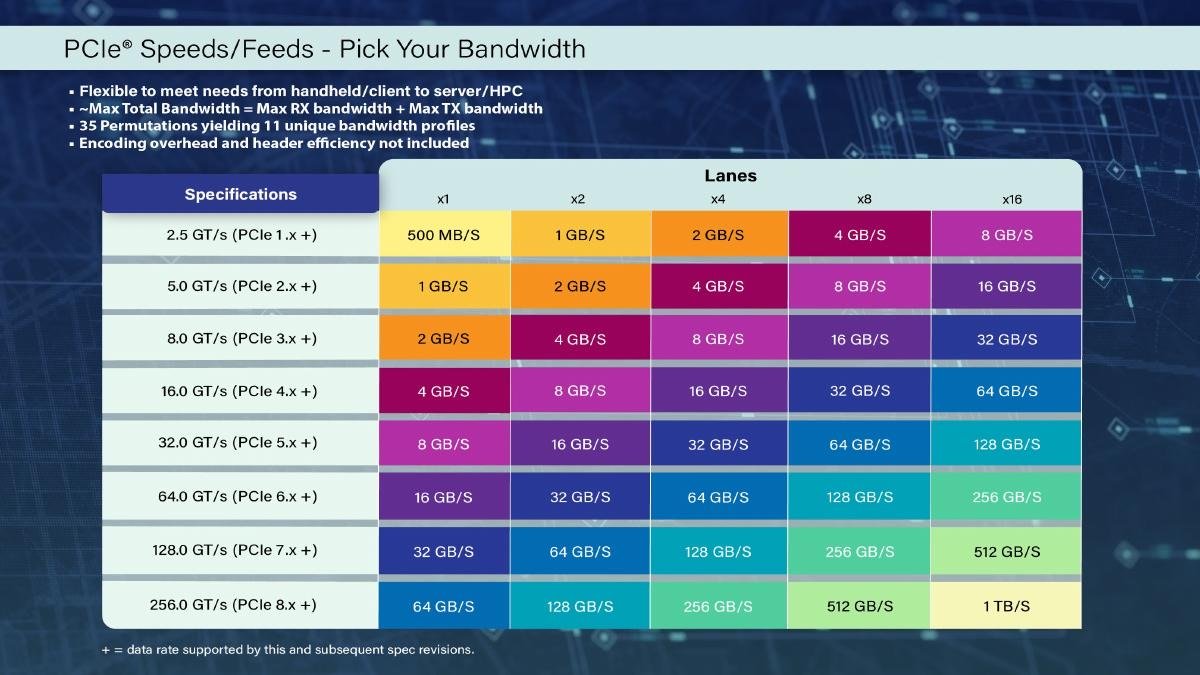
PCIe 8.0 Specification Progress
This development follows the initial PCIe 8.0 announcement by PCI-SIG that we covered previously. Draft 0.5 incorporates member feedback from the draft 0.3 specification that arrived in September 2025. PCI-SIG confirms the standard remains on track for a full specification release in 2028, maintaining a consistent development timeline despite the accelerated completion of the first draft.
The generational importance of this update cannot be overstated. PCIe 7.0 was only released to members in June 2025, making PCIe 8.0 a significant leap forward. While not a near-term platform feature, the 2028 target gives silicon, connector, retimer vendors, and platform teams clear direction on where the interconnect standard is headed. 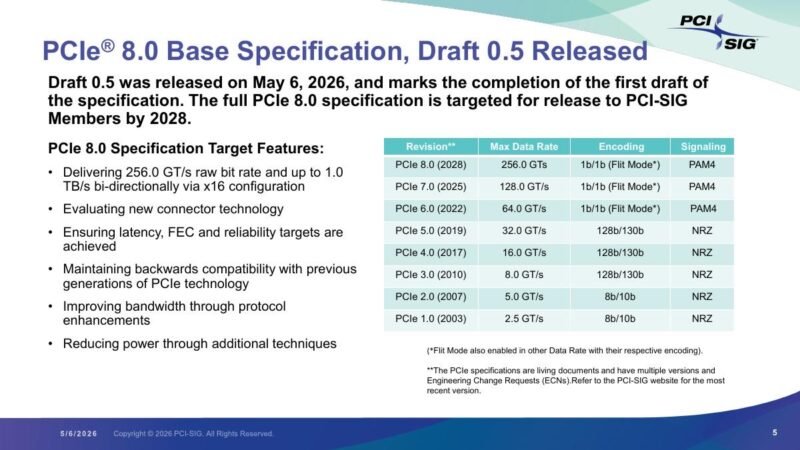
Technical Specifications and Improvements
PCI-SIG's headline slide clearly outlines the basic target: PCIe 8.0 doubles PCIe 7.0 from 128 GT/s to 256 GT/s while maintaining PAM4 signaling and FLIT encoding. This doubling of raw transfer rate represents a substantial performance increase that will enable next-generation computing workloads. 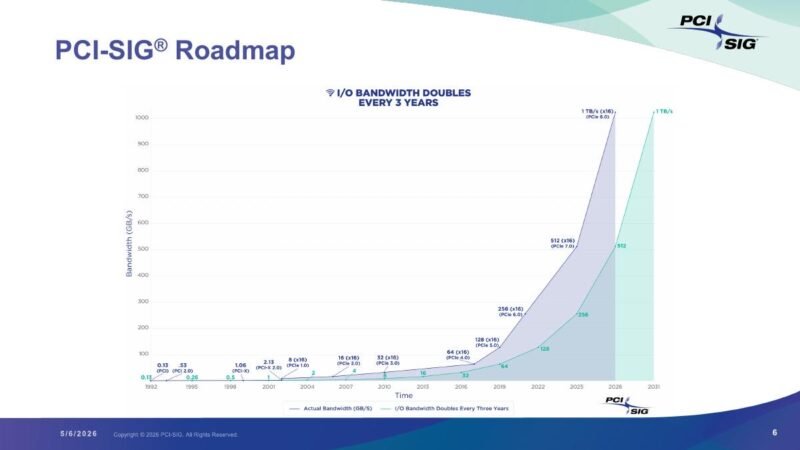
The bandwidth improvements are particularly impressive when examined across different lane configurations:
| PCIe Version | Speed (GT/s) | x1 Bandwidth | x4 Bandwidth | x8 Bandwidth | x16 Bandwidth |
|---|---|---|---|---|---|
| PCIe 3.0 | 8.0 | 1.0 GB/s | 4.0 GB/s | 8.0 GB/s | 16.0 GB/s |
| PCIe 4.0 | 16.0 | 2.0 GB/s | 8.0 GB/s | 16.0 GB/s | 32.0 GB/s |
| PCIe 5.0 | 32.0 | 4.0 GB/s | 16.0 GB/s | 32.0 GB/s | 64.0 GB/s |
| PCIe 6.0 | 64.0 | 8.0 GB/s | 32.0 GB/s | 64.0 GB/s | 128.0 GB/s |
| PCIe 7.0 | 128.0 | 16.0 GB/s | 64.0 GB/s | 128.0 GB/s | 256.0 GB/s |
| PCIe 8.0 | 256.0 | 32.0 GB/s | 128.0 GB/s | 256.0 GB/s | 512.0 GB/s |
Table: PCIe speeds and lane bandwidth comparison (effective bandwidth after encoding)
PCIe 8.0 moves a x16 link to 512GB/s of effective bandwidth, while even a x4 link reaches 128GB/s. These numbers represent a dramatic increase from previous generations and will enable future accelerators, NICs, SSDs, and CXL-adjacent platform designs to achieve unprecedented I/O performance. 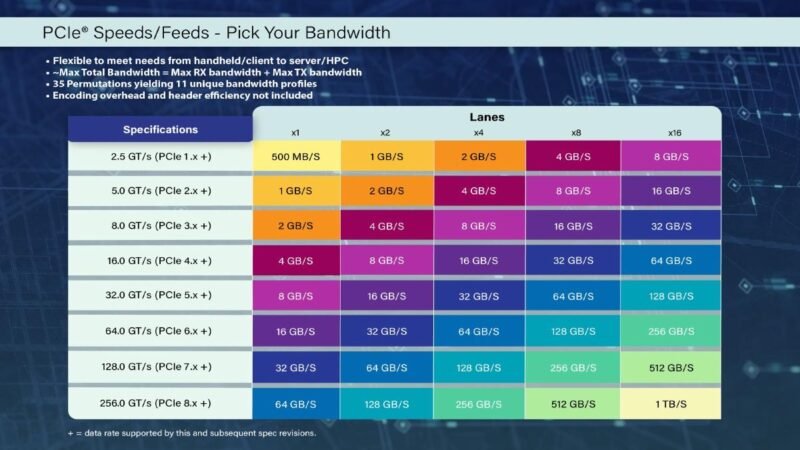
Compliance Timeline and Ecosystem Readiness
Compliance timing typically trails the final specification. PCI-SIG indicates that integrator lists are usually finalized three years after a full specification release, with preliminary testing typically starting two years after version 1.0. Early products can arrive before formal compliance, but the compliance program ensures broader ecosystem interoperability.
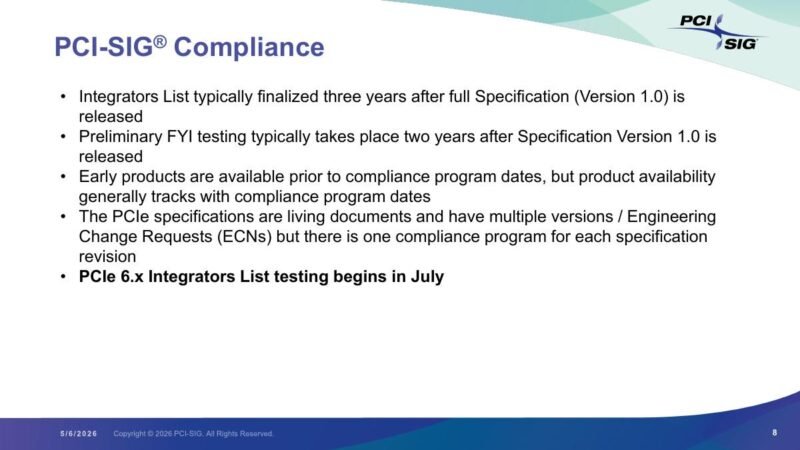
The PCI-SIG compliance timeline suggests we can expect first PCIe 8.0 compliant products around 2030-2031, with widespread adoption following shortly thereafter. This timeline gives manufacturers adequate lead time to develop compliant products while maintaining a realistic development schedule.
Applications in AI and Data Center Workloads
AI platforms represent one of the most significant pressure points driving PCIe evolution. PCIe remains the primary I/O fabric between CPUs, GPUs, accelerators, memory expansion, storage, and networking devices. As accelerator platforms continue to grow in complexity and performance requirements, PCI-SIG points to higher speeds, unordered I/O, and MultiLink work as part of the broader bandwidth and latency story.
The increased bandwidth of PCIe 8.0 will be particularly valuable for:
- Multi-GPU systems requiring high-bandwidth interconnects
- High-performance storage arrays
- Memory expansion via CXL
- Network interface cards handling massive data throughput
- Accelerator clusters for AI and HPC workloads
Optical and Copper Cable Developments
Electrical reach becomes increasingly challenging as signaling speeds rise, making optical PCIe work more relevant. PCI-SIG released an Optical Aware Retimer ECN in June 2025 for PCIe 6.0 and 7.0 compliant designs, with optical updates planned for PCIe 8.0. This explains the emergence of demonstrations like the Microchip PCIe Gen5 x16 over QSFP56-DD and Kioxia AIO Core and Kyocera Develop PCIe Gen5 Over Optics SSD.
Copper cabling represents another critical aspect of the platform story. The CopprLink internal and external specifications currently support PCIe 5.0 and PCIe 6.0, with support for PCIe 7.0 and PCIe 8.0 planned. This matters because future systems will require more topology flexibility than short motherboard traces alone can provide, especially in large-scale data center deployments.
Future Implications
The release of PCIe 8.0 draft 0.5 represents steady progress in the I/O interconnect space as AI and data center workloads demand ever-higher bandwidth. The 2028 target for full release gives silicon vendors adequate time to develop compliant products once the specification finalizes.
The parallel development of optical and copper cable solutions alongside the base specification will help system designers manage signal integrity and overcome reach challenges. The substantial increase in bandwidth per lane will enable next-generation computing architectures while maintaining backward compatibility with previous generations.
As we look toward the future of computing, PCIe 8.0's capabilities will become increasingly important. While current systems may not fully utilize this bandwidth immediately, the specification's development ensures that future platforms will have the I/O capacity they need to support emerging workloads and applications.
Comments
Please log in or register to join the discussion