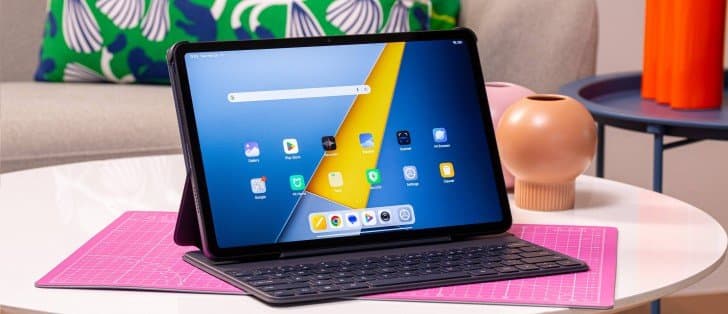
The Poco Pad M1 offers a large 12.1-inch display, Snapdragon 7s Gen 4 performance, and 12,000mAh battery in a rebranded Redmi Pad 2 Pro package, available in limited configurations.
The Poco Pad M1 enters the tablet market as a rebranded version of the Redmi Pad 2 Pro, bringing Xiaomi's tablet expertise to the Poco lineup. This review examines whether the Pad M1 offers enough value to stand out in the increasingly competitive Android tablet space.
Design and Display
The Poco Pad M1 features a substantial 12.1-inch IPS LCD display with a resolution of 1600x2560 pixels, delivering a pixel density of 249ppi. The 14.4:9 aspect ratio provides ample screen real estate for productivity tasks and media consumption. The display supports 120Hz refresh rates for smooth scrolling and Dolby Vision for enhanced HDR content.
With a peak brightness of 600 nits in High Brightness Mode (HBM), the screen performs adequately in various lighting conditions. The glass front is protected by an aluminum frame and aluminum back, giving the tablet a premium feel despite its mid-range positioning.
Performance and Hardware
Powering the Poco Pad M1 is the Qualcomm Snapdragon 7s Gen 4 chipset, built on a 4nm process. The octa-core CPU configuration includes one 2.7 GHz Cortex-A720 core, three 2.4 GHz Cortex-A720 cores, and four 1.8 GHz Cortex-A520 cores. The Adreno 810 GPU handles graphics duties, providing capable performance for everyday tasks and light gaming.
The tablet comes with 8GB of RAM and 256GB of UFS 2.2 storage, offering a single configuration option. A dedicated microSDXC slot allows for storage expansion, which is particularly useful given the fixed storage configuration.
Camera System
True to most tablet form factors, the Poco Pad M1's camera system takes a back seat to other features. Both the rear and front cameras feature 8MP sensors with f/2.0 and f/2.3 apertures respectively. Both cameras support 1080p video recording at 30fps, sufficient for video calls and basic photography needs but unlikely to replace a dedicated camera for most users.
Audio and Battery
Audio performance stands out with four Dolby Atmos speakers providing immersive sound for media consumption. The stereo speaker setup delivers clear audio with good spatial separation.
Battery life is a strong point, with a massive 12,000mAh battery that should easily last through a full day of heavy use. The tablet supports 33W fast charging with PD3.0 and QC3+ compatibility, though the actual charging speed may vary by region. Interestingly, the device also supports 27W reverse wired charging, allowing it to function as a power bank for other devices.
Software and Features
The Poco Pad M1 runs Android 15 with HyperOS 2, Xiaomi's latest software layer. This combination brings modern Android features with Xiaomi's customization options and optimizations.
Connectivity options include Wi-Fi 6, Bluetooth 5.4 with aptX HD and aptX Adaptive support for high-quality wireless audio, and a 3.5mm headphone jack for wired audio connections. The tablet also includes standard sensors like accelerometer, gyro, and compass, with proximity sensor available only with certain accessories.
Accessories and Stylus Support
The Poco Pad M1 supports stylus input, though the review doesn't specify whether this is an active stylus or passive capacitive pen. This feature adds productivity value for note-taking and creative work.
Market Position and Value
As a rebranded Redmi Pad 2 Pro, the Poco Pad M1's value proposition depends largely on its pricing relative to the original model. The single storage configuration (256GB/8GB RAM) and limited color options (Blue and Gray) suggest a focused market approach.
The tablet's strengths lie in its large display with high refresh rate, capable mid-range performance, excellent battery life, and premium audio experience. However, the lack of cellular connectivity and limited camera capabilities may deter some potential buyers.
Conclusion
The Poco Pad M1 offers a compelling package for users seeking a large-screen Android tablet with good performance and battery life. Its rebranded nature means it inherits the strengths of the Redmi Pad 2 Pro while potentially offering different pricing or availability advantages through the Poco brand.
For users prioritizing media consumption, productivity with stylus support, and long battery life over cellular connectivity or advanced photography, the Poco Pad M1 presents a solid option in the mid-range tablet market.
Comments
Please log in or register to join the discussion