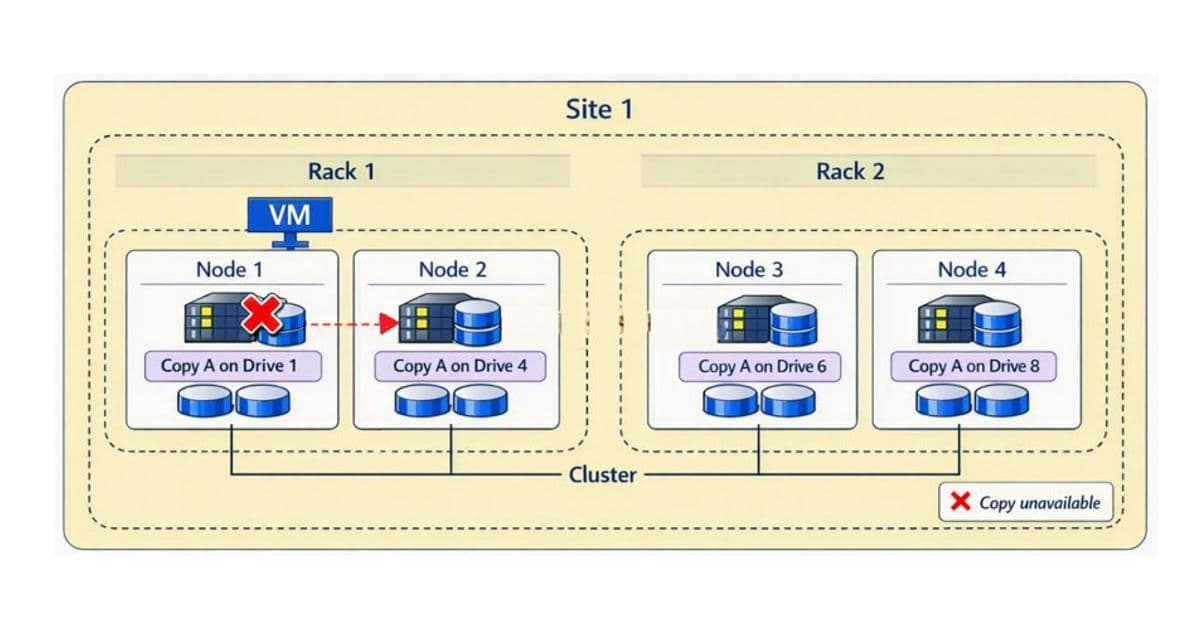
Windows Server 2025 introduces Rack-Local Reads for Storage Spaces Direct, optimizing read operations by prioritizing local rack data copies to reduce cross-rack traffic and improve latency in campus and multi-rack deployments.
Storage Spaces Direct (S2D) on Windows Server 2025 introduces a significant performance optimization for campus and multi-rack deployments: Rack-Local Reads. This feature fundamentally changes how read operations are handled in distributed storage environments, keeping data traffic local whenever possible while maintaining the same fault tolerance guarantees.
The Challenge of Topology-Agnostic Reads
Before Rack-Local Reads, S2D treated all healthy copies of data equally during read operations. When a read request arrived, Storage Spaces Direct could satisfy it from any available copy containing the requested data offset—regardless of where that copy was located in the cluster.
This topology-agnostic approach was correct and safe from a data integrity perspective, but it created performance inefficiencies in larger deployments. In a multi-rack cluster, a workload running on Node 1 in Rack 1 might read data from Node 3 in Rack 2, even when a healthy copy existed on Node 2 in the same rack. This unnecessary cross-rack traffic increased latency and made read performance dependent on fabric conditions rather than locality.
How Rack-Local Reads Work
The new feature changes only read selection behavior while leaving write operations and data placement unchanged. When a read request arrives, S2D now evaluates the proximity of each healthy copy based on the fault domain hierarchy—node, chassis, rack, or site.
Instead of treating all healthy copies as equal, the system now prefers the closest available copy. If a local copy exists on the same node, that's used first. If not, the system looks for copies within the same rack, then the same chassis, and so on. Only when no closer copy exists does S2D reach across racks or sites to satisfy the read.
Performance Benefits in Practice
The optimization delivers several tangible benefits:
- Reduced cross-rack traffic: Read operations stay within the local rack whenever possible, preserving inter-rack bandwidth for other workloads
- Lower and more predictable latency: By eliminating unnecessary network hops, read performance becomes less dependent on fabric conditions
- Better scalability: As deployments grow larger, the reduction in east-west storage traffic helps maintain performance
- No resiliency trade-offs: Data placement for fault tolerance remains exactly the same—only the read path is optimized
Real-World Impact
For organizations running Storage Spaces Direct across multiple racks or campus environments, Rack-Local Reads address a fundamental inefficiency in distributed storage. The feature is particularly valuable for:
- Large enterprise data centers with multiple racks per cluster
- Campus deployments spanning multiple buildings or locations
- High-performance workloads sensitive to read latency
- Environments where inter-rack bandwidth is a precious resource
Implementation and Availability
Rack-Local Reads is available in Windows Server 2025 as part of the expanded Campus Cluster capabilities. The feature builds on the foundation of fault-tolerance domain support introduced in the same release, which allows S2D deployments to span racks, chassis, and even sites.
Organizations running earlier versions of Windows Server can upgrade to take advantage of this optimization. The change is transparent to applications and requires no reconfiguration of existing storage pools or volumes.
Looking Forward
This optimization represents Microsoft's continued investment in making Storage Spaces Direct more efficient at scale. By separating resiliency from performance—keeping fault tolerance placement unchanged while optimizing the read path—Rack-Local Reads deliver immediate performance benefits without compromising the reliability that makes S2D attractive for mission-critical workloads.
The feature demonstrates how thoughtful engineering can extract significant performance gains from existing architectures, making multi-rack and campus deployments more practical for a wider range of workloads.
Comments
Please log in or register to join the discussion