
Radicle introduces its Desktop client, offering developers a peer-to-peer code collaboration platform built on Git that provides full control over data and workflow without relying on centralized entities.
Radicle Desktop Launches: A Decentralized Alternative to Centralized Code Forges
In an era dominated by centralized code hosting platforms, Radicle has emerged as a compelling alternative, offering developers sovereignty over their code and collaboration workflows. With the recent launch of Radicle Desktop, the open-source peer-to-peer code collaboration stack built on Git is now more accessible than ever, positioning itself as a viable option for those seeking censorship-resistant, local-first development environments.
The Vision Behind Radicle
Unlike traditional code hosting platforms where a single entity controls the network, Radicle operates on a decentralized principle. Repositories are replicated across peers, ensuring that users maintain full control of their data and workflow. This approach eliminates the risks associated with centralized platforms, including potential censorship, service outages, and corporate control over open-source projects.
"Radicle is an open source, peer-to-peer code collaboration stack built on Git. Unlike centralized code hosting platforms, there is no single entity controlling the network." — Radicle Announcement
How Radicle Works
The Radicle protocol combines several technologies to create its unique collaborative environment:
- Cryptographic Identities: Every code and social artifact is signed using public-key cryptography, ensuring authenticity and authorship.
- Git Integration: Leverages Git for efficient data transfer between peers, maintaining familiarity for developers.
- Custom Gossip Protocol: Employs a specialized protocol for exchanging repository metadata across the network.

Key Features of Radicle
Your Data, Forever and Secure
All social artifacts within Radicle are stored in Git and cryptographically signed. The system automatically verifies the authenticity and authorship of all data, providing a secure foundation for collaboration.
Unparalleled Autonomy
Radicle enables users to run their own nodes, ensuring censorship-resistant code collaboration. This fosters a resilient network without reliance on third-party services, giving developers true ownership of their projects.
Local-First Development
Perhaps one of Radicle's most compelling features is its local-first approach. Functionality remains available even without internet access, and users own their data, making migration, backup, and access straightforward both online and offline.
Evolvable & Extensible Architecture
Radicle's Collaborative Objects (COBs) serve as the social primitive of the platform. This innovative approach allows features like issues, discussions, and code review to be implemented as Git objects. Developers can extend Radicle's capabilities to build custom collaboration workflows tailored to their specific needs.
Modular Design
The Radicle Stack consists of a CLI, web interface, and TUI, all backed by the Radicle Node and HTTP Daemon. This modular architecture allows any component to be swapped out, enabling the development of alternative clients that can interface with the Radicle network.
┌─────────────────┐┌────────────────┐
│  Radicle CLI    ││ Radicle Web    │
└─────────────────┘└────────────────┘
┌───────────────────────────────────┐
│  Radicle Repository               │
│ ┌────────┐ ┌────────┐ ┌─────────┐ │
│ │  code  │ │ issues │ │ patches │ │
│ └────────┘ └────────┘ └─────────┘ │
├───────────────────────────────────┤
│  Radicle Storage (Git)            │
└───────────────────────────────────┘
┌────────────────┐┌─────────────────┐
│  Radicle Node  ││  Radicle HTTPD  │
├────────────────┤├─────────────────┤
│    NoiseXK     ││   HTTP + JSON   │
└────────────────┘└─────────────────┘
Getting Started with Radicle
For developers interested in exploring Radicle, the installation process is straightforward:
curl -sSLf https://radicle.xyz/install | sh
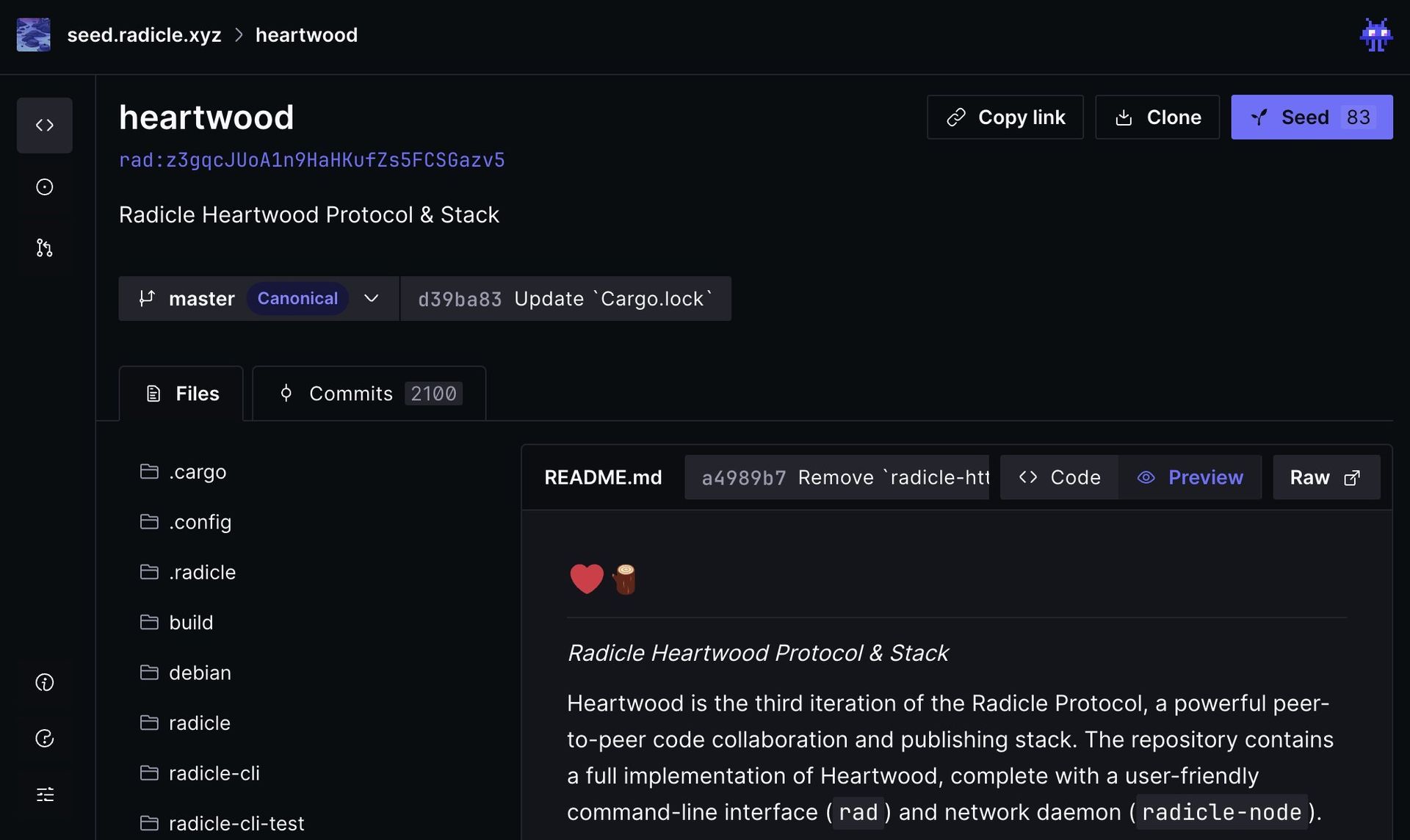
Alternatively, users can build from source. Currently, Radicle supports Linux, macOS, and BSD variants. The newly launched Radicle Desktop provides a graphical collaborative experience, complementing the existing command-line interface.
The Future of Decentralized Code Collaboration
Radicle's emergence comes at a time when concerns about centralized control of code repositories are growing. As open-source projects become increasingly critical to the software industry, the ability to collaborate without relying on corporate platforms represents a significant shift in how development might evolve.
The project has shown consistent progress, with regular releases since its initial announcement in April 2023. The recent launch of Radicle Desktop marks a significant milestone in making decentralized code collaboration more accessible to a broader audience of developers.
As the open-source community continues to grapple with questions about data ownership, platform governance, and censorship resistance, projects like Radicle offer a glimpse into a future where code collaboration is truly decentralized, user-controlled, and resilient.
For developers interested in exploring this alternative approach to code collaboration, Radicle provides not just a tool, but a philosophy—one that places control back in the hands of those who create and maintain the software that powers our world.
Source: Radicle
Comments
Please log in or register to join the discussion