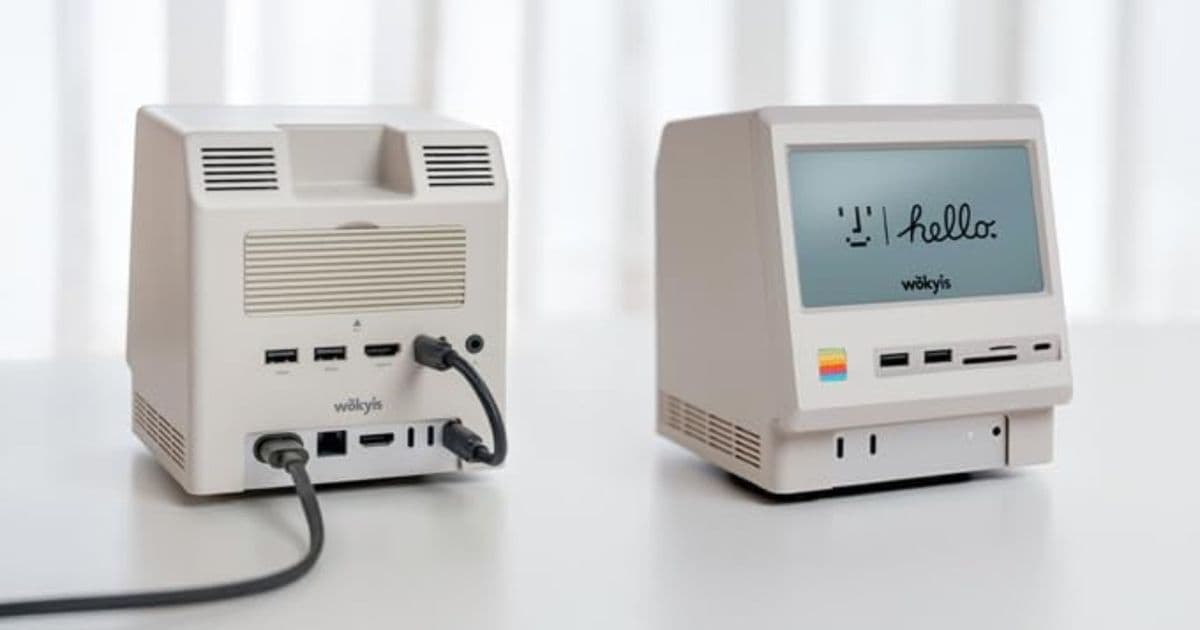
As semiconductor shortages persist and Apple's storage premium reaches $2,000 for upgrades, third-party accessories like the Wokyis M5 Retro Dock offer both aesthetic customization and practical expansion options for constrained Mac Mini users.
The ongoing semiconductor supply crisis continues to reshape the personal computing landscape, with Apple's Mac Mini facing unprecedented delivery windows of 5-6 weeks even for base configurations. Against this backdrop, the Wokyis M5 Retro Dock Station emerges as both a nostalgic aesthetic solution and a practical hardware expansion option for Mac Mini users grappling with Apple's escalating storage pricing.
The accessory addresses two critical pain points in the current market: Apple's egregious storage upgrade costs and the limited expansion options in the compact Mac Mini form factor. With Apple charging $2,000 for a 256GB storage upgrade and removing the 512GB option entirely from the Mac Store lineup, third-party solutions like this dock with integrated M.2 NVMe slot represent a compelling alternative for users requiring additional capacity.
From a technical architecture perspective, the dock presents an interesting case study in peripheral design. The standard $169.99 version utilizes a USB-C interface with transfer speeds up to 10 Gbps, while the premium Thunderbolt 5 model ($339.99) achieves significantly higher bandwidth through Intel's latest connectivity standard. This architectural choice reflects the broader industry trend of leveraging existing interface standards rather than developing proprietary solutions.
Manufacturing these docks presents an intriguing contrast to Apple's vertically integrated approach. Wokyis, like many third-party manufacturers, must navigate the same component shortages affecting larger players while maintaining competitive pricing. The dock's inclusion of both legacy USB-A ports and modern USB-C connections demonstrates the challenge of balancing backward compatibility with forward-looking design—a microcosm of the broader semiconductor industry's transition periods.
The M.2 NVMe implementation deserves particular attention from a technical standpoint. While Apple has increasingly integrated storage directly onto the system-on-chip (SoC) in their latest silicon, the dock provides an external expansion path that bypasses this limitation. This approach mirrors enterprise solutions where storage and compute are decoupled, offering potential performance benefits for workloads that can leverage high-speed external storage.
From a supply chain perspective, the dock's availability highlights the divergent recovery trajectories between different semiconductor market segments. While consumer PC components remain constrained, certain connectivity and peripheral chip categories have stabilized, enabling third-party manufacturers to bring innovative products to market. This divergence creates opportunities for niche players like Wokyis to address specific consumer needs that larger players may overlook.
The market implications extend beyond simple storage expansion. As Apple's silicon integration continues, with the M4 chip representing yet another step in the company's vertical integration strategy, third-party accessories that provide expansion capabilities may become increasingly valuable. This trend aligns with broader industry analysis suggesting that while performance gains from Moore's Law are slowing, specialized expansion and acceleration solutions will grow in importance.
Interestingly, the dock's retro aesthetic serves a practical purpose beyond nostalgia. The compact 5-inch 720p display provides functionality similar to the auxiliary screens found in professional workstations, demonstrating how form factor constraints can drive innovative design solutions. This particular implementation echoes the historical pattern where technological limitations often inspire creative approaches.
The accessory's compatibility across multiple platforms—MacBooks, Windows PCs, Android devices, and even Raspberry Pis—reflects the USB-C/Thunderbolt ecosystem's maturation. This cross-platform compatibility represents a significant manufacturing advantage, allowing Wokyis to address a broader market than platform-specific solutions would permit.
As the semiconductor industry continues to navigate supply chain disruptions and shifting demand patterns, products like the Wokyis M5 Retro Dock highlight the growing importance of third-party innovation in addressing consumer needs. While Apple's vertical integration strategy continues to limit expansion options, creative solutions that leverage existing interface standards and form factors will likely play an increasingly important role in the personal computing ecosystem.
Comments
Please log in or register to join the discussion