Rocksky offers an open‑source, decentralized alternative to Last.fm, letting users scrobble, discover and share music across a growing ecosystem of clients while keeping data under their own control.
Rocksky – a new home for music scrobbling
Music‑tracking services have long been dominated by a handful of centralized platforms. Users hand over listening histories, preferences and social signals to companies that monetize the data in opaque ways. Rocksky aims to flip that model by building a decentralized scrobbling and discovery platform on the open AT Protocol.
The problem Rocksky solves
- Data lock‑in – Traditional services store scrobbles in proprietary databases, making it hard to migrate or export your listening history.
- Limited integration – Most scrobblers only speak to a single API (typically Last.fm). Users with multiple media players end up running separate clients or losing data.
- Sparse social context – Existing platforms provide basic “what‑are‑you‑listening‑to” feeds but lack real‑time community interaction beyond simple likes.
Rocksky tackles each of these pain points by:
- Storing scrobbles on the AT Protocol, a decentralized social graph that lets users own their data and grant selective access.
- Offering drop‑in compatible APIs for both Last.fm and ListenBrainz, so any existing scrobbler can point at Rocksky without code changes.
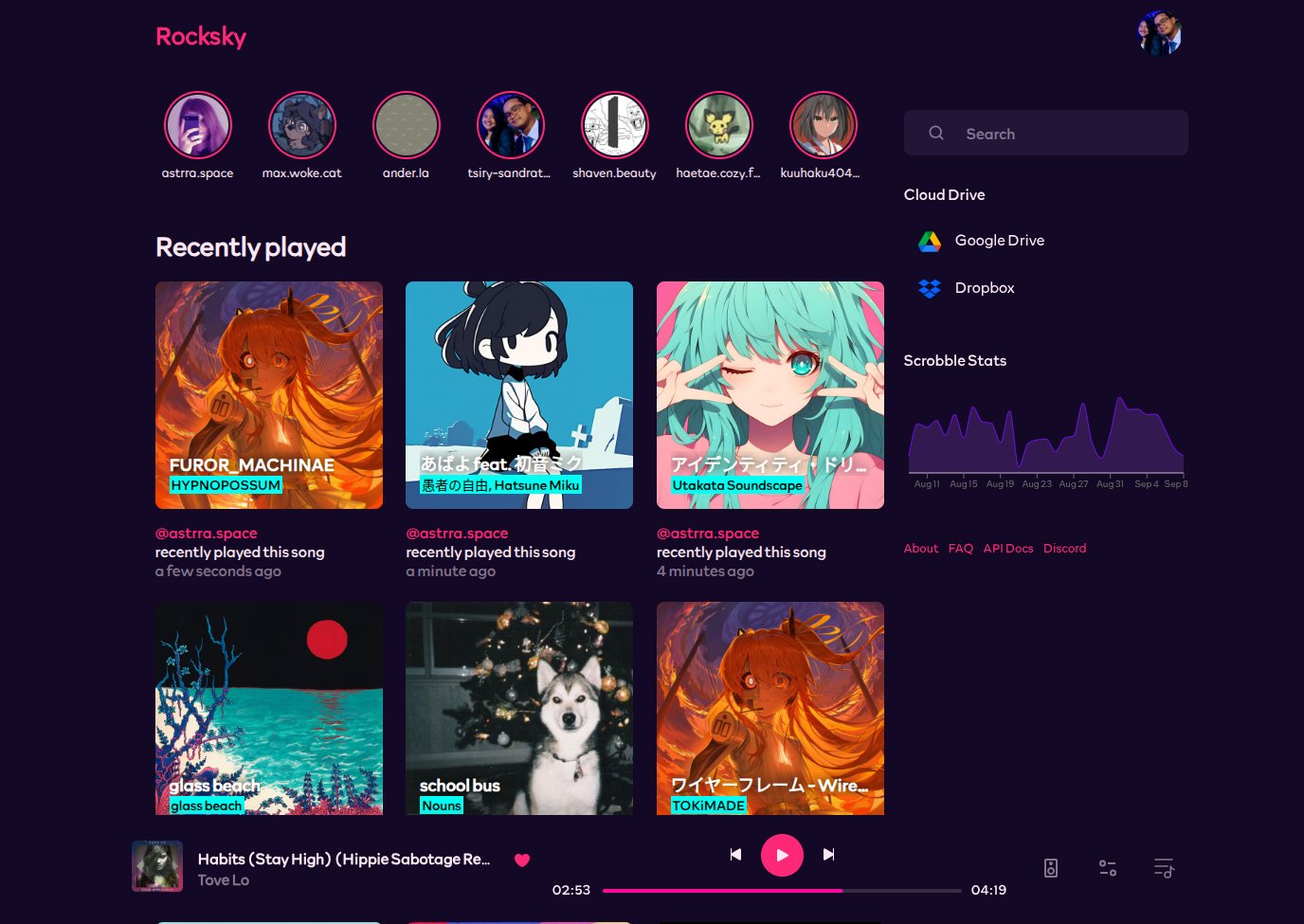
- Adding a real‑time Stories view, shoutbox, and likes system that surface what other listeners are playing right now.
Core features and early traction
| Feature | What it does | Current status |
|---|---|---|
| Scrobbling APIs | Last.fm‑compatible endpoint; ListenBrainz‑compatible endpoint | Public beta, documented at the repo |
| Playback & history | Timeline of recent tracks, per‑user stats, daily charts | Live on the web UI |
| User insights | Top artists/tracks/albums, personalized charts | Available for all accounts |
| Client integrations | Spotify, Jellyfin, Pano Scrobbler, WebScrobbler | Integration guides published |
| Search | MeiliSearch‑powered fast lookup of tracks and artists | Deployed in production |
| Roadmap items | Webhooks, personalized feeds, multi‑source libraries, Rocksky Connect | Planned for Q4 2026 |
The project is open‑source and hosted on a public Git repository (GitHub mirror). The codebase is polyglot – Node.js, Deno, Rust, Go and Docker are all used to keep the stack flexible for contributors. A minimal Docker compose file lets anyone spin up a full instance locally, and the team provides a step‑by‑step Getting Started guide that walks through environment setup, Spotify API credentials and database migrations.
Why the AT Protocol matters
Rocksky’s choice of the AT Protocol is more than a technical curiosity. The protocol supplies a decentralized identity layer (AT handles) and a content‑addressable storage model that can be hosted on any compatible server. In practice this means:
- Users can migrate their scrobble history between self‑hosted nodes without losing data.
- Community‑run instances can experiment with custom moderation or recommendation algorithms without needing permission from a central authority.
- Third‑party developers can build extensions – for example, a Discord webhook that posts a user’s latest track – by subscribing to the upcoming Webhooks endpoint.
Funding and market positioning
Rocksky has not announced a formal funding round yet, but the project has attracted strategic backing from several AT Protocol ecosystem contributors who have pledged compute credits and developer time. The team’s positioning is clear: they are not trying to replace mainstream streaming services, but rather to provide the infrastructure layer that lets any service add transparent, user‑owned scrobbling.
By targeting the niche of privacy‑conscious audiophiles and developers building music‑related tools, Rocksky sidesteps the crowded consumer market while establishing a foothold in the emerging decentralized social graph space. Early adopters include a handful of indie music blogs and a small community of self‑hosted Jellyfin users who have already switched their scrobble pipelines from Last.fm to Rocksky.
Looking ahead
The roadmap outlines several features that could broaden appeal:
- Webhooks – allowing real‑time notifications to Discord, Slack or custom dashboards.
- Personalized feeds – community‑driven recommendation engines that run on user‑owned data.
- Rocksky Connect – a protocol‑level playback sync similar to Spotify Connect, but without a central server.
- Multi‑source libraries – the ability to scrobble from cloud storage providers (Google Drive, S3, etc.) and even user‑uploaded tracks.
If those items materialize on schedule, Rocksky could become the de‑facto backend for a new generation of music‑tracking apps that respect user sovereignty. For now, the project offers a solid, well‑documented foundation for anyone who wants to experiment with decentralized scrobbling today.
Get started: Clone the repo with git clone [email protected]:rocksky.app/rocksky, follow the Docker compose instructions, and point your favorite scrobbler at the provided API endpoint. The community is active on Discord, and contributions are welcomed via pull requests.
Comments
Please log in or register to join the discussion