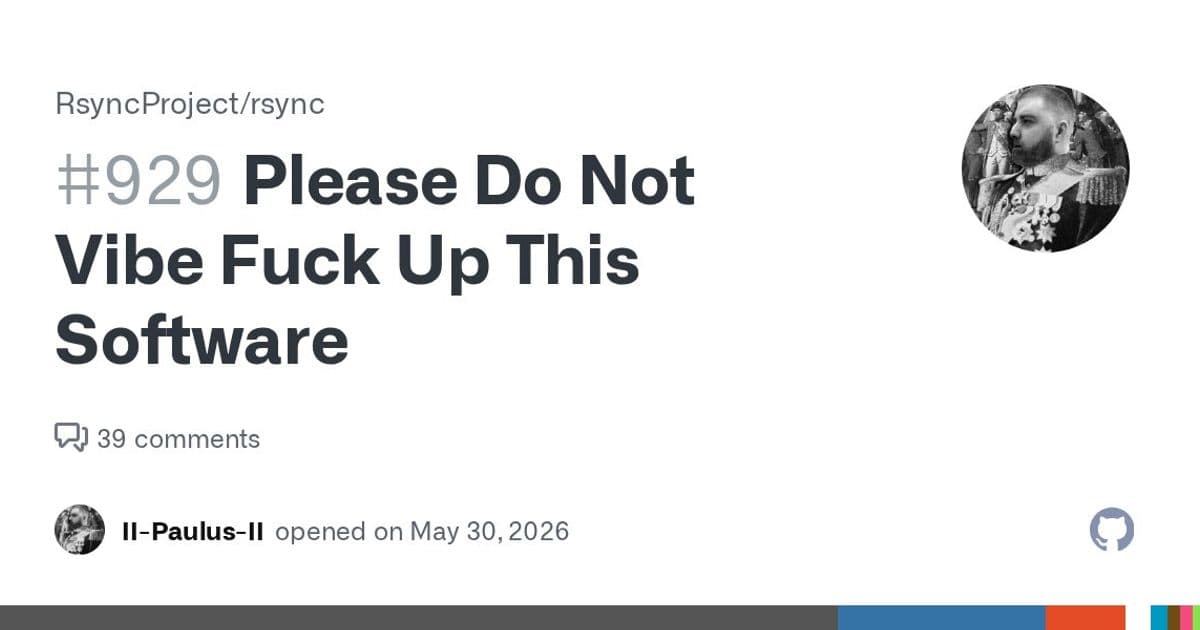
The long-standing file synchronization tool rsync is at the center of a controversy after users allege recent AI-introduced changes have destabilized the software.
The rsync project, a cornerstone of file synchronization and backup solutions in the Unix/Linux world, has found itself in the midst of a contentious debate following recent changes that users claim have destabilized the once rock-solid utility. The controversy erupted on GitHub with issue #929 titled "Please Do Not Vibe Fuck Up This Software," which has sparked a broader discussion about the role of AI in open-source development and community feedback.
What is Rsync?
Rsync has served for decades as a fundamental tool for efficiently synchronizing files and directories between systems. Its delta-transfer algorithm minimizes network usage by only transferring differences between source and destination files, making it indispensable for system administrators, developers, and anyone needing to maintain synchronized copies of data across machines. The project has maintained a reputation for stability and reliability, with many users relying on it for mission-critical operations involving terabytes of data.
The Controversy Unfolds
The GitHub issue began with a user posting what appears to be a screenshot expressing concern about "vibe coding" in rsync, a term that generally refers to making changes based on intuition or superficial understanding rather than deep technical knowledge. The original poster, @II-Paulus-II, framed their concern around AI being introduced to the project.
What followed was a heated exchange in the comments section, with many developers pushing back against the approach of raising concerns through what they perceived as non-constructive means. Developer ppowo responded with: "@II-Paulus-II Stop. You know nothing. You have shipped 0 features by hand. No one has ever depended on your code. You are a finger-wagging 'AI wrote this' type in an era where you hide in plain sight coasting on the moral high ground of writing toy projects and scripts from scratch."
Technical Concerns Emerge
Beyond the debate about communication styles, actual technical issues with recent rsync versions have come to light. User dogtopus provided some perspective on the scale of changes: "git diff aa142f08ef31d3ffa8d6b3b8af16d00324a98c1b --stat ... 286 files changed, 21006 insertions, 5209 deletions." While many of these changes were for test cases and additional features, some appear to have introduced regressions.
Specific issues reported include:
- Rsync 3.4.3+ fails to build on Linux kernels < 5.6 due to openat2() dependencies
- Problems with --delete-missing-args and --files-from options
- Issues with --link-dest via rsync daemon
- "Invalid argument" errors on file reads when using the native protocol in version 3.4.3+
Community Response
The reaction from the rsync user community has been mixed. Some users have taken to downgrading to earlier versions:
"had to downgrade to 3.4.1 and ignore all future releases of rsync, thank you very cool," commented user qwelias.
Others have begun exploring alternatives:
"switched to openrsync," noted cuynu.
Meanwhile, some developers have argued for maintaining stability:
"Please consider at the very least keeping around a stable branch of rsync only getting bugfixes and security updates. I use rsync on hundreds of terabytes of data, and it has been an amazing tool for that because of the stability and reliability it provides," rebane2001 commented.
The AI Question
The central question surrounding this controversy is the role of AI in the rsync project. While some users have expressed concern about "AI-written code" being introduced, the specifics remain unclear. What is evident is that recent changes have introduced compatibility issues and regressions that weren't present in earlier versions.
"I use this tool in a professional environment for DFIR, please do not 'vibe fuck up' this software. It's free, and we're using it for free, so I'm aware that we're kinda biting the hand that feeds us, but please. Now that I know AI is involved with updates it has to go through a bunch of scrutiny because it's considered an 'AI tool' by policy," broman explained.
Broader Implications
This controversy highlights several important issues in the open-source ecosystem:
- Communication Channels: How should users provide feedback about project direction?
- Stability vs. Innovation: How can projects evolve without breaking existing functionality?
- AI in Open Source: What are the implications of introducing AI-generated code into long-standing projects?
- Maintainer Burnout: How can projects balance maintainer capacity with community expectations?
The rsync controversy serves as a case study in how communities navigate technological change while preserving the reliability that made foundational tools valuable in the first place. As voncowenhoven pointed out: "So, is anyone actually going to start a fork, or is this just a classic free-rider problem where everyone expects someone else to do the heavy lifting while they sit back and vent?"
For those following the issue, the GitHub discussion provides the most current information on the evolving conversation. The rsync project's maintainers now face the challenge of addressing legitimate technical concerns while managing community expectations about stability and innovation.
Comments
Please log in or register to join the discussion