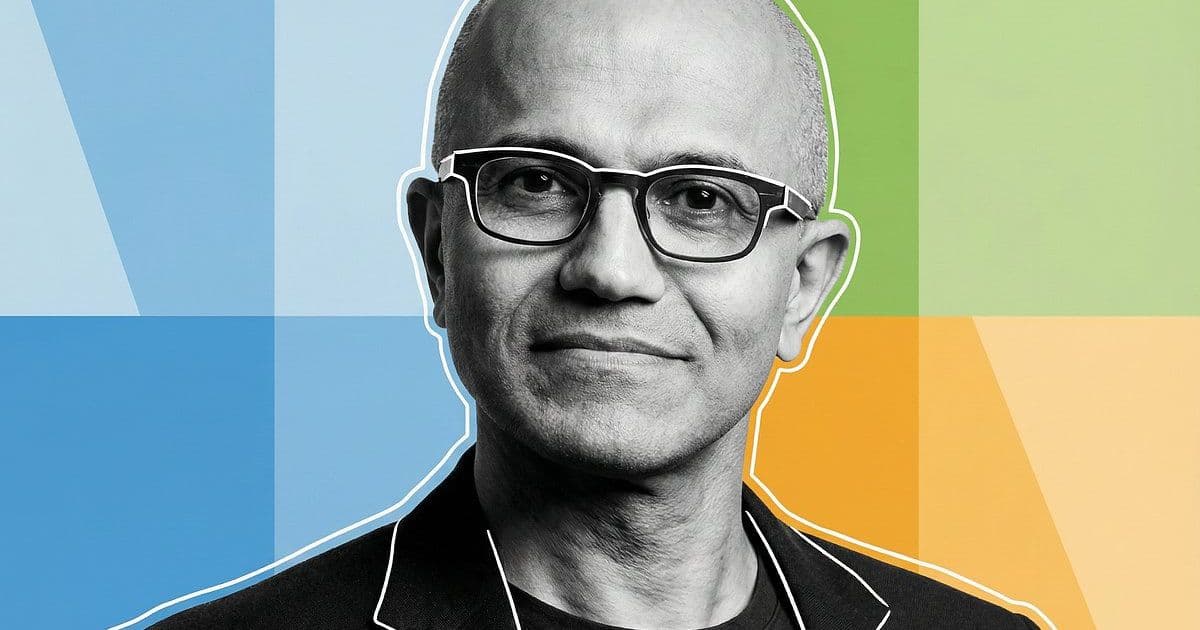
A fact-check of Microsoft's CEO reveals the gap between boardroom polish and operational reality, examining how Nadella's Davos performance exemplifies the disconnect between corporate rhetoric and actual AI development practices.
I watched Satya Nadella's Davos interview three times. Once to hear what he said. Once to note what he didn't say. And once more because I couldn't quite believe how smoothly he'd managed to do both simultaneously.
The Microsoft CEO sat across from Larry Fink at the World Economic Forum, radiating the particular brand of composed confidence that comes from having given essentially the same performance hundreds of times. His hands moved in measured gestures. His voice modulated between earnest concern and quiet optimism. He deployed phrases like "unprecedented investment" and "democratising AI" with the ease of someone who has long since stopped thinking about whether they're true.
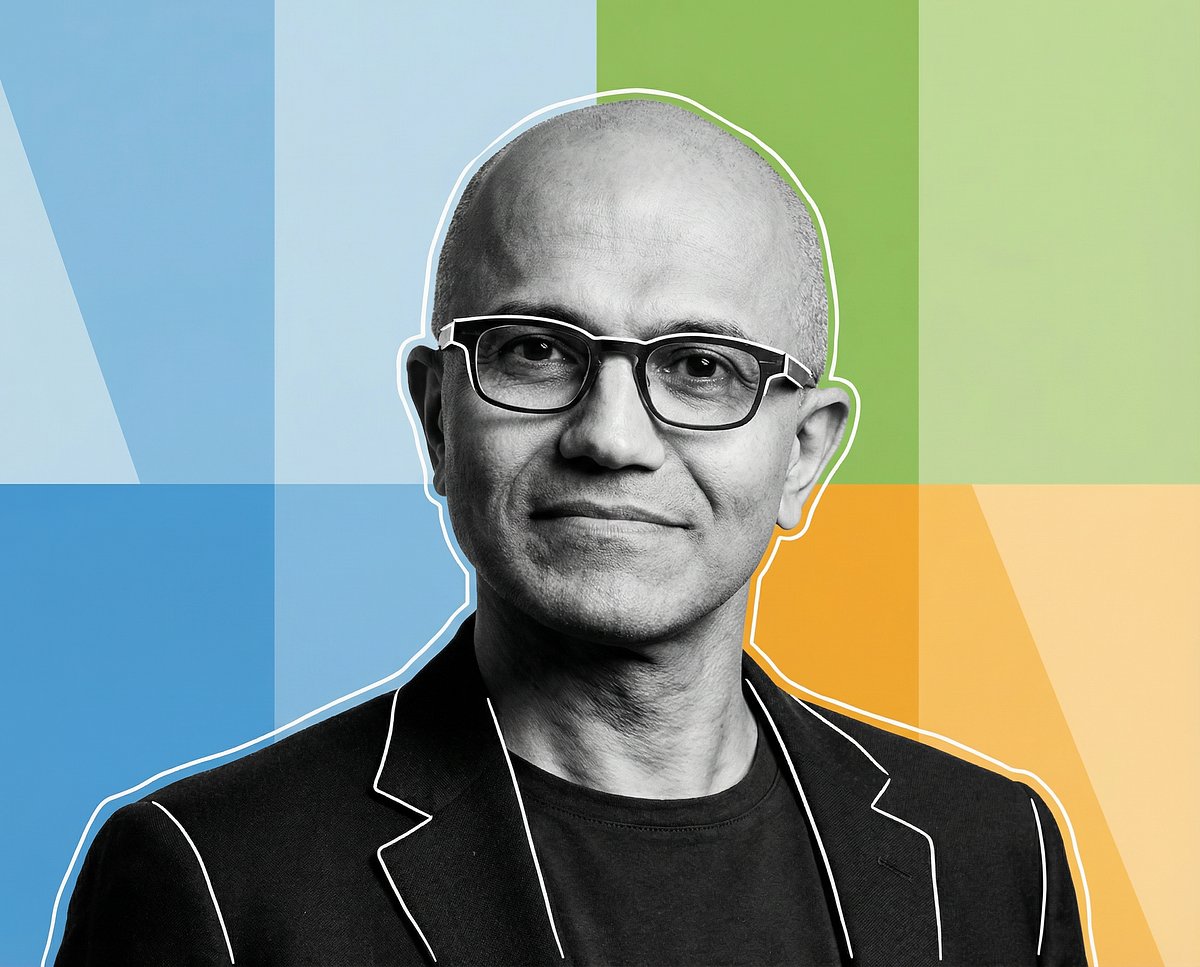
And here's the thing: he was genuinely impressive. Nadella is, by any reasonable measure, one of the most skilled corporate communicators of his generation. He transformed Microsoft's image from the aggressive monopolist of the Ballmer years into something approaching a beloved technology partner. He speaks about artificial intelligence with the reverence of a convert and the precision of an engineer.
But watching the interview, I kept thinking about the receipts. The actual, verifiable data points that exist in tension with the narrative. The gap between what Nadella says about Microsoft's AI strategy and what Microsoft actually does.
The Performance of Certainty
Nadella's Davos performance followed a familiar pattern for tech CEOs at global forums. He spoke about AI's potential to "democratise intelligence" and create "unprecedented opportunity." He positioned Microsoft as a responsible steward, investing billions in safety research and ethical guardrails. He acknowledged concerns about job displacement while pivoting to the promise of new roles and productivity gains.
It's a masterclass in strategic ambiguity. Every statement contains a kernel of truth wrapped in layers of interpretation. When he says Microsoft is "democratising AI," he's technically correct that Azure AI services are accessible to developers. But he doesn't mention the concentration of power in the hands of a few cloud providers. He doesn't discuss how "democratisation" often means making powerful tools available while keeping the underlying models and data proprietary.
The same applies to "unprecedented investment." Microsoft has indeed committed billions to AI infrastructure. But what does that investment actually buy? The company's recent financial reports show that while capital expenditures have skyrocketed, the return on investment remains unclear. The AI revenue figures Microsoft reports often bundle traditional cloud services with AI offerings, making it difficult to isolate the true impact.
The Receipts: What Actually Happens
Let's look at some concrete examples that contradict the smooth narrative.
Copilot Reality Check: Microsoft has been aggressively pushing Copilot across its product suite. The marketing promises a "AI companion" that helps with everything from coding to document creation. But user feedback tells a different story. GitHub Copilot, while genuinely useful for boilerplate code, often produces incorrect suggestions that junior developers accept without review. The "democratisation" of coding assistance has, in some cases, led to a generation of developers who can write code but can't debug it.
OpenAI Partnership Complexity: Nadella frequently praises Microsoft's partnership with OpenAI as a model of responsible AI development. The reality is more complicated. Microsoft's $13 billion investment gives them significant influence over OpenAI's direction, but not complete control. When OpenAI's board briefly ousted Sam Altman in late 2023, Microsoft's response revealed the limits of their partnership. They had to scramble to protect their investment, ultimately supporting Altman's return despite governance concerns.
Azure AI's Actual Usage: Microsoft reports that Azure AI services are used by "millions of customers." But what does that mean? Many of these customers are using basic cognitive services like speech recognition or image analysis—technologies that have been around for years and represent a small fraction of Microsoft's AI investment. The cutting-edge models, like GPT-4, remain largely inaccessible to most users due to cost and complexity.
Safety vs. Speed: Nadella emphasizes Microsoft's commitment to AI safety. Yet the company's product release schedule tells a different story. Features are rolled out rapidly, often with minimal testing. The "responsible AI" framework exists, but its implementation appears inconsistent. When Bing Chat launched with bizarre and sometimes disturbing responses, it revealed how safety considerations can take a backseat to competitive pressure.
The Counter-Narrative: What Critics Say
The tech community's response to Nadella's Davos performance reveals a growing skepticism about corporate AI narratives.
The Scale Skeptics: Researchers like Dr. Emily Bender and Timnit Gebru have consistently argued that the "democratisation" narrative obscures fundamental limitations of large language models. They point out that these systems don't truly understand language but pattern-match at scale. When Nadella talks about AI "understanding" or "reasoning," he's using terms that researchers consider misleading.
The Environmental Cost: While Nadella mentions sustainability in passing, the environmental impact of Microsoft's AI infrastructure is staggering. Training a single large model can consume as much electricity as a small town for a year. Microsoft's commitment to carbon negativity by 2030 becomes harder to reconcile with its aggressive AI expansion. The company's own sustainability reports show that cloud and AI services are driving up emissions despite efficiency improvements.
The Labor Impact Reality: The "new jobs" narrative doesn't match the data. Studies from MIT and other institutions suggest that AI automation is already displacing certain types of work faster than new roles are being created. Microsoft's own research division has published papers acknowledging this tension, yet the public messaging remains optimistic.
The Concentration of Power: Perhaps the most significant critique is that Microsoft's "democratisation" actually concentrates power. By making AI tools available through Azure, Microsoft becomes the gatekeeper. Developers and companies must build their applications on Microsoft's infrastructure, using Microsoft's APIs, subject to Microsoft's terms of service. This isn't democratisation—it's platform capture.
The Technical Reality Behind the Rhetoric
Let's examine what "democratising AI" actually means from a technical perspective.
When Microsoft makes GPT-4 available through Azure OpenAI Service, they're providing an API to a model that costs millions to train. The "democratisation" is limited to the ability to call an API. The underlying architecture, training data, and model weights remain proprietary. This is like saying you've democratised electricity by allowing people to flip switches, while keeping the power plants and grid under exclusive control.
The real democratisation would involve open-sourcing models, sharing training methodologies, and making compute resources accessible. Microsoft has taken some steps in this direction with initiatives like the OpenAI partnership and Azure AI Studio, but the core models remain closed. The company's recent release of smaller models like Phi-2 shows some movement toward openness, but these are significantly less capable than their flagship offerings.
The Investment Reality Check
Nadella's "unprecedented investment" claim deserves scrutiny. Microsoft's capital expenditures have indeed increased dramatically, from $20 billion in 2020 to over $50 billion in 2024. But where is this money going?
A significant portion goes to data center construction and GPU procurement. These are necessary but not sufficient for AI leadership. The real competitive advantage comes from algorithmic innovation, talent, and data—areas where Microsoft's spending is less visible.
Moreover, the investment narrative often conflates spending with results. Building data centers doesn't guarantee better AI products. It just guarantees higher infrastructure costs. The question is whether this spending translates to sustainable competitive advantage or just follows the industry's capital-intensive arms race.
The Partnership Paradox
Microsoft's relationship with OpenAI exemplifies the complexity of modern tech partnerships. On paper, it's a perfect symbiosis: Microsoft provides capital and cloud infrastructure; OpenAI provides cutting-edge models. In practice, it's a tense negotiation.
Microsoft needs OpenAI's models to stay competitive with Google and Meta. OpenAI needs Microsoft's capital and distribution. But both have diverging interests. OpenAI wants to maintain independence and pursue its mission. Microsoft wants to integrate AI deeply into its products and capture enterprise value.
This tension became visible during the Altman ouster. Microsoft's swift move to hire Altman and his team suggested they were prepared to bypass OpenAI entirely. The eventual reconciliation left both parties in an uneasy alliance. Nadella's public praise for the partnership masks these underlying tensions.
The Safety Theater
Perhaps the most concerning aspect is how safety discussions serve as both genuine concern and strategic positioning. When Nadella talks about "responsible AI," he's responding to real regulatory pressure and public concern. But the implementation often feels performative.
Microsoft's Responsible AI Standard, published in 2023, outlines principles like fairness, reliability, and transparency. But the standard is voluntary and self-policed. There's no independent oversight. When conflicts arise between safety and speed-to-market, speed usually wins.
The recent controversy over Microsoft's AI-generated images that produced historically inaccurate depictions of diverse historical figures revealed the limits of their safety systems. The company had to pull the feature and issue apologies. This pattern—release, controversy, apology, fix—suggests safety is reactive rather than proactive.
The Broader Pattern
Nadella's Davos performance isn't unique. It's part of a broader pattern in tech leadership communication. CEOs at global forums use similar language, make similar promises, and face similar scrutiny.
What makes Nadella's performance notable is its polish. He's not just repeating talking points; he's embodying a vision that many in the tech community want to believe. The vision of responsible, democratic, beneficial AI is compelling. It's also, in many ways, aspirational rather than descriptive.
The Path Forward
So where does this leave us? The gap between Nadella's rhetoric and Microsoft's operational reality doesn't necessarily mean the company is acting in bad faith. It may simply reflect the inherent tension between corporate communication and technical complexity.
AI development is genuinely difficult. The technology is evolving rapidly. The social and economic implications are uncertain. In this environment, corporate leaders must communicate with some level of optimism and certainty, even when the reality is messy and uncertain.
But for developers, researchers, and users, it's important to maintain critical perspective. The promises made at Davos should be evaluated against actual product experiences, technical capabilities, and independent research.
Microsoft's AI work is substantial and often impressive. The company is investing heavily and building real products. But the "democratisation" narrative oversimplifies a complex reality. The "unprecedented investment" claim deserves scrutiny. The "responsible AI" framework needs independent verification.
The receipts are there for anyone willing to look beyond the polished performance. The question is whether the tech community will continue to accept the narrative or demand more transparency about the gap between promise and practice.
Nadella's Davos performance was, indeed, a masterclass. But in what? In corporate communication, certainly. In strategic ambiguity, absolutely. In maintaining investor confidence while navigating genuine technical and ethical challenges, perhaps. But whether it represents a masterclass in actual AI leadership remains an open question—one that the receipts suggest we should approach with healthy skepticism rather than uncritical admiration.
Comments
Please log in or register to join the discussion