InfoQ's latest eMag explores the critical security challenges facing AI in production, from data poisoning to shadow AI governance, providing essential guidance for building resilient systems.
AI has officially shifted from experimentation to production, outpacing legacy defenses and creating a volatile new security landscape. This challenge is defined by three critical frontiers: data poisoning, AI-driven phishing, and shadow cloud governance. While each threat requires a unique technical response, they collectively define the new standard for responsible AI deployment.
This eMag provides your roadmap for the machine age, exploring how to move from vulnerable prototypes to resilient systems through layered defense, robust MLOps, and integrated governance.
The Evolution of AI Threats
Traditional security controls are no longer sufficient in an era where attackers leverage the same sophisticated AI tools as defenders. The threat landscape has fundamentally changed, requiring organizations to assume that adversaries are using advanced AI capabilities to scale their attacks.
AI-Driven Phishing: The Automation Revolution
Marco Rizzi's article "Artificial Intelligence-Driven Phishing: How Phishing Technique Is Evolving and Implemented" reveals how AI has transformed phishing from manual tasks into high-velocity threats. By automating reconnaissance, generating realistic deepfakes, and optimizing delivery, AI enables even low-skilled actors to execute sophisticated social engineering attacks.
The implications are profound: modern defense strategies must now mirror these layered AI tactics to counter automated, personalized attacks. Static signature-based detection is obsolete when phishing emails can be generated on-the-fly with perfect grammar and context-aware content.
Data Poisoning: The Silent Corruption
Igor Maljkovic's "Understanding ML Model Poisoning: How It Happens and How to Detect It" warns of the growing threat of training data manipulation. Subtle changes to training datasets can cause models to misbehave in unpredictable ways, creating vulnerabilities that may not manifest until critical moments.
Real-world incidents demonstrate the severity of this threat. The corruption of Microsoft's Tay chatbot showed how quickly models can be manipulated through poisoned inputs. In medical diagnostic systems, poisoned data could lead to false diagnoses with life-threatening consequences.
The article emphasizes that securing data integrity from ingestion to inference is critical for long-term accuracy and safety. Organizations must implement robust data validation, provenance tracking, and anomaly detection throughout the ML pipeline.
Shadow AI and Cloud Governance
Dave Ward's "Governing AI in the Cloud: A Practical Guide for Architects" addresses the dangerous expansion of organizational attack surfaces through "Shadow AI" and unregulated API calls. When teams deploy AI services without proper oversight, they create blind spots that attackers can exploit.
To regain control, governance must be integrated into the delivery pipeline using model registries, automated security scanning, and unified observability dashboards. This proactive approach ensures that AI deployments remain visible and controllable throughout their lifecycle.
Building Trust in Regulated Industries
Stefania Chaplin and Azhir Mahmood's "Building Trust in AI: Security and Risks in Highly Regulated Industries" demonstrates that implementing robust MLOps practices for secure, scalable model management is just the beginning. Organizations must develop comprehensive responsible AI frameworks that prioritize fairness, transparency, ethical practices, and compliance with evolving regulations like GDPR and the EU AI Act.
This holistic approach to AI security recognizes that technical controls alone cannot address the full spectrum of risks. Ethical considerations, bias mitigation, and regulatory compliance are integral to building trustworthy AI systems.
Expert Perspectives on AI Security Evolution
The virtual panel "Security in the Machine Age: Expert Insights on AI Threat Evolution," moderated by Claudio Masolo, brings together perspectives from Elham Arshad, Sabri Allani, Vijay Dilwale, and Igor Maljkovic. The panelists underscore the need for security engineers to evolve alongside AI's emergent behaviors.
Their recommendations include specialized monitoring for AI-specific threats, novel forensic methodologies for investigating AI incidents, and adaptive response frameworks to manage unpredictable threats. The consensus is clear: traditional security approaches must be augmented with AI-aware strategies.
The Path Forward: Integrated Security and Governance
Securing AI requires rethinking security as a total lifecycle responsibility. This means protecting data integrity from ingestion to inference and baking governance into development pipelines. By aligning people, processes, and technology, organizations can ensure their AI is not only performant but secure, transparent, and ready for the machine age.
The eMag emphasizes that AI security is not a one-time implementation but an ongoing commitment to building resilient systems. As AI continues to evolve and integrate into critical infrastructure, the importance of comprehensive security frameworks will only increase.
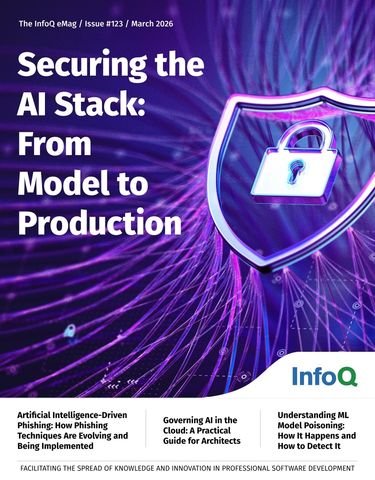
For organizations looking to navigate this complex landscape, the eMag provides actionable guidance across multiple dimensions of AI security. From technical controls to governance frameworks, the content offers a roadmap for building AI systems that can withstand the sophisticated threats of the machine age.
Free download available at InfoQ
This content is in the DevOps topic FOLLOW TOPIC
Related Topics: DEVOPS, AI, ML & DATA ENGINEERING, ARTIFICIAL INTELLIGENCE, SECURITY
We'd love to hear which perspectives resonated with you and what you're learning. Reach out at [email protected] or on LinkedIn, Bluesky or X.
Comments
Please log in or register to join the discussion