
As the new year unfolds, many designers find themselves reflecting on their professional trajectory. Moving beyond reactive career management requires deliberate tools for self-assessment and strategic planning. This article explores practical frameworks for evaluating your skills, understanding career levels in specialized roles like design systems, and proactively shaping a role that aligns with your strengths and business needs.
The start of a new year often brings a natural moment for reflection. For many designers, this introspection quickly turns toward career trajectory—a topic that dominates conversations with colleagues and mentors. Yet, too often, career growth happens reactively. We respond to opportunities as they arise, floating between projects and making things work as we go along, rather than actively designing the life we want to lead.
Moving from a reactive to a proactive approach requires structure. It demands tools that help us understand where we stand, what we want to leave behind, and where we want to grow. As we look toward 2026, the landscape of UX design continues to evolve, demanding new skills and deeper strategic thinking. This article explores a collection of powerful frameworks and self-assessment tools to help you shape your career path with intention.
Run a Retrospective for Last Year
Before you can chart a course forward, you need a clear understanding of your starting point. One of the most effective ways to ground yourself is by running a thorough annual retrospective. This isn't just about listing achievements; it's about understanding the emotional and professional texture of the past year.
A structured retrospective involves sitting down with paper and pencil (or a digital equivalent) and honestly evaluating:
- Successes and mistakes: What worked, and what didn't?
- Highs and lows: What moments brought joy, and what caused stress?
- Energy drains vs. energizers: Which tasks or projects left you feeling depleted, and which made you feel alive?
From this reflection, a set of guiding questions can help distill insights into actionable priorities:
- What did I find most rewarding and fulfilling last year?
- What fears and concerns slowed me down the most?
- What could I leave behind, give away, or simplify?
- What tasks would be good to delegate or automate?
- What are my three priorities for growth this upcoming year?
- What times will I block in my calendar to protect those priorities?
This exercise, while simple, sets the foundation for the changes you want to introduce. It transforms vague aspirations into concrete plans, giving you a trajectory to design and prioritize for the year ahead.
UX Skills Self-Assessment Matrix
Once you've reflected on the past, the next step is to map your current skills against your aspirations. The UX Skills Self-Assessment Matrix by Maigen Thomas is a Figma template designed to provide exactly this clarity.
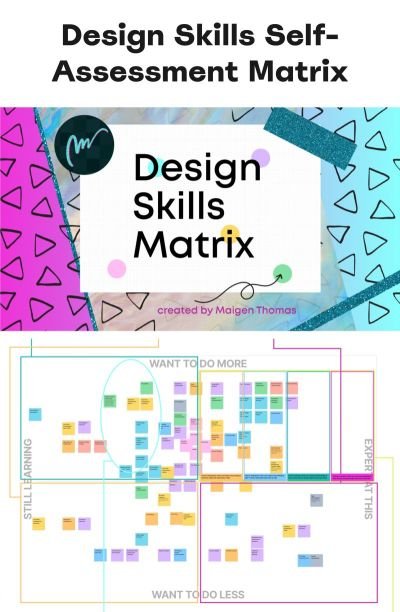
This tool helps you visualize where you stand across a range of UX competencies. It allows you to identify:
- Skills you want to do more of: Areas where you feel energized and want to deepen your expertise.
- Skills you want to do less of: Tasks that might be necessary but don't align with your long-term goals or passions.
- Your learning curve: Where you feel less confident and need development.
- Areas of expertise: Where you already excel.
The exercise typically takes 20-30 minutes. The goal is to identify the "sweet spot"—often the upper half of the canvas—where your confidence and interest intersect. It serves as a reality check, highlighting gaps between your current role and your desired growth path. Reviewing this matrix year after year provides a tangible record of your professional evolution.
Understanding Career Levels in Specialized Roles
Career progression isn't always linear, and it certainly doesn't always lead to management. For those interested in specialized tracks, understanding the specific expectations and skill requirements is crucial.
Javier Cuello's Career Levels For Design System Teams is a Figma kit that maps progression levels—from Junior to Staff—to key development areas. This tool is invaluable for product designers looking to transition into design systems or for managers building a career matrix for their teams.
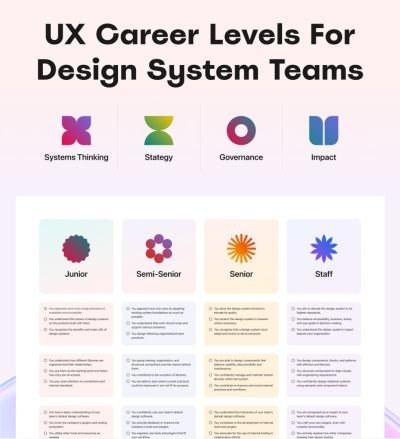
What makes this model particularly valuable is its emphasis on strategy and impact, alongside systematic thinking and governance. While designers often excel at tactical work—crafting elegant UI components, organizing Figma files—seniority increasingly depends on strategic thinking.
The shift from tactical to strategic involves:
- Proactively identifying organizational challenges that a design system can solve.
- Engaging key stakeholders early to ensure buy-in and adoption.
- Embedding within other teams to understand their needs and constraints.
- Anticipating failure points and creating safeguards to prevent them.
- Managing UX debt by creating viable plans to address technical and design debt while shipping on tight deadlines.
This framework helps designers visualize what growth looks like beyond just "senior" or "lead" titles, providing a roadmap for impact at higher levels of seniority.
Finding Your Product Design Career Path
A common assumption is that career progression inevitably leads to management. However, this path isn't ideal for everyone. Some designers thrive on diving deep into complex UX challenges and perfecting intricate flows. The challenge arises when you hit a ceiling in your organization, leaving little room for further exploration or growth.
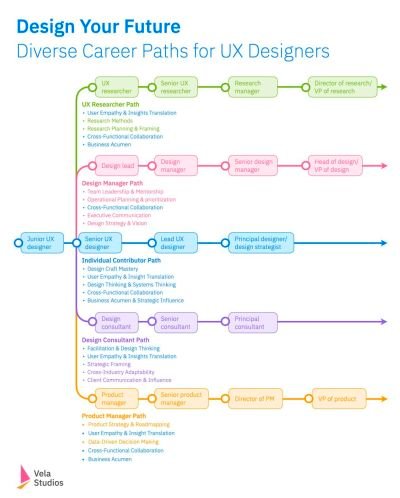
Ryan Ford's Mirror Model offers a helpful way to visualize alternative paths. It maps creative and managerial tracks side-by-side, showing that both can offer equivalent influence and compensation. This model encourages designers to advocate for roles that align with their strengths, rather than defaulting to a management track.
Before considering a company change, explore internal opportunities:
- Switch teams to work on different products or challenges.
- Shape a more fulfilling role by identifying unmet needs within the organization.
The key is to find the right spot where your expertise can shine and make the biggest impact.
Proactively Shaping Your Role
Jason Mesut's observation on career ladders highlights a limitation: they often assume only vertical progression (up, down, or out). In reality, careers can move sideways, offering fresh perspectives and new challenges.
Promoting only vertical progression feels restrictive, especially in a diverse field like UX. Instead of just climbing, consider moving sideways to explore new interests. Focus on the intersection between:
- Business needs and user needs
- Problem space and solution space
- Strategic decisions and operations
Zoom out to see the bigger picture, then zoom in to find where you can make a tangible difference. Sometimes, you don't need to climb a ladder—you need to find the right spot.
Lily Yue's Career Decision Map for UX Designers is another excellent tool for visualizing these paths. It helps you identify gaps in the organization that you could fill, such as:
- Acting as a "translator" between design and engineering.
- Specializing in UX and accessibility.
- Automating design processes with AI.
- Improving workflow efficiency.
- Focusing on internal search UX or legacy systems.
These roles are rarely advertised but can have a tremendous impact. If you spot such a gap, proactively bring it to senior management. You might be able to shape a role that amplifies your strengths rather than forcing you to fit into a predefined box.
The Role of AI in Design Careers
As we look to 2026, AI is an undeniable force shaping the industry. However, the rise of AI doesn't signal the end of design roles—it signals a shift in what we value.

Sharang Sharma's overview of Design Patterns For AI Interfaces highlights the need for designers who can create experiences that users understand, value, and trust. The point isn't to replace design work with AI automation. Instead, it's about using AI to amplify the need for:
- Authenticity: Creating genuine human connections.
- Curation: Sifting through noise to deliver value.
- Critical thinking: Evaluating AI outputs and ensuring ethical design.
- Strategy: Aligning AI capabilities with human needs.
AI cannot create clarity, structure, or care out of poor content or weak value propositions. Designers who understand the fundamentals of good design and keep humans at the center will be indispensable. They will bridge the gap between what AI can do and what users actually need.
Wrapping Up: Clarity is Power
The tools and frameworks discussed here—retrospectives, self-assessment matrices, career level maps, and decision trees—share a common goal: clarity.
They help you understand where you stand and where you want to grow. They serve as conversation starters with your manager or mentors, guiding you toward a path that excites you.
Most importantly, remember that your career is yours to design. Refine your role to amplify your strengths. Don't just try to fit into a predefined position. You bring unique value to your team and company. Sometimes, all it takes is the right framework to highlight that value and guide it to the right spot.
Happy 2026.
Useful Resources
- UX Skills Self-Assessment Matrix (Figma template), by Maigen Thomas
- Product Designer’s Career Levels Paths + PNG, by Ryan Ford
- Career Decision Map For UX Designers (PNG), by Lily Yue
- Diverse Career Paths For UX Designers (PNG), by Lily Yue
- Shaping Designers and Design Teams, by Jason Mesut
- UX Skills Self-Assessment Map template (Miro), by Paóla Quintero
- UX Skill Mapping Template (Google Sheets), by Rachel Krause, NN/g
- Design Team’s Growth Matrix, by Shannon E. Thomas
- Figma Product Design & Writing Career Levels, by Figma
- Content Design Role Frameworks, by Tempo
- UX Research Career Framework, by Nikki Anderson
- UX Career Ladders (free eBook), by Christopher Nguyen
- Product Design Level Expectations, by Aaron James (yk)
Comments
Please log in or register to join the discussion