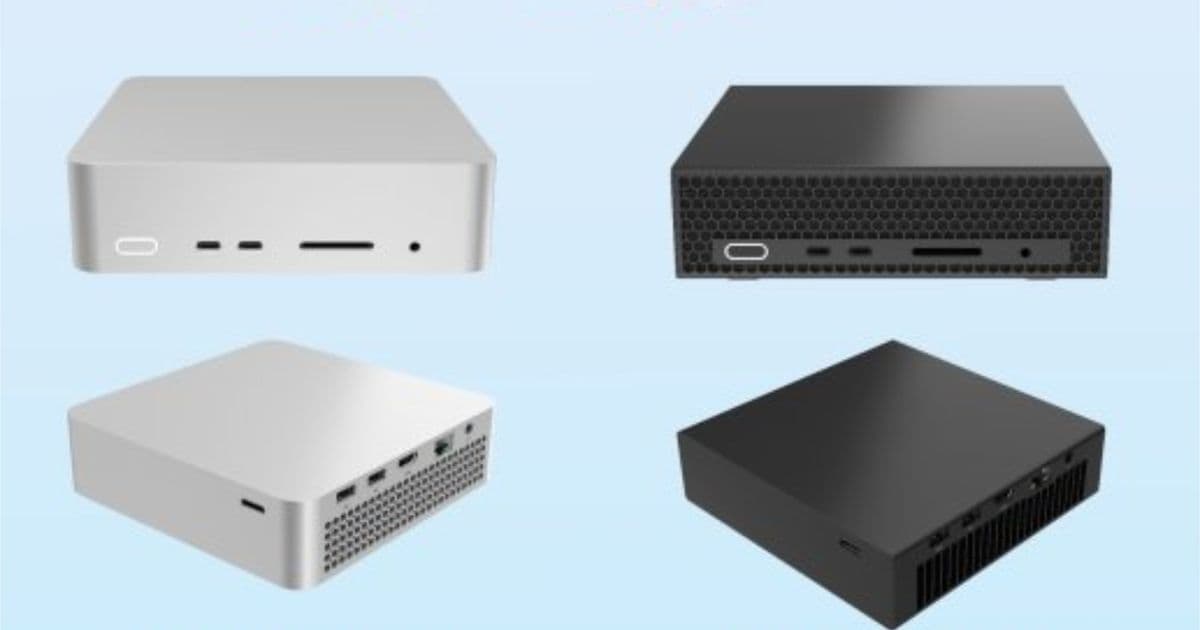
A new mini-PC challenger enters the Strix Halo arena with a remarkably compact design that undercuts the GMKtec EVO-X2 in size while promising full 120W APU power delivery.
What's New
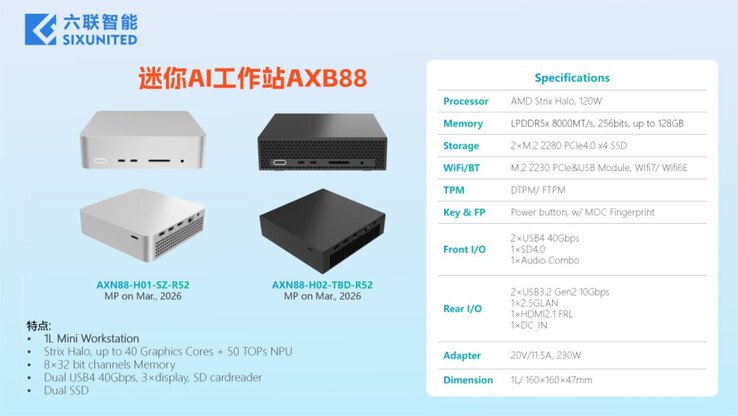
Sixunited has unveiled the Mini AI Workstation AXB88, a compact desktop powered by AMD's Strix Halo architecture that measures just 160 x 160 x 47 mm. This creates a 1.2-liter case volume that significantly smaller than competing Strix Halo systems like the GMKtec EVO-X2. Despite the tiny footprint, Sixunited claims the system can deliver a full 120W TDP to its APU, supported by a 230W external power supply.
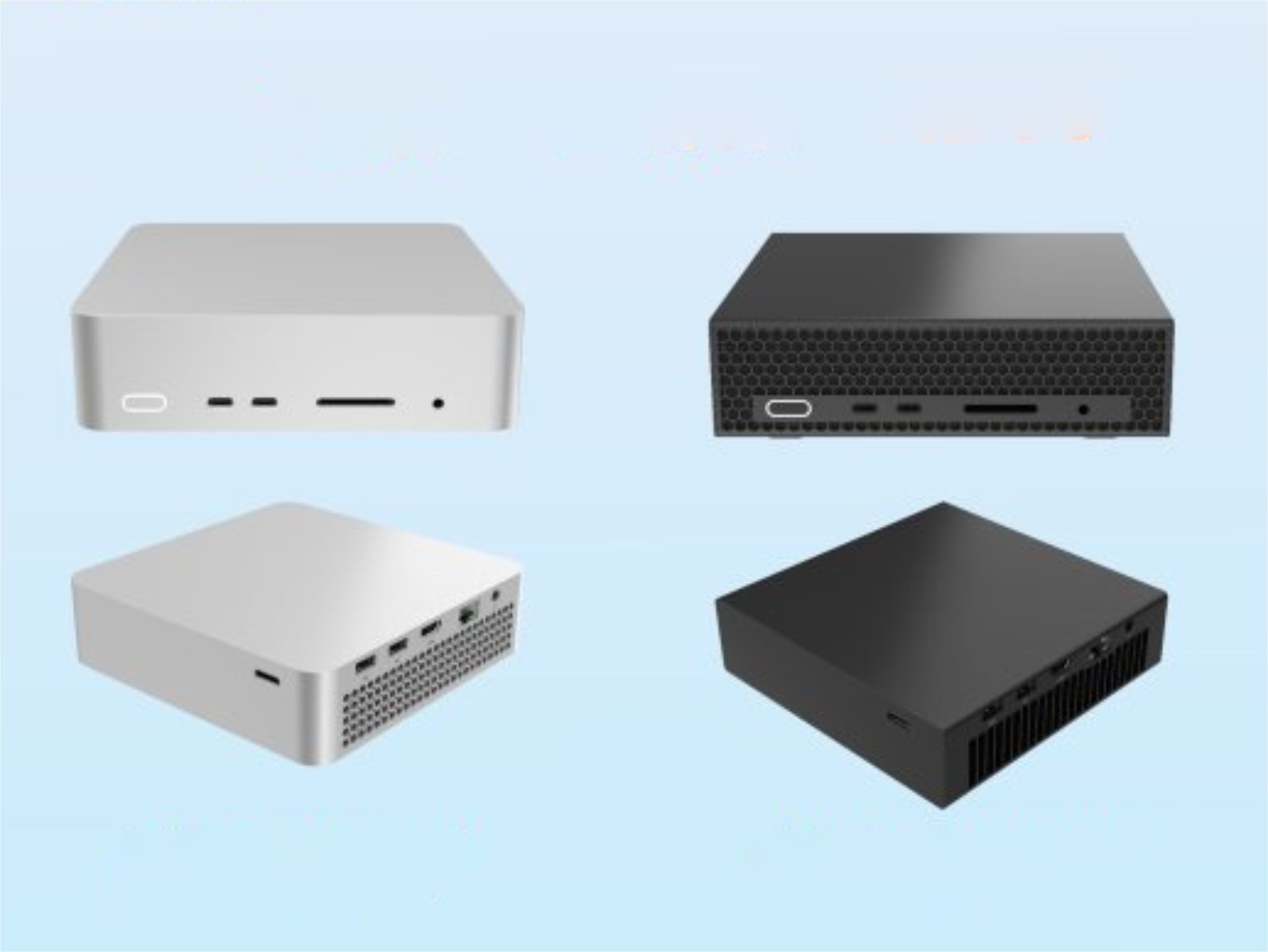
The company previously introduced other Strix Halo devices including the AXA33 all-in-one with up to 128GB RAM and 4K OLED display, and the AXP77 tablet competitor. The AXB88 represents their entry into the ultra-compact mini-PC segment, targeting users who need substantial AI and compute power without the traditional desktop footprint.
Connectivity includes dual USB4 ports and M.2 2280 slots supporting PCIe 4.0 x4 SSDs. The system comes in two finish options, though Sixunited hasn't specified whether these are color variations or material differences.
How It Compares
The Strix Halo mini-PC market is heating up with several manufacturers adopting AMD's powerful mobile APU for desktop applications. The GMKtec EVO-X2 currently leads this segment with a 2-liter chassis, making the AXB88's 1.2-liter volume roughly 40% smaller. This size advantage could be crucial for users deploying multiple units in cluster configurations or those with severe space constraints.
However, the GMKtec EVO-X2 has established itself with proven thermal solutions and availability. The EVO-X2 also utilizes the same 120W TDP envelope, suggesting both systems should deliver similar compute performance assuming thermal headroom allows sustained boost clocks. The key question will be whether Sixunited's smaller chassis can maintain thermal stability under sustained loads without excessive fan noise or throttling.
Power delivery is another critical comparison point. Both systems require substantial external power bricks (230W for the AXB88), which limits portability but ensures the APU receives adequate power. The dual USB4 implementation matches what competitors offer, providing 40Gbps data transfer and display output capabilities.
Storage flexibility appears comparable with M.2 2280 PCIe 4.0 support, though the AXB88's compact layout may impose limitations on cooling solutions for high-performance SSDs that run hot under sustained workloads.
Who It's For
The AXB88 targets several distinct user groups who prioritize space efficiency without sacrificing compute capability. AI developers and researchers working with local models will benefit from the Strix Halo's integrated NPU and GPU cores, combined with the ability to stack multiple units for distributed processing. The tiny footprint makes it practical to deploy several AXB88s in a home lab or small office environment.
Creative professionals running local AI-assisted workflows—such as Stable Diffusion, local LLM inference, or video processing—gain a capable workstation that fits on a crowded desk or behind a monitor. The 120W TDP envelope suggests sustained performance for batch processing tasks, though thermal constraints in the small chassis remain an unknown.
Home server enthusiasts seeking efficient compute nodes for virtualization or containerized applications will appreciate the combination of low power consumption and compact size. The USB4 ports enable high-speed external storage arrays or 10GbE networking via adapters.
Users upgrading from older mini-PCs based on previous AMD architectures (like Ryzen 5000/6000 series) will see substantial performance gains, particularly in AI workloads where the Strix Halo's NPU provides dedicated acceleration. The ability to configure up to 128GB RAM in similar Sixunited products suggests the AXB88 may support high memory configurations, crucial for running large language models locally.
Availability and Considerations
Sixunited plans to begin mass production in March 2026, though international pricing and availability remain unannounced. The company has shown working prototypes, but final specifications and retail channels are still pending. Potential buyers should watch for thermal performance reviews, as the 1.2-liter volume presents engineering challenges for dissipating 120W of continuous heat load.
The Strix Halo architecture itself brings significant advantages: integrated RDNA 3.5 graphics capable of gaming and content creation, dedicated NPU for AI acceleration, and up to 16 CPU cores. However, the platform's success in mini-PC form factors depends heavily on each manufacturer's thermal engineering. The AXB88's ultimate performance will be determined by whether Sixunited can maintain sustained boost clocks or if the system will need to reduce power under extended loads.
For users comparing options, the AXB88 represents an interesting alternative if size is the primary constraint. Those needing maximum sustained performance may prefer larger chassis with better thermal headroom, while users prioritizing minimal desk footprint should monitor the AXB88's real-world thermal and acoustic performance once units ship.
Sixunited's track record with previous Strix Halo devices suggests they understand the platform's requirements, but the AXB88's extreme miniaturization will be the true test of their engineering capabilities. International availability through retailers like Amazon would significantly impact the competitive landscape against established players like GMKtec.
Comments
Please log in or register to join the discussion