Beyond technical skills, social capital—forged through trust, credibility, and relationships—is the hidden engine that transforms high-agency engineers into organizational forces. This article reveals how consistent, small investments in social currency unlock career-defining influence and resilience, especially in remote work environments, with practical habits to build and leverage it effectively.
Friday afternoon. Production is down. An obscure backend component fails, threatening service reliability. No formal owner exists, but you recall mentoring Oliver months ago during a security patch upgrade for that very system. You ping him—he’s packing for the weekend but responds instantly, spotting the flaw and deploying a fix in minutes. This isn’t luck; it’s social capital in action: the accumulated trust and goodwill that turns past generosity into critical, high-stakes support no process could replicate.
The Invisible Currency of Engineering Success
Social capital is the bedrock of influence in tech careers, defined by three interlocking pillars:
- Trust: Built by keeping commitments, admitting mistakes, and surfacing risks early. As Tanya Reilly emphasizes in The Staff Engineer’s Path, "Colleagues back engineers they can count on."
- Credibility: Earned through consistent execution, data-driven communication, and continuous learning. It transforms you into a sought-after voice in technical decisions.
- Relationships: Cultivated by investing in people—mentoring peers, celebrating wins, and offering help without transactional expectations. These bonds become conduits for unblocking work and amplifying impact.
Like compound interest, small, regular deposits—such as quick PR reviews or public recognition—grow into a reserve that fuels career-defining moments, from securing headcount to driving risky migrations. Ignore one pillar, and your influence erodes; master all three, and you unlock exponential growth.
From Lone Wolf to Org-Changing Force
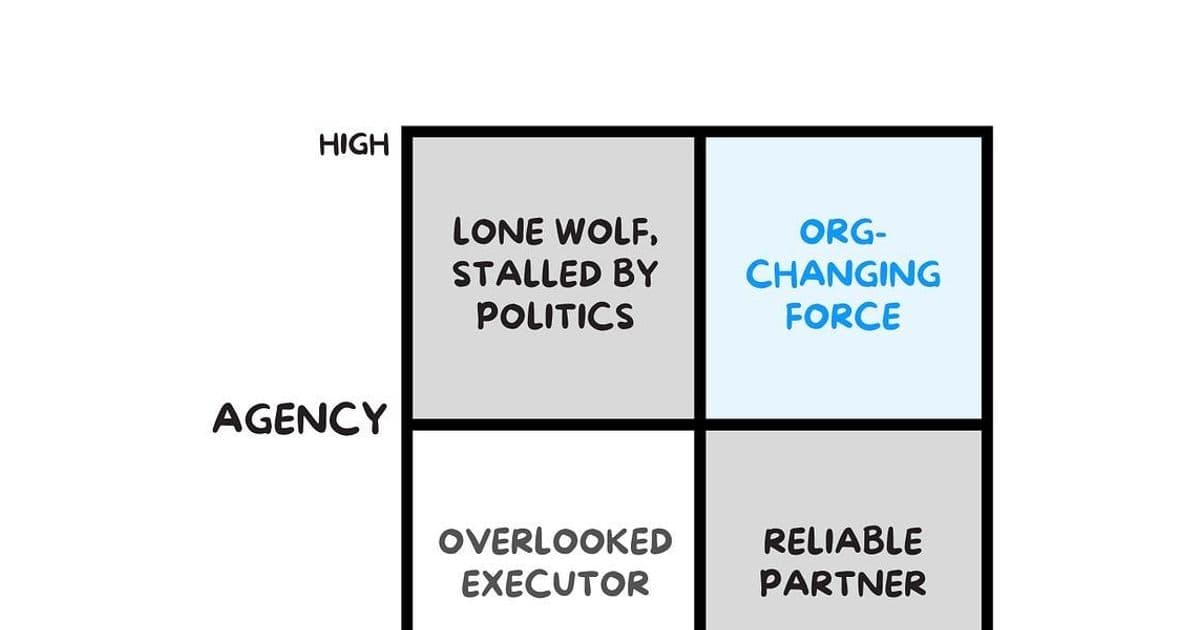
High-agency engineers thrive on initiative and ownership, but without social capital, they hit a "lone genius ceiling." The intersection of agency and social capital determines career trajectory:
Low agency + Low social capital → Overlooked Executor
High agency + Low social capital → Lone Wolf (stalled by politics)
Low agency + High social capital → Reliable Partner
High agency + High social capital → Org-Changing Force
Operating in the top-right quadrant multiplies impact. For example, senior engineers broker cross-departmental alliances, while managers act as "social routers" linking networks to accelerate team outcomes. In remote settings, intentionality replaces hallway chats: weekly virtual coffees, Loom explainers, or Friday gratitude messages bridge distances and scale context.
Practical Habits for Sustaining Your Social Balance
Social capital requires active management—spend it on high-leverage opportunities (e.g., shielding teams during crunch time) and replenish it to avoid burnout. Key signs of depletion include delayed replies or hesitant support. Embed these micro-habits into your weekly routine:
- Monday: Post a win recap (builds trust/credibility)
- Tuesday: Review a PR outside your team (strengthens relationships)
- Wednesday: Schedule a virtual coffee (expands networks)
- Thursday: Share a documented learning (boosts credibility)
- Friday: Publicly thank a collaborator (reinforces trust)
Remote work demands deliberate effort, but these actions democratize access to influence, contrasting sharply with exclusionary favoritism. As careers advance, social capital evolves—juniors focus on visibility, mid-level engineers widen their sphere, and leaders sponsor talent to steer organizational currents.
Social capital isn’t about politics; it’s the scaffold that elevates agency from solo effort to systemic change. Start small: thank a colleague, share a insight, or mentor a peer. These deposits compound silently until, like Oliver’s Friday fix, they materialize as the support that defines your legacy.
Source: Rafa Páez, The Engineering Leader. Original article: Social Capital: The Compound Interest of Your Engineering Career
Comments
Please log in or register to join the discussion