
A new architectural paradigm is emerging where specifications evolve from static documentation into the executable backbone of software systems. By inverting the traditional relationship between code and design, Spec Driven Development (SDD) represents a fifth-generation shift in abstraction, enabling continuous validation and drift detection that transforms architecture into a self-enforcing runtime invariant.

Featured image: The evolution toward executable specifications represents a fundamental shift in how we architect software systems.
Every major shift in software engineering history has been driven by the relentless rise of abstraction. From raw machine code to assembly, from procedural languages to object-oriented paradigms, each generation has pushed developers further from implementation details and closer to intent. We're now witnessing the emergence of what may be the fifth generation of this evolution: Spec Driven Development (SDD), where architecture becomes not just executable but self-enforcing.
This isn't incremental improvement to existing practices. SDD represents a structural inversion of how software systems are governed. Instead of code defining behavior and documentation drifting into obsolescence, specifications become the authoritative source of truth, and implementations are continuously generated, validated, and regenerated to conform to that truth.
The Architectural Inversion
Traditional software delivery follows a linear, lossy pipeline: requirements become design documents, which become code, which becomes tests, which becomes deployed artifacts. Each translation step introduces reinterpretation, manual adaptation, and hidden assumptions. Architectural drift isn't prevented—it's discovered late, typically through production incidents, failed integrations, or compliance breaches.
SDD fundamentally restructures this flow into a governed control loop where the specification layer defines system behavior, and all downstream artifacts are continuously reconciled against it. This isn't documentation-driven development with better tooling; it's a new architectural pattern that treats specifications as executable programs.
The five-layer execution model reveals how this works:
1. Specification Layer - The authoritative definition of system behavior, capturing declarative intent. This is human-readable and machine-executable, serving simultaneously as design artifact and operational control surface.
2. Generation Layer - A multi-target compiler that transforms declarative intent into executable form across languages, frameworks, and platforms.
3. Artifact Layer - The concrete outputs (services, clients, models) that are treated as regenerable, disposable, and continuously reconcilable.
4. Validation Layer - Continuous enforcement through contract tests, schema validation, payload inspection, and drift detection.
5. Runtime Layer - The operational system, whose shape is entirely constrained by upstream specification and validation.
Drift Detection as Architectural Enforcement
When specifications become authoritative, drift detection transforms from testing convenience to mandatory architectural capability. Drift is any divergence between declared system intent and observed behavior—structural, behavioral, semantic, security-related, or evolutionary.
Consider a practical example. In a traditional system, an API might silently start returning fields not declared in its specification. This drift persists until integration tests fail or production breaks. In an SDD system, specification validators embedded in CI pipelines and runtime enforcement layers detect this immediately. The system fails fast, preventing the drift from propagating.
This enforcement becomes critical in our emerging multi-model future. Software systems will increasingly be shaped by both human-driven development and machine-driven generation, often operating concurrently across the same specification surface. Changes may originate from developers, AI agents, automated refactoring tools, or policy-driven generators. This multiplicity of evolutionary paths amplifies the drift problem: divergence becomes the natural state that must be continuously governed.
The net effect is profound. Architecture shifts from design-time artifact to continuously enforced runtime invariant. Specifications move from passive reference material to active control surfaces.
Human Authority in an Automated Architecture
A common misconception about SDD is that it removes humans from the loop. The reality is more nuanced: it relocates human judgment to a higher control plane.
When we first explored this mode of system design, we approached it with a "vibe coding" mindset—accepting generated changes with minimal resistance and trusting the toolchain to handle edge cases. That assumption failed quickly. What emerged instead was a powerful realization: machines excel at enforcement, but humans remain essential for governance.
SDD shifts the burden of mechanical consistency onto machines while deliberately retaining human authority over:
- Intent and domain semantics - What the system should accomplish
- Risk tolerance and safety envelopes - What trade-offs are acceptable
- Evolutionary direction - Where the system should head
- Legal, ethical, and moral frameworks - What constraints shape engineering decisions
These dimensions cannot be inferred from execution traces or behavioral observation. They exist at a level of abstraction machines cannot fully own. Humans encode these constraints into the Specification Layer, and machines assume responsibility for enforcement and continuous conformance.
This creates a new division of responsibility: enforcement becomes automated, meaning remains human. Breaking schema changes require human approval. Policy shifts require human authorization. AI-proposed refactors require human confirmation.
SDD enables bounded autonomy, not full automation.
Core Capabilities of a Spec-Native System
Moving from theory to operational paradigm requires five tightly coupled architectural capabilities. When any is absent, SDD reverts to documentation-driven development.
1. Spec Authoring as a First-Class Engineering Surface
Specifications must be treated with the same operational rigor as source code: version control, peer review, branching, controlled merge strategies. The specification ceases to be descriptive and becomes a programmable model of the system itself.
This requires multi-model specifications where structural, behavioral, and policy definitions coexist within unified schema space. Composable domain modeling becomes essential so layered specifications become viable architectural strategy rather than documentation convenience.
2. Formal Validation and Type Enforcement
Specifications must be machine-verifiable with compiler-level rigor. This spans structural validation, semantic coherence, and domain-invariant enforcement. Conditional constraints, referential integrity, and cross-spec consistency must be provable.
The effect is elimination of entire classes of system failure from what can be represented at all—similar to how static typing constrains illegal programs.
3. Deterministic Generation and Composition
Generation must be strictly deterministic: identical specifications always yield identical artifacts. It must be target-agnostic, producing consistent outputs across languages, platforms, and runtime environments.
Most critically, generation must be logically reversible. The system must always answer: "Which specification state produced this behavior?" This traceability elevates generation from productivity aid to architectural authority.
4. Continuous Conformance and Drift Enforcement
Once generation is automated, enforcement becomes continuous. Runtime systems cannot diverge quietly from declared intent. Implementations cannot introduce undocumented behavior. Consumers cannot rely on undefined properties.
Architecture transitions from design-time assertion into runtime invariant, actively maintained by the system itself.
5. Governed Evolution and Compatibility Control
The most difficult capability is change without fracture. The system must automatically classify changes as additive, compatible, breaking, or ambiguous, and enforce explicit compatibility policy.
This introduces formal governed evolution: parallel version surfaces, known compatibility windows, controlled deprecation curves, explicit approval gates for breaking changes. Without this, SDD becomes architecturally brittle. With it, the system evolves without violating its own correctness guarantees.
The Real Engineering Trade-offs
Every abstraction leap delivers productivity gains while introducing new systemic risks. SDD is no exception.
Specifications Become a Primary Complexity Surface
In SDD, specifications acquire properties traditionally associated with source code: technical debt, cross-team coupling, compatibility inertia, architectural gravity. Schema engineering becomes a first-class architectural discipline, on par with data modeling and distributed systems design.
Generator Trust Becomes a Supply Chain Problem
AI code generators evolve from developer conveniences to structural components of the trusted computing base. Determinism, reproducibility, auditability, sandboxed execution, and verifiable provenance become mandatory properties, not optional features.
Runtime Enforcement Has Real Cost
Runtime contract validation introduces computational overhead. At small scale, this is negligible. At large scale—in high-frequency APIs, real-time streams, or latency-sensitive systems—it becomes an explicit architectural budget item. Correctness becomes a metered resource.
The Cognitive Shift is Non-Trivial
SDD replaces implementation-first thinking with contract-first reasoning. Engineers must learn to:
- Think in invariants instead of behaviors
- Reason about compatibility rather than features
- Express intent declaratively instead of procedurally
- Treat schemas as executable programs
Every historical abstraction shift expanded human leverage while introducing unfamiliar failure modes that took years to master. SDD is entering the same maturation curve.
The Price of Architectural Authority
SDD delivers architectural determinism, continuous correctness enforcement, systemic drift reduction, multi-language parity, reproducible system boundaries. But it exacts its price in schema complexity, generator trust requirements, runtime validation cost, long-term compatibility burden, and cognitive transformation of engineering roles.
This isn't a reason to avoid SDD. It's a reason to adopt it deliberately, with explicit governance, disciplined specification practice, and sober recognition of its costs.
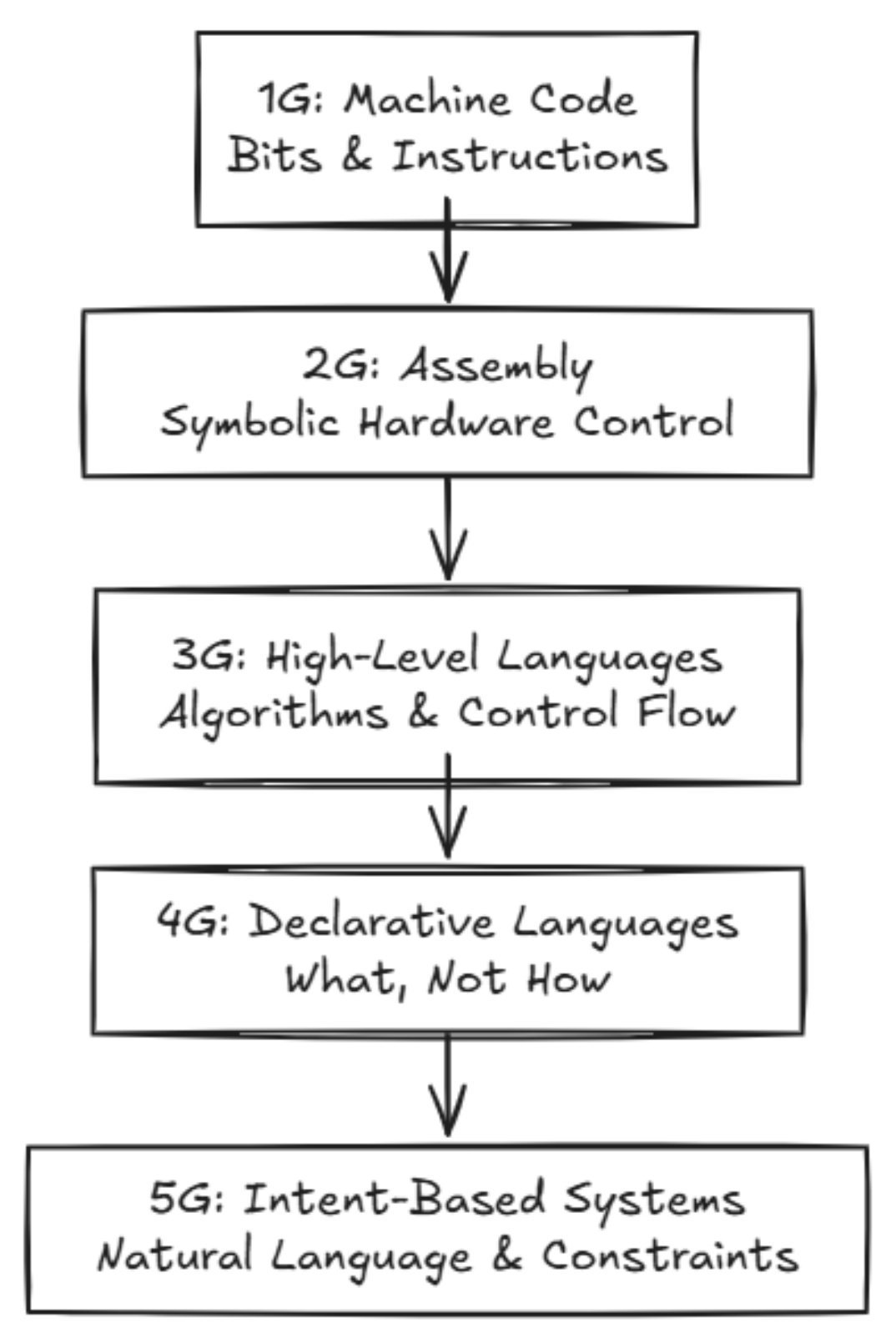
The generation of languages and specifications represents a continuum of abstraction evolution.
Looking Forward: The Fifth Generation
The fifth generation of programming—using natural language as the primary interface—is being accelerated by AI. But AI-assisted code generation without architectural governance is just sophisticated copy-paste. SDD provides the missing control plane.
As we delegate mechanical enforcement to machines, we elevate human responsibility to the highest abstraction layers. The question is no longer how humans implement systems, but how and where they govern them.
This represents the next major inflection point in software abstraction's long evolution. Not because it eliminates complexity, but because it relocates complexity to where it belongs: the definition of system truth itself.
The tools are emerging. The patterns are crystallizing. The question for engineering teams isn't whether this shift will happen, but how deliberately they'll navigate it.
About the Authors
Leigh Griffin holds a PhD in Computer Science and works for the Office of the CTO at Red Hat, helping explore emerging technologies and their intersection with engineering process and flow.
Ray Carroll is a Senior Principal Engineer in Red Hat's Emerging Technology group, focused on investigating and developing new technologies. He holds a PhD in Computer Science with backgrounds in software engineering, research architecture, and technical architecture.
This article is based on their exploration of Spec Driven Development at Red Hat's Emerging Technology group.
Comments
Please log in or register to join the discussion