
A deep look at the sharp drop in Stack Overflow questions, the moderation choices that accelerated it, and what the rise of generative AI means for developers and the broader knowledge‑sharing ecosystem.
What’s New
The monthly question count on Stack Overflow has fallen from a peak of over 200,000 in 2014 to under 3,000 in 2026. The graph below, originally shared on Data Stack Exchange, captures the steep descent.
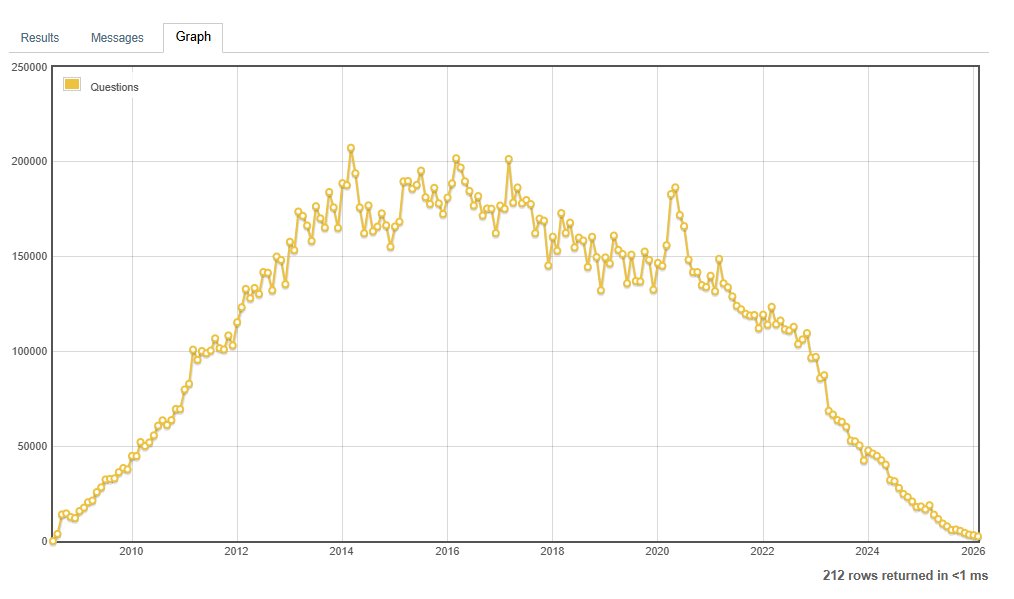
The headline‑grabbing narrative blames large language models (LLMs) for the drop, but the data tells a more nuanced story. Moderation policies introduced after 2014, combined with a cultural shift toward “quick answers without judgment,” set the stage for the decline long before ChatGPT entered the conversation.
Developer Experience
1. Moderation at Scale
When the site grew to hundreds of thousands of monthly posts, the community adopted a close‑or‑delete workflow. Questions that could not be answered immediately were flagged, often without constructive feedback. This approach kept the site’s signal‑to‑noise ratio high for search engines, but it also created a barrier for newcomers:
- Higher entry friction – New developers faced rapid closures, sometimes for reasons that felt arbitrary.
- Reduced learning loops – Instead of iterating on a question, users were sent away, limiting the chance to refine their problem‑solving skills.
The policy worked for SEO, but it sacrificed the community‑building aspect that made Stack Overflow a learning hub.
2. The AI Disruption
Enter generative AI. Tools like GitHub Copilot, Claude, and the latest ChatGPT models can produce code snippets in seconds, often without the “stigma” of a closed question. For many developers, the workflow looks like this:
- Paste a brief description into an LLM.
- Receive a ready‑to‑run code block.
- Test, tweak, and ship.
The convenience is undeniable, yet research highlights hidden costs:
- Security – A VeraCode study found 45 % of AI‑generated code contained vulnerabilities.
- Maintainability – Cornell research shows AI code tends to be simpler but includes more dead code and hard‑coded debugging statements.
- Skill atrophy – Over‑reliance on copy‑paste solutions can erode a developer’s ability to debug, refactor, and design robust architectures.
3. Practical Guidance for Developers
To keep the benefits of AI while avoiding its pitfalls, consider a disciplined approach:
- Ask focused, incremental questions – Break a problem into small steps and verify each LLM response before moving on.
- Review the output – Treat the generated snippet as a draft; understand its logic, test edge cases, and refactor for readability.
- Validate sources – When the model cites references, check that they are reputable and up‑to‑date.
- Integrate with existing tooling – Pair LLM suggestions with static analysis, unit tests, and code‑review processes.
These habits preserve the craft of programming while still leveraging AI as a productivity aid.
User Impact
The Loss of a Public Learning Space
Stack Overflow’s decline means fewer fresh perspectives on emerging topics. When a community stops asking questions, the collective knowledge base stagnates. New CSS features like nesting, view transitions, and container queries evolve rapidly; without fresh queries, the documentation that powers LLM training can become outdated, leading to stale suggestions.
Shifts in Knowledge Distribution
- Search engine dominance – With fewer unique questions, Google and Bing become the primary gateways to existing answers, reinforcing a “one‑size‑fits‑all” model.
- Echo chambers – Developers may gravitate toward niche Discord or Reddit channels where the moderation tone is more welcoming, but the reach is limited.
- LLM feedback loop – If developers stop contributing new Q&A, future models will be trained on a narrower set of examples, potentially degrading answer quality for novel problems.
What Can the Community Do?
- Re‑open the dialogue – Encourage sites, meet‑ups, and internal forums to host “question‑of‑the‑day” sessions where beginners feel safe to ask.
- Mentor‑first moderation – Shift from punitive closures to guided edits that help the asker improve the post.
- Contribute to open datasets – Share anonymized, high‑quality Q&A on platforms like the OpenAI Community Dataset to keep LLMs current.
Closing Thoughts
The decline of Stack Overflow is not a simple AI‑only story. It is the result of long‑standing moderation choices that prioritized short‑term signal quality over long‑term community health. Generative AI amplified the effect by offering an instant, judgment‑free alternative.
For developers, the takeaway is clear: use AI as a tool, not a crutch. Keep asking, keep answering, and keep iterating on questions—both for personal growth and for the health of the ecosystems we rely on.
“Stack Overflow is you.” – Jeff Atwood
If we let that spirit fade, we risk losing the very feedback loops that keep our craft evolving.
Comments
Please log in or register to join the discussion