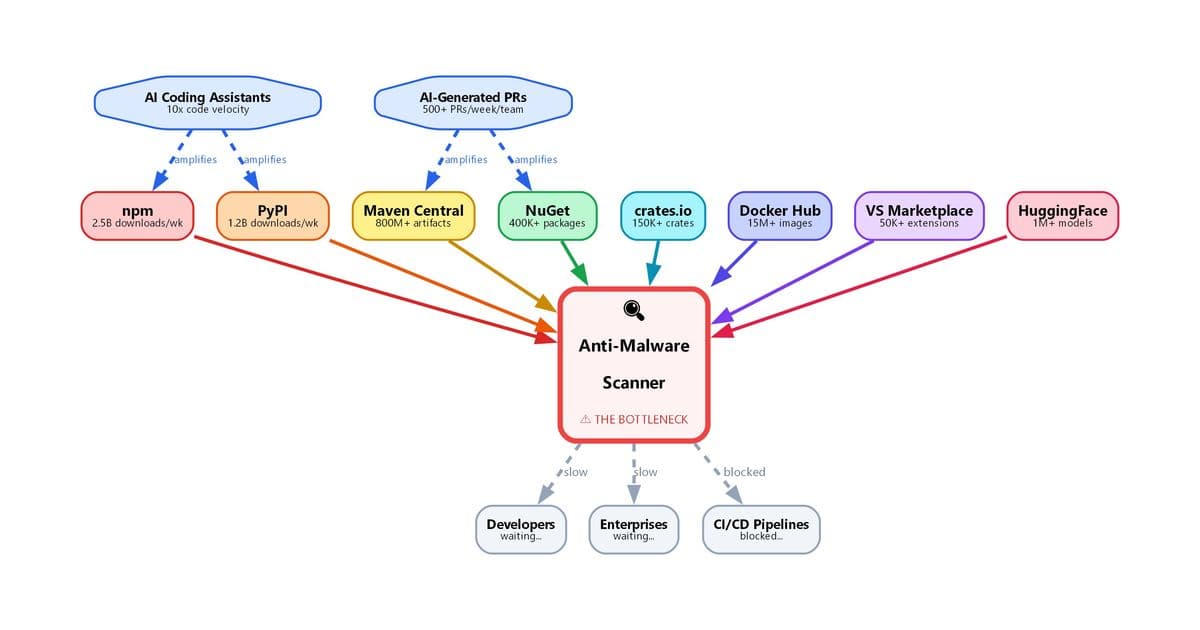
AI‑driven development is generating billions of new package states daily, overwhelming conventional file‑level scanners. A single line of code can alter a package’s intent, forcing defenders to re‑analyse every change at scale. This article breaks down the problem, compares heuristic and LLM‑based scanning approaches, and outlines the business impact of the widening latency‑accuracy gap.
State Explosion in AI‑Era Software Supply Chains
What changed?
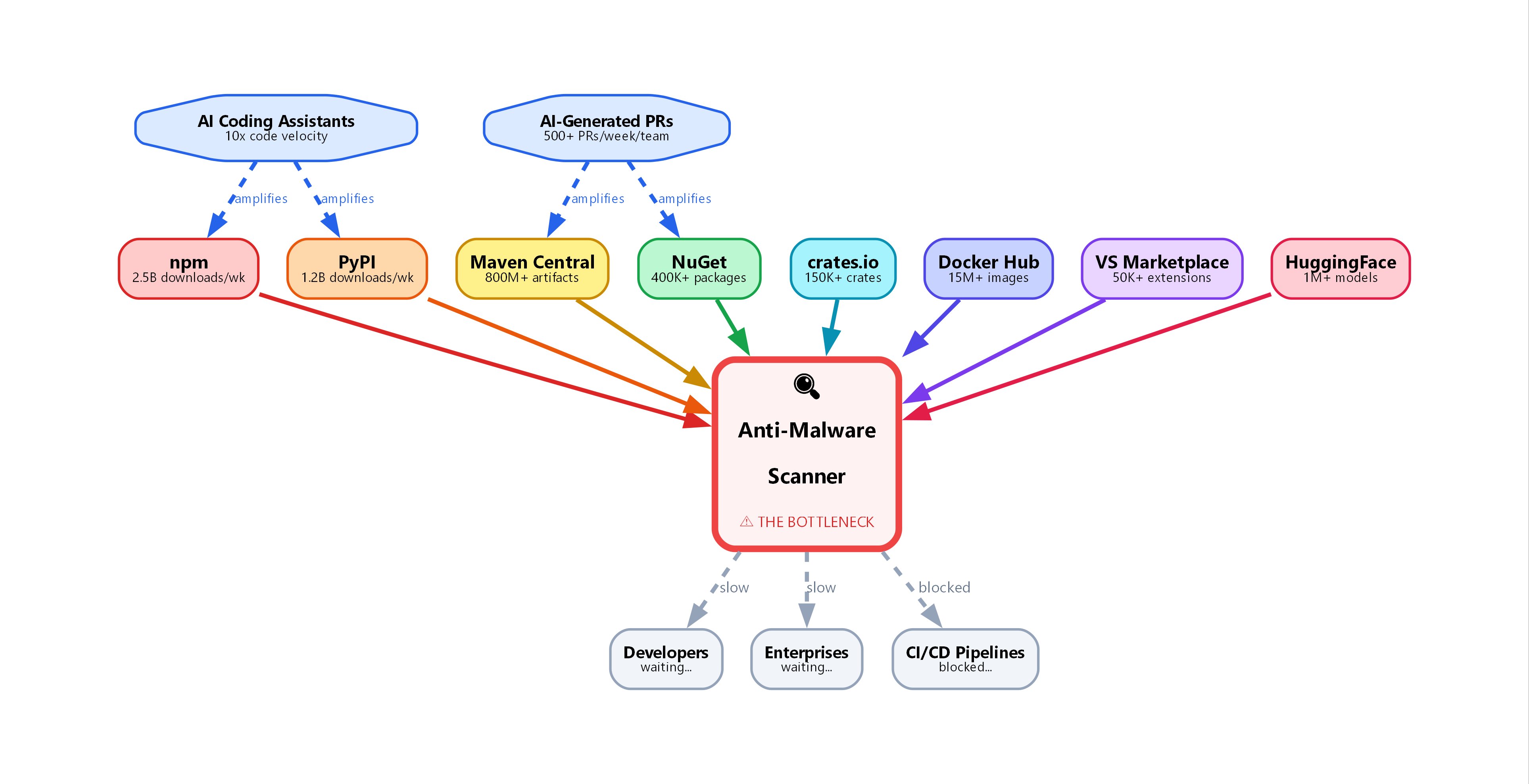
AI‑assisted code generation has turned software development into a high‑velocity assembly line. In 2025 GitHub recorded nearly 1 billion commits and 43 million pull requests per month; by 2026 that pace is projected to hit 38 million commits per day. Similar growth appears across npm, PyPI, NuGet and Maven Central. The result is not just more code, but millions of distinct package states that must be interpreted for security.
A single line edit can shift a package from a benign state (State X) to a malicious one (State Y). The change may:
- Introduce a new dependency that loads untrusted code at runtime.
- Alter execution flow so that a previously harmless utility now exfiltrates data.
- Re‑wire a build script to execute arbitrary commands after install.
Because software semantics emerge from the interaction of files, file‑level diff checks no longer provide sufficient security insight. Attackers now distribute malicious intent across several innocuous files, making it visible only when the whole package is reconstructed.
Provider comparison: Heuristic scanners vs LLM‑based semantic analysis
| Feature | Heuristic / Signature‑Based Scanners | LLM‑Based Semantic Analyzers |
|---|---|---|
| Speed | Milliseconds per file; can scan millions of files per hour. | Approx. 30 seconds per package for full reasoning (LLM inference). |
| Depth of understanding | Limited to known patterns, regexes, and simple static heuristics. | Can follow data flow across files, decode obfuscation, and explain intent. |
| Evasion resistance | Low against novel, AI‑generated code that avoids known signatures. | Higher, but still vulnerable to adversarial prompts and heavy obfuscation. |
| Cost | Low compute, low cloud spend; scales easily on commodity hardware. | Higher compute (GPU/accelerator usage), increasing per‑package cost. |
| Operational model | Inline, real‑time enforcement in CI/CD pipelines; easy to cache results. | Often async or batch‑oriented; latency makes inline enforcement challenging. |
| Scalability at ecosystem level | Handles billions of file scans daily, but misses complex, multi‑file attacks. | Provides deep insight but struggles to keep up with daily 50 k+ package influx without massive parallelism. |
Why the gap matters
Even a modest deployment that scans 50 000 packages per day with a 30‑second LLM analysis would need ≈417 hours of compute—far beyond the 24‑hour window before the next wave of packages arrives. Heuristic scanners can keep up with volume but leave a large blind spot for compositional attacks. The industry therefore needs a hybrid approach that marriages the throughput of heuristics with the intent‑level reasoning of LLMs.
Business impact
- Increased risk exposure – Organizations that rely solely on file‑level signatures may miss supply‑chain compromises that manifest only when files are combined. A breach can propagate downstream to thousands of downstream consumers, amplifying liability.
- Higher operational costs – Deploying pure LLM analysis at scale forces firms to provision large GPU farms or pay for expensive managed inference services, inflating OPEX.
- Compliance pressure – Regulations such as the EU Cybersecurity Act and U.S. Executive Orders on software supply‑chain security expect “reasonable assurance” that all published artifacts are vetted. Inadequate scanning can lead to audit failures.
- Developer friction – Slow, asynchronous security checks delay releases, prompting developers to bypass controls or ship with known vulnerabilities.
- Strategic advantage – Companies that invest in a cloud‑native, data‑plane semantic scanner—one that can evaluate every package inline with sub‑second latency—gain a competitive edge by reducing time‑to‑market while maintaining a strong security posture.
Path forward
- Layered detection pipelines: Use ultra‑fast heuristics for initial triage, then route suspicious packages to an LLM‑driven analysis pool.
- Model serving at the edge: Deploy inference nodes close to package registries (e.g., Azure Edge Zones) to cut latency.
- Incremental reasoning: Cache intermediate semantic graphs for packages that share dependencies, reducing repeat work.
- Adaptive throttling: Apply back‑pressure to publishers when scan queues exceed thresholds, protecting downstream consumers.
- Continuous model updates: Treat the scanner as a distributed system—handle versioning, rollout, and rollback without downtime.
By treating the state explosion as both a security and an infrastructure challenge, enterprises can align their detection architecture with the velocity of modern AI‑augmented development. The result is a supply chain that remains fast enough for developers, deep enough for defenders, and cost‑effective for the business.
For more details on building large‑scale semantic scanners, see the Microsoft Security Copilot documentation and the recent Azure AI infrastructure guide.
Comments
Please log in or register to join the discussion