A deep dive into doocloud, a service that automates backend API setup to help founders focus on product development rather than infrastructure.
The repetitive cycle of backend development has long been a bottleneck for solo founders and small startup teams. Before building the actual product that customers will pay for, developers spend days, sometimes weeks, on the same foundational tasks: authentication, CRUD operations, API configuration, Docker setup, deployment pipelines, custom domain configuration, CORS policies, rate limiting, and logging. This boilerplate work, while necessary, doesn't differentiate products and represents a significant opportunity cost.
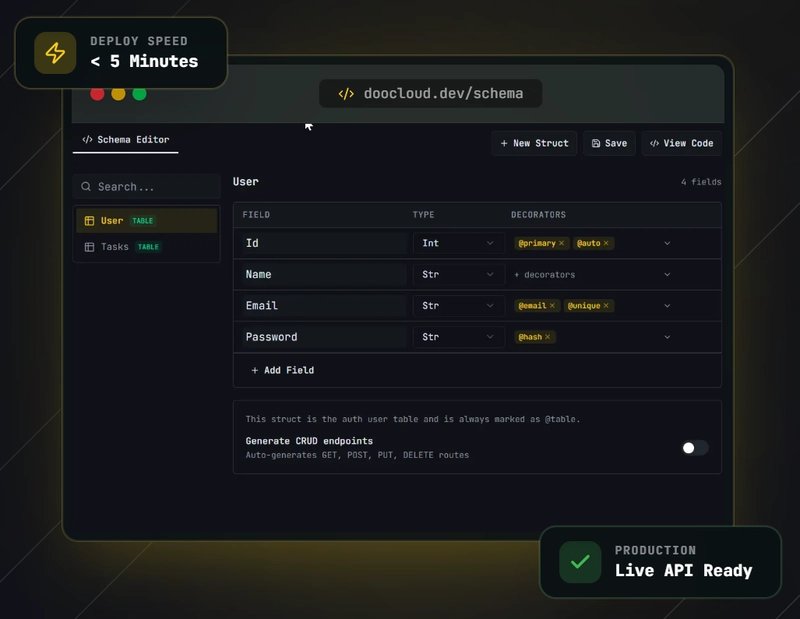
doocloud enters this space with a straightforward value proposition: define your data model and get a production-ready API in minutes rather than days. The platform abstracts away the infrastructure concerns that typically consume early development cycles, allowing teams to focus on their core product features.
The service handles the full backend stack including authentication, CRUD operations, configuration management, containerization, deployment, custom domain setup, CORS handling, rate limiting, and logging. This comprehensive approach addresses the most common pain points in early-stage backend development.
From a technical perspective, doocloud's approach raises interesting questions about the trade-offs between rapid development and long-term maintainability. By generating code rather than providing a managed service, it offers teams the ability to customize and extend their backend as needed, which becomes crucial as applications scale and requirements become more complex.
The platform's approach reflects a broader trend in backend development tools that prioritize developer velocity while maintaining code ownership. Services like doocloud, Supabase, and Firebase have popularized the idea of instant backends, but doocloud differentiates itself through its emphasis on code generation and open transparency.
One key consideration for teams evaluating doocloud is how it handles consistency models in distributed environments. While the service abstracts away much of the complexity, teams building applications with strict consistency requirements will need to understand the underlying implementation choices. This is particularly relevant for applications where data integrity is non-negotiable, such as financial systems or healthcare applications.
The service also speaks to the evolving nature of full-stack development in the startup ecosystem. As tools become more sophisticated, the barrier to entry for building complete applications continues to lower. This democratization of development tools enables solo founders and small teams to build products that previously required larger engineering organizations.
For teams considering doocloud, the primary benefit is clear: reduced time-to-market for the core product features. However, teams should also consider how the generated code aligns with their long-term architecture goals and whether the abstractions provided will support future scaling needs. The trade-off between immediate velocity and long-term flexibility is a critical consideration that varies by application type and business requirements.
The emergence of services like doocloud represents a maturation of the "backend-as-a-service" space, moving beyond simple database services to comprehensive API generation platforms. This evolution suggests a growing recognition that the biggest bottleneck in early-stage development isn't building features, but rather establishing the foundational infrastructure that supports those features.

From an API design perspective, doocloud's approach likely follows RESTful conventions, which would provide familiar patterns for most developers. However, teams building applications with specific API requirements may need to evaluate whether the generated endpoints can be customized to meet their needs. The balance between convention and customization is a key consideration for any abstraction layer in backend development.
As the platform continues to develop, it will be interesting to see how it handles more complex use cases and whether it can maintain its focus on both developer velocity and code transparency. For now, it offers a compelling solution for founders looking to minimize backend setup time and maximize product development focus.
Learn more about doocloud at doocloud.dev.
Comments
Please log in or register to join the discussion