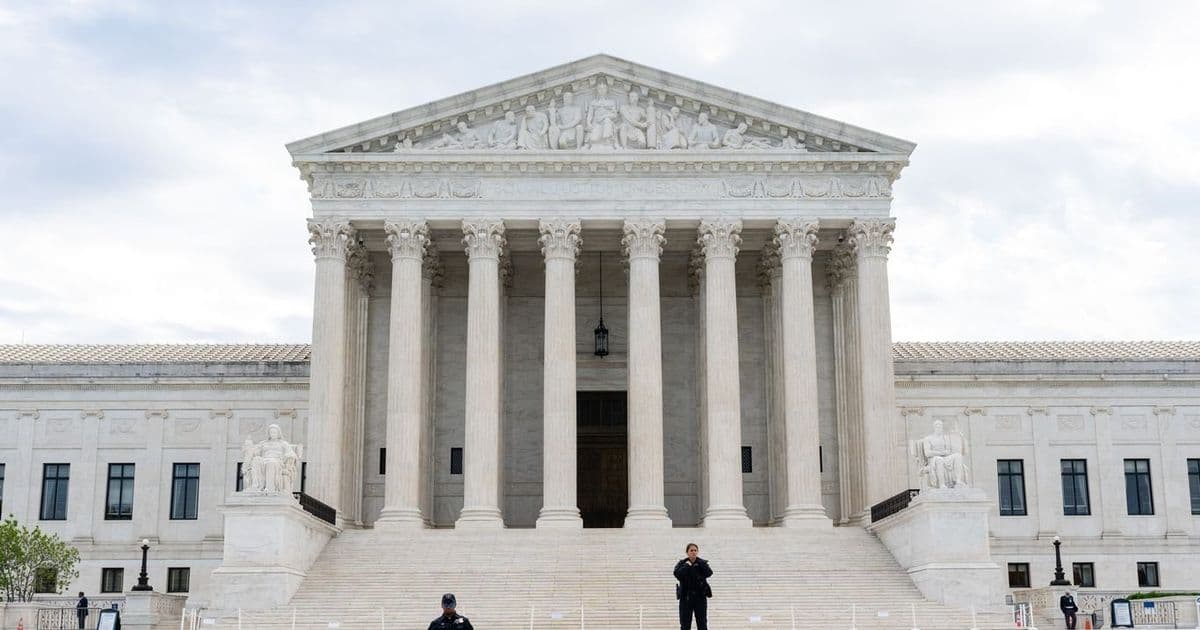
The U.S. Supreme Court has struck down Virginia's redistricting referendum, ruling that state constitutional amendments cannot override the General Assembly's authority to draw congressional districts, a decision that preserves partisan advantages and limits direct democratic intervention in electoral mapmaking.
The U.S. Supreme Court issued a decisive ruling Tuesday that effectively terminates Virginia's ambitious redistricting reform initiative, affirming that state constitutional amendments cannot supersede the legislature's constitutional authority to establish congressional districts.
The 5-4 decision, written by Justice Samuel Alito, centers on the interpretation of Virginia's constitution and the separation of powers between state legislative and referendum-driven processes. The case stems from a 2023 ballot measure approved by Virginia voters that established an independent commission to redraw congressional districts, bypassing the traditionally partisan General Assembly.
Virginia's redistricting landscape has been particularly contentious. The state approved a referendum in 2021 creating an independent redistricting commission, which produced maps that were subsequently challenged in court. The commission's work resulted in districts that political analysts projected would yield a more competitive electoral environment, with approximately 6 of the 10 congressional seats considered potentially competitive.
The Supreme Court's ruling hinges on Article I, Section 5 of the Virginia Constitution, which explicitly states that the General Assembly shall have the power to apportion the state's congressional districts. The majority opinion argues that while voters can amend the state constitution through referenda, they cannot alter the fundamental structure of government or strip constitutionally granted powers from elected branches.
"The people of Virginia, through their constitution, have vested the authority to ap congressional districts in the General Assembly," Justice Alito wrote. "While the initiative process allows for constitutional amendments, it does not permit the electorate to restructure the state government in ways that eliminate core legislative functions."
Justice Elena Dissent, writing for the four justices in opposition, countered that "the people's direct voice in redistricting is fundamental to democratic governance. When partisan legislatures draw maps designed to entrench their own power, the people have a constitutional right to intervene through their initiative process. This decision undermines a crucial check on partisan gerrymandering."
The ruling has immediate practical implications for Virginia's 2026 congressional elections. The state's current congressional map, drawn by a Republican-controlled legislature in 2021, contains 6 districts favoring Republicans and 4 favoring Democrats. Without the commission's alternative map, this configuration is likely to remain in place for the upcoming election cycle.
Politically, the decision represents a victory for Virginia's Republican leadership, which had challenged the redistricting commission's authority. Republican House Speaker Todd Gilbert issued a statement saying, "Today's ruling affirms the constitutional structure established by our founders, ensuring that elected representatives rather than unelected commissions retain the authority to represent their constituents."
Democratic leaders condemned the decision. "The Supreme Court has effectively told Virginia voters that their voices don't matter when it comes to fair representation," said Senate Democratic Leader Dick Saslaw. "This decision protects politicians who draw maps to benefit themselves rather than the people they serve."
The ruling aligns with a broader pattern of Supreme Court decisions that have limited the ability of states to implement independent redistricting processes. Similar cases in Ohio and Arizona have been decided in favor of preserving legislative control, though with different reasoning.
From a national perspective, the Virginia decision adds another layer to the ongoing redistricting battles that will shape the political landscape for the remainder of this decade. With control of the U.S. House hanging by a narrow margin, states like Virginia, Pennsylvania, and North Carolina have become battlegrounds where district lines can determine partisan control.
The decision also highlights the increasing importance of state constitutional provisions in redistricting disputes. While the Supreme Court has largely declined to intervene in partisan gerrymandering cases at the federal level, state courts and constitutions have emerged as alternative venues for challenging unfair maps.
Virginia's experience reflects a national tension between direct democracy and representative governance. Twenty states have some form of initiative process, but the extent to which those processes can override constitutional provisions assigning specific powers to elected branches remains unsettled legal territory.
Legal scholars note that the Virginia decision differs from cases like Citizens United, which expanded the rights of corporate entities, and instead focuses on the structural relationship between different branches of state government. "This is about the vertical separation of powers within state government, not the horizontal separation between federal branches," explained election law professor Rick Hasen. "The Court is saying that state constitutions can't be used to eliminate core legislative functions, even through voter initiatives."
The ruling may have implications for other states considering redistricting reforms. Michigan, Colorado, and California have all implemented independent redistricting commissions in recent years, though their constitutional foundations differ from Virginia's approach.
Looking ahead, advocates for redistricting reform may need to pursue alternative strategies, including state constitutional conventions or more carefully crafted ballot initiatives that explicitly preserve legislative authority while creating advisory or limited roles for independent bodies.

For Virginia voters, the decision means that the redistricting maps for the 2026 congressional elections will likely be drawn by the General Assembly, following the typical partisan process that has characterized mapmaking in most states. Whether this will lead to renewed efforts for reform through the 2027 legislative session remains to be seen.
Comments
Please log in or register to join the discussion