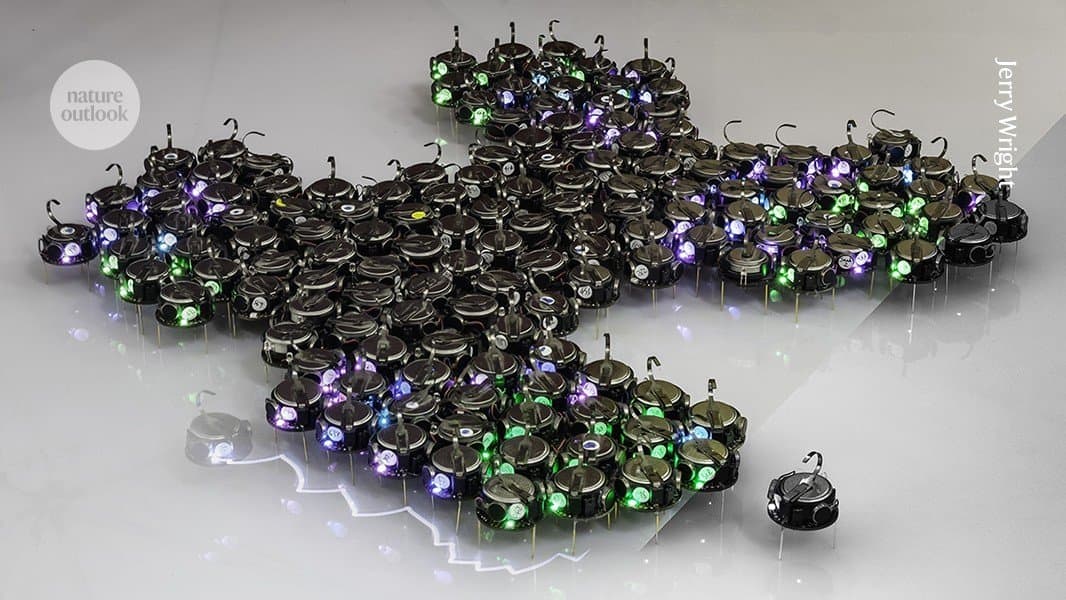
UK researchers are pioneering nanoparticle swarms designed to intelligently hunt and destroy tumour cells. Mimicking natural swarm behaviours, these simple particles achieve complex collective decision-making through local interactions, offering a radical new approach to targeted cancer therapy.
In a Bristol laboratory, scientists are pushing the boundaries of medical robotics and artificial intelligence into the nanoscale. Their work focuses on developing nanoparticle swarms – vast numbers of minuscule synthetic particles – engineered to operate collectively within the human body with a singular, devastating mission: find and eliminate cancer cells. This research represents a significant leap beyond conventional targeted drug delivery, harnessing principles of swarm intelligence typically observed in insect colonies or bird flocks.
The Power of Emergence
Unlike complex, single nanorobots, these swarms rely on the emergent properties of simple components. Individual nanoparticles are relatively basic, but through carefully designed interactions with each other and their environment (like chemical gradients or physical obstacles near tumours), they exhibit sophisticated group behaviours. This collective decision-making enables the swarm to perform complex tasks – such as identifying tumour boundaries, concentrating therapeutic payloads precisely, and adapting to dynamic biological conditions – that would be impossible for a single agent or a simple dispersed cloud of particles.
"The beauty lies in the simplicity of the individual units and the complexity arising from their interactions," explains Sabine Hauert, a leading researcher in swarm robotics at the University of Bristol, whose foundational work on robot swarms informs this medical application. "We're programming behaviours, not micromanaging each particle."
Beyond Single-Agent Limitations
Current nanoparticle therapies often struggle with precision targeting, off-site toxicity, and overcoming biological barriers like dense tumour microenvironments. The swarm approach offers potential solutions:
- Robustness: The loss of individual particles doesn't compromise the swarm's overall mission.
- Scalability: Swarms can easily scale up in size to deliver larger therapeutic doses.
- Adaptability: Collective sensing allows the swarm to respond dynamically to the heterogeneous and changing conditions inside a tumour.
The Path to Clinical Reality
While promising, translating nanoparticle swarms from the lab bench to the clinic faces substantial hurdles. Key challenges include:
- Precise Control: Ensuring reliable and predictable swarm behaviour within the incredibly complex and variable environment of the human body.
- Biocompatibility & Safety: Guaranteeing the nanoparticles and their degradation products are non-toxic and effectively cleared.
- Manufacturing: Scaling up production of consistently engineered nanoparticles.
- Imaging & Tracking: Developing methods to monitor the swarm's location and activity in real-time within a patient.
Research groups worldwide are tackling these issues. Recent studies published in journals like Science Robotics and Cell Reports Physical Science demonstrate progress in simulating swarm behaviours and designing responsive particle systems.
A New Paradigm for Medicine
The Bristol team's work exemplifies a growing trend: leveraging bio-inspired AI and robotics principles for medical breakthroughs. If successful, nanoparticle swarms could revolutionize not just cancer treatment, but the targeted delivery of therapeutics for a wide range of diseases, moving us towards a future where intelligent microscopic collectives patrol our bodies, seeking and destroying threats with unprecedented precision. The era of medical nanorobotics is shifting from solitary agents to coordinated, intelligent armies.
Source: Based on reporting from Nature article 'doi: https://doi.org/10.1038/d41586-025-02269-4' and referenced scientific studies (Slavkov et al., Sci. Robot. 2018; Pan et al., Cell Rep. Phys. Sci. 2024; Ceron et al., PNAS 2023).
Comments
Please log in or register to join the discussion