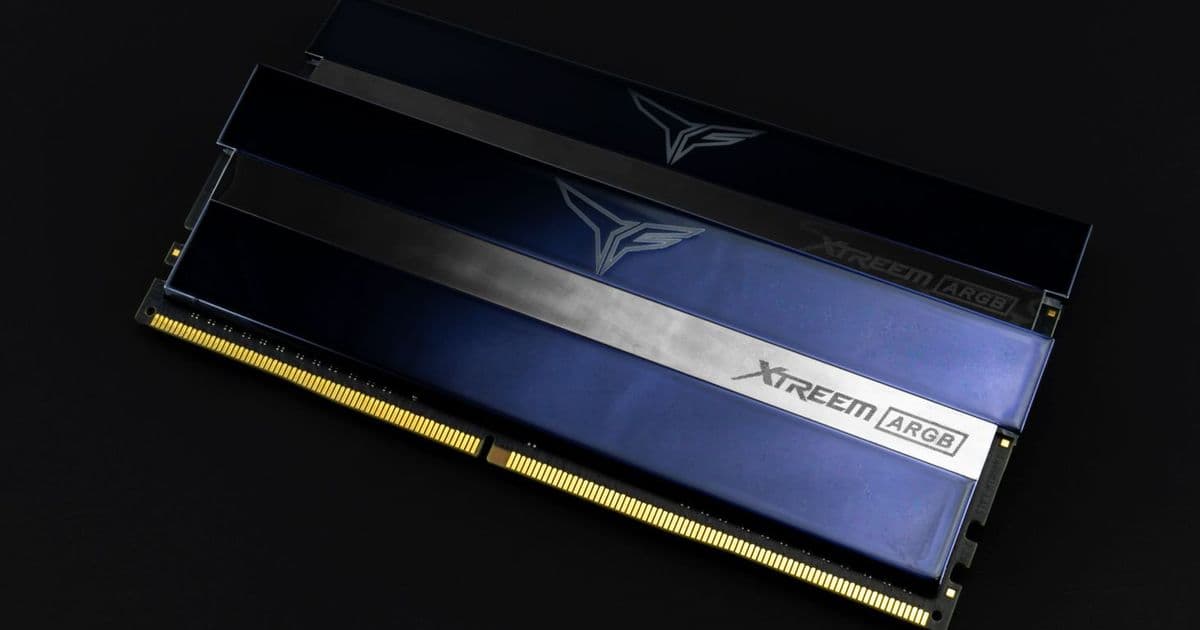
Team Group will pay $1.1 million to U.S. consumers who bought DDR3, DDR4 or DDR5 kits that were marketed at speeds requiring XMP/EXPO BIOS tweaks. The settlement highlights ongoing scrutiny of memory manufacturers’ speed claims and may push the industry toward clearer labeling.
Team Group agrees to $1.1 M settlement in DDR‑memory speed lawsuit
Team Group has agreed to a $1.1 million class‑action settlement covering U.S. purchases of its DDR3, DDR4 and DDR5 memory kits between May 3 2020 and April 8 2026. The lawsuit alleged that the company advertised “out‑of‑the‑box” frequencies that could only be reached after users enabled XMP (Intel) or EXPO (AMD) profiles in the motherboard BIOS/UEFI.
Technical background
| Memory type | JEDEC default speed* | Advertised speed in the suit | Typical XMP/EXPO profile |
|---|---|---|---|
| DDR3 | 1333 MT/s | 1866 MT/s – 2133 MT/s | 1866 MT/s (XMP) |
| DDR4 | 2133 MT/s | 3000 MT/s – 3600 MT/s | 3200 MT/s (XMP) |
| DDR5 | 4800 MT/s | 5600 MT/s – 7200 MT/s | 6000 MT/s (EXPO) |
*JEDEC defaults are the baseline frequencies guaranteed by the memory standard without any overclocking.
Most consumer kits ship with the JEDEC‑compliant timing values programmed into the SPD (Serial Presence Detect) chip. To reach the higher numbers printed on the box, the SPD must contain an XMP/EXPO profile that the BIOS can load. If the user never activates that profile, the memory runs at the lower, default speed.
The plaintiffs argued that the packaging and product pages did not make the need for a BIOS tweak explicit, leading buyers to believe the advertised speed would be achieved automatically. In practice, a typical user would need to:
- Enter the BIOS/UEFI menu.
- Locate the XMP/EXPO setting.
- Enable the profile and save changes.
- Re‑boot the system.
For many first‑time builders, especially those buying pre‑built PCs or using motherboards with “auto‑overclock” disabled, this extra step is not obvious.
Settlement mechanics
- Eligibility: Individual consumers who purchased any Team Group DDR3/4/5 kit in the U.S. during the defined window.
- Claim limit: Up to five memory modules per household can be claimed without proof of purchase; additional claims require receipts.
- Payout calculation: The $1.1 M fund is divided proportionally based on the number of eligible modules each claimant reports.
- Deadline: Claims must be filed by July 7 2026 via the official Claim Hub website.
- Exclusions: Business purchases (corporations, LLCs, etc.) are not covered, and the settlement does not impose any labeling changes on future products.
Market implications
1. Pressure on labeling practices
The Team Group case follows a similar $2.4 M settlement with G.Skill earlier this year, which forced G.Skill to add explicit “XMP required for advertised speed” warnings on packaging. While Team Group’s agreement does not contain a labeling clause, the financial exposure may encourage other manufacturers to pre‑emptively update their marketing language to avoid future litigation.
2. Impact on consumer confidence
Memory kits are a high‑visibility component for enthusiasts and mainstream builders alike. Repeated lawsuits could erode trust, prompting buyers to gravitate toward brands with clearer specifications—potentially benefiting companies like Corsair and Kingston that already include XMP/EXPO notes on their boxes.
3. Supply‑chain considerations
The settlement does not affect Team Group’s production volumes, but legal costs and the need for revised packaging could add marginal overhead. In a market where DRAM pricing is already volatile—averaging $1.30 per GB for DDR4 in Q2 2026—any additional expense may be passed to end users, nudging price‑sensitive segments toward cheaper, lower‑speed kits.
4. Regulatory outlook
U.S. consumer‑protection agencies have shown increased willingness to act on “misleading performance” claims in the PC hardware sector. If more lawsuits follow, we may see the Federal Trade Commission issue guidance specific to memory speed advertising, similar to the guidance released for graphics‑card boost clocks in 2024.
What buyers should do now
- Check your kits: Verify whether your Team Group modules list an XMP or EXPO profile on the SPD. Tools like CPU‑Z or HWiNFO can display this information.
- Enable the profile: If you haven’t already, enable XMP/EXPO in the BIOS to achieve the advertised frequency.
- File a claim: If you purchased a qualifying kit and have not yet claimed, submit your request before the July 2026 deadline.
- Watch future packaging: Expect clearer speed disclosures from most major memory vendors in upcoming product cycles.
The settlement does not set a precedent for mandatory labeling, but it underscores a growing legal focus on how performance metrics are communicated to consumers. As DDR5 adoption climbs—projected to reach 45 % of new desktop builds by the end of 2026—clearer marketing will become a competitive differentiator.
Comments
Please log in or register to join the discussion