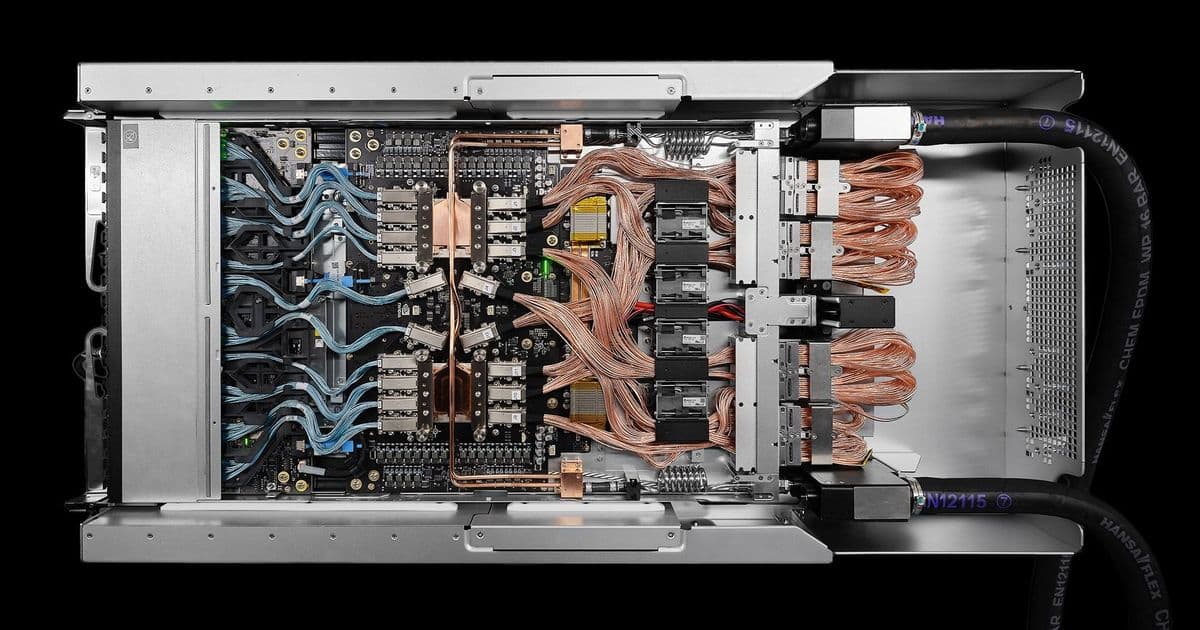
Nvidia, AMD, Broadcom, Microsoft, Meta, and OpenAI have formed the Optical Compute Interconnect Multi-Source Agreement (OCI MSA) to develop open standards for optical interconnections in AI data centers, aiming to break through copper's physical limitations and enable faster, more scalable AI infrastructure.
The AI buildout faces a critical bottleneck: copper interconnects are hitting their physical limits for data transfer speeds and power consumption. This week, a coalition of tech giants announced a groundbreaking initiative to solve this problem through optical interconnects.
The Copper Ceiling
Copper has been the backbone of data center connectivity for decades, but it's reaching its breaking point. As AI models grow exponentially larger, the demand for bandwidth between servers has skyrocketed. Copper's fundamental limitations - signal degradation over distance, high power consumption, and physical resistance - are becoming insurmountable obstacles.
Electrical signals traveling through copper experience significant losses, especially at high speeds. To maintain signal integrity, data centers must either limit transmission distances or consume enormous amounts of power for signal amplification. Neither approach scales effectively for the massive AI clusters being built today.
The Optical Solution
The Optical Compute Interconnect Multi-Source Agreement (OCI MSA) group brings together AMD, Broadcom, Nvidia, OpenAI, Meta, and Microsoft to define an open connectivity specification for optical interconnections in AI data centers. Their goal: enable data centers to scale using optical interconnections rather than relying solely on copper.
Optical interconnects use light instead of electrical signals to transmit data. Light travels through fiber optic cables with minimal signal loss, enabling much higher bandwidth over longer distances. The OCI MSA aims to develop a physical layer (PHY) capable of delivering up to 3.2Tb/s and beyond - speeds that would be impossible with copper.
Breaking the Supply Chain Constraints
Beyond performance limitations, copper faces significant supply chain constraints. The AI infrastructure buildout demands massive amounts of copper, creating bottlenecks in availability and driving up costs. An industry-wide shift to optical interconnections would alleviate some of this demand while enabling new capabilities.
However, optics comes with its own challenges: higher initial costs, increased heat output, and failure rates that need to be addressed. The OCI MSA's work includes developing standards that make optical solutions more reliable and cost-effective at scale.
Platform-Agnostic Standards
The key innovation of the OCI MSA is creating a platform-agnostic standard. Rather than each vendor developing proprietary optical solutions, the group is defining an open specification that allows multiple vendors to offer compatible components.
This approach serves several critical purposes:
- Cost reduction: Competition among vendors drives down prices
- Supply chain diversification: Reduces reliance on any single manufacturer
- Interoperability: Different systems can work together seamlessly
- Innovation acceleration: Open standards enable faster technological advancement
Supporting Multiple Protocols
The new standard supports various optical solutions, including pluggable optical modules, on-board optics, and chips using co-packaged optics. This flexibility means data centers can run different AI accelerator protocols - like Nvidia's NVLink or AMD's UALink - while using the same underlying optical infrastructure.
As Vivek Raghunathan, CEO of Xscape Photonics, explains: "Fundamentally, the current copper-based interconnects just cannot meet that bandwidth requirement." The OCI MSA's standard enables these different protocols to travel over fiber connections, breaking down the silos that would otherwise exist between vendor ecosystems.
The Path to Superintelligence
With AI models growing more complex and data centers becoming more massive, speed is no longer optional - it's a requirement. The OCI MSA's work reflects the rapid advancement of data center technology and the urgent need for solutions that can keep pace.
Gilad Shainer, SVP of networking at Nvidia, emphasizes the stakes: "By equipping best-in-class compute with state-of-the-art optics, the OCI MSA can deliver the scale and performance required by the next era of super-intelligence."
Early Deployment and Future Scaling
The alliance is targeting deployment starting at 200Gbps speeds, with plans to scale up to the 3.2Tb/s specification. This phased approach allows for early adoption while continuing to push the boundaries of what's possible.
Companies involved in the alliance are all major AI accelerator developers, ensuring their products will be supported by the new standard from day one. This alignment between hardware developers and the standards body creates a powerful ecosystem effect.
The Bottom Line
The formation of the OCI MSA represents a critical inflection point in AI infrastructure development. As AI models approach the complexity needed for true superintelligence, the underlying hardware must evolve to support them. Optical interconnects offer a path forward that copper cannot provide.
By creating open standards for optical interconnections, these tech titans are not just solving today's bottleneck - they're laying the foundation for the next decade of AI advancement. The question is no longer whether optical interconnects will replace copper in data centers, but how quickly this transition can occur and what new capabilities it will unlock.
Comments
Please log in or register to join the discussion