
Tesla Financial Services has been convicted at least 18 times in UK courts for failing to identify drivers involved in traffic offences, resulting in over £20,000 in fines. The pattern reveals systemic issues in how the company handles police requests for driver identification, a critical function for leased vehicles where the company, not the driver, is the registered keeper.
Tesla's British operations are facing a growing legal headache that goes beyond typical corporate compliance failures. The electric vehicle giant's UK financial services arm has been convicted at least 18 times in criminal courts over the past two years for repeatedly failing to cooperate with police investigations into road traffic offences, with total fines, costs, and court fees exceeding £20,000.
The issue stems from a fundamental aspect of how Tesla operates in the UK market. Unlike traditional car ownership, many Tesla vehicles in Britain are offered through long-term lease arrangements. In these scenarios, Tesla Financial Services—not the individual driver—serves as the registered keeper of the vehicle. When a speeding camera or police officer catches a leased Tesla breaking traffic laws, the legal responsibility to identify the driver falls squarely on Tesla's shoulders.

The pattern of non-compliance appears systematic rather than isolated. Court records show convictions brought by multiple police forces including the Metropolitan Police, Hampshire Constabulary, and Thames Valley Police. In one notable case from July 2025, South Wales Police wrote to Tesla Financial Services seeking to identify the driver of a Tesla that had been recorded doing 80mph (128km/h) on the M4 motorway near Llantrisant.
Despite admitting the criminal charge, Tesla's response revealed troubling operational gaps. A company director, Becky Hodgson, pleaded guilty by email in late November 2025, claiming the company had attempted to enter its plea through the Online Plea Service portal but "encountered a technical issue." In the same email, she suggested Tesla had complied with the police request and followed internal processes, with the nomination sent via post. The conviction still proceeded at Merthyr Tydfil Magistrates' Court on January 6, resulting in a £1,000 fine plus £520 in costs and victim surcharge.
The consequences of these failures extend beyond financial penalties. In at least one case, a Tesla driver was caught on camera doing nearly 100mph (160km/h) on the A3 in Petersfield, Hampshire. Because police letters went unanswered, the speeding driver was never identified, and the company received a conviction instead. Another driver was caught speeding three times—potentially enough to trigger license disqualification—yet remained unidentified due to Tesla's failure to respond to police correspondence.
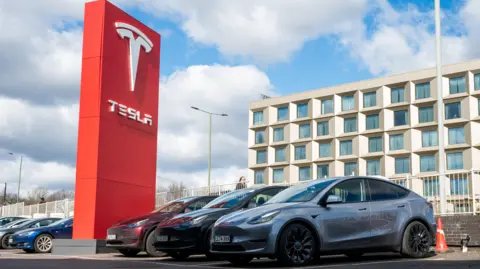
The scale of the problem becomes clearer when examining broader statistics. In just the last two weeks, nearly 4,000 defendants across England and Wales were convicted for failing to identify drivers under police investigation, with fines ranging from £1 to £1,000. Tesla's 18+ convictions represent a significant portion of this pattern, particularly for a company that prides itself on technological efficiency.
Police correspondence has reportedly been sent to multiple Tesla locations, including offices and service centers in London and Manchester, yet responses have been inconsistent or absent. This suggests the issue may be organizational rather than logistical—Tesla's internal systems for handling these legally mandated requests appear to be breaking down.
The legal framework here is straightforward but strict. When a leased vehicle commits a traffic offence, the registered keeper must provide the driver's details within a specified timeframe. Failure to do so constitutes a separate criminal offence, with the keeper (in this case, Tesla Financial Services) becoming liable for prosecution. This system exists precisely because it prevents drivers from evading responsibility through vehicle ownership structures.
For Tesla, these convictions represent more than just financial costs. Each conviction damages the company's reputation for operational excellence and raises questions about its compliance infrastructure. As the company expands its leasing operations in the UK, these systemic failures could create regulatory scrutiny and potentially affect its ability to operate leasing programs effectively.
The pattern also highlights a growing challenge for modern automotive companies. As vehicle ownership models evolve—whether through leasing, subscription services, or ride-sharing platforms—the traditional mechanisms for identifying drivers and enforcing traffic laws must adapt. Tesla's struggles suggest the company's systems haven't kept pace with its business model.
Both Tesla and South Wales Police have been asked for comment on these developments, though neither has yet provided detailed public statements addressing the pattern of non-compliance. As the number of convictions continues to mount, the question becomes whether this represents a temporary operational glitch or a fundamental flaw in how Tesla manages its UK leasing operations.
Comments
Please log in or register to join the discussion