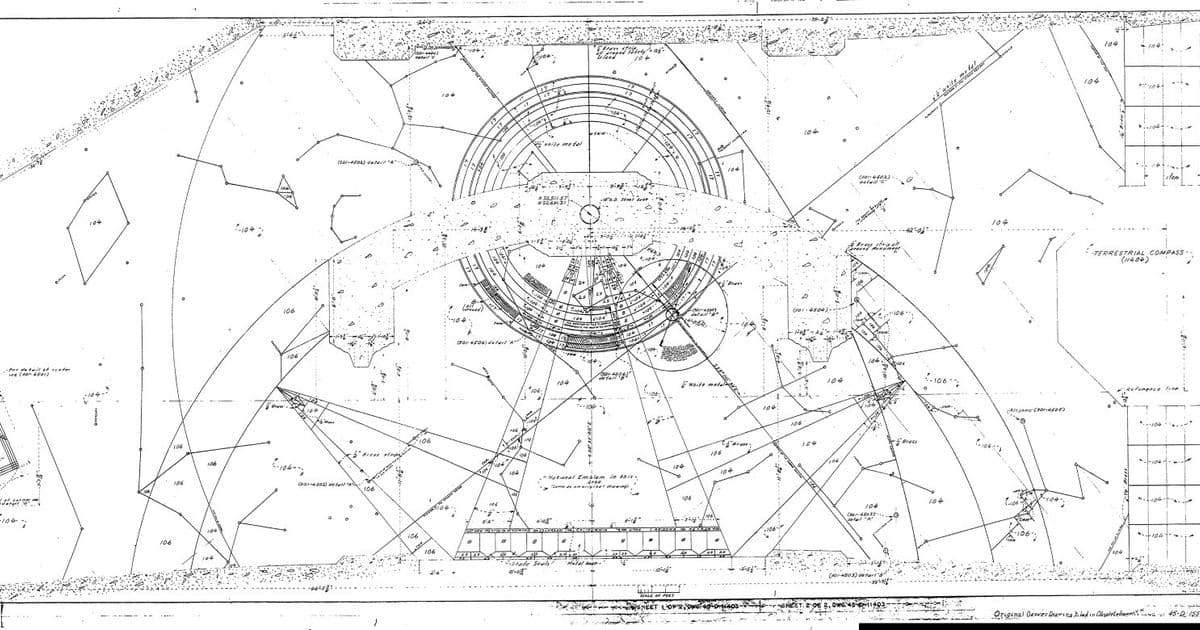
A concrete plaza at Hoover Dam contains a precise celestial map frozen in terrazzo, marking the dam's completion within a 25,772-year astronomical cycle that tracks Earth's axial precession.
On the western flank of the Hoover Dam, millions of visitors walk past a monument they don't understand. The massive winged bronze sculptures and central flagpole in Monument Plaza draw cameras, but the most remarkable feature lies underfoot: a terrazzo floor that functions as a 26,000-year astronomical clock.

The plaza was commissioned by the US Bureau of Reclamation when construction began in 1931. What looks like decorative inlay is actually a precise celestial map marking the dam's completion date based on Earth's axial precession—the 25,772-year cycle where our planet's axis slowly wobbles like a gyroscope, tracing a circle through the stars.
Understanding Axial Precession
Earth's axis currently points near Polaris, our familiar North Star. But that position isn't permanent. The axis traces a slow circle across the sky, meaning different stars serve as our North Star over millennia. Thuban was the North Star when Egyptians built the pyramids. In roughly 12,000 years, Vega will take that position.
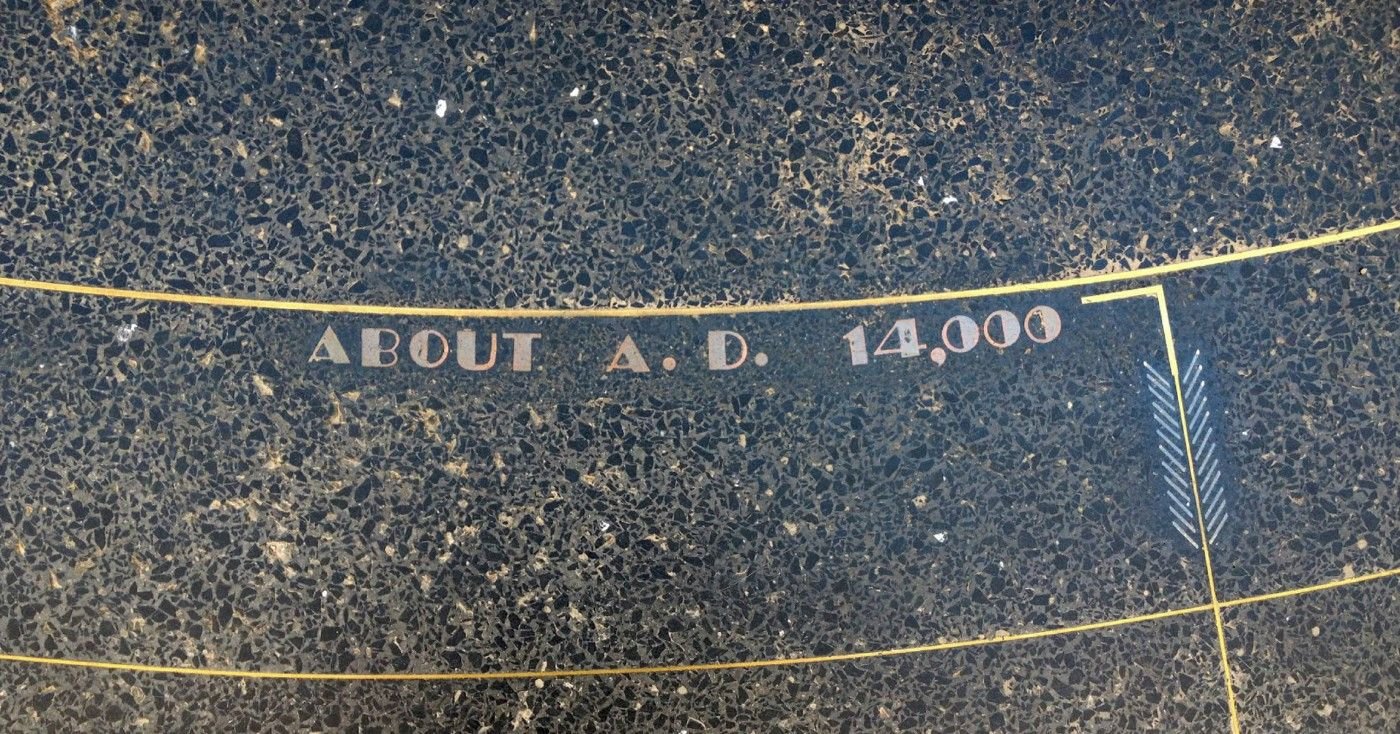
This precession cycle is the slowest timekeeping mechanism Long Now tracks in their 10,000 Year Clock. It's also what makes the Hoover Dam monument technically remarkable: artist Oskar J. W. Hansen created a static representation of this dynamic astronomical phenomenon.
Decoding the Plaza
The monument's center is the flagpole, which marks the center of the circle traced by axial precession. Around this pole, the terrazzo floor shows:
- The axial precession circle itself
- Polaris's precise angle on the dam's opening date
- Planets visible that evening
- Bright stars in the night sky at that location
By combining planet locations with the precession angle, the plaza pinpoints the dam's completion to within a day.

Technical Discovery
Documentation proved elusive. The Bureau of Reclamation historian, Emme Woodward, eventually provided original blueprints and construction photos. The search revealed that the plaza was originally called "Safety Island"—a protected area for workers during construction.
Hansen's own description of the monument is convoluted, discussing human postures and reflexes matched to angles "much as one would join cams in a worm-gear drive." The Bureau doesn't use this interpretation publicly, leaving the plaza's true purpose largely unknown to visitors.
Construction Process
The monument required careful planning. Before the terrazzo was laid, Hansen's axial precession layout had to be precisely marked on the concrete base. The bronze sculptures were craned into place, creating the visible landmarks that frame the celestial map.

Long-Term Significance
Hoover Dam's concrete structure may persist for hundreds of thousands of years. The monument beneath visitors' feet serves as both celebration and instruction—a static representation of astronomical cycles that outlasts the civilization that built it.
The Long Now 10,000 Year Clock uses similar principles but with moving parts. Hansen's terrazzo floor achieves the same goal through artistry: it makes abstract astronomical cycles tangible and permanent.
For those interested in the technical details, original plans and Hansen's writings are available through the Internet Archive, revealing the full scope of this obscure but sophisticated astronomical monument.

The plaza remains a rare example of engineering and artistry combined to create timekeeping across geological scales—visible to millions, understood by few.
Comments
Please log in or register to join the discussion