
A deep dive into the financial mathematics behind the AI boom, revealing that current AI investments may never generate returns proportional to their costs across hyperscalers, AI companies, and enterprise adopters.
The AI revolution has been accompanied by unprecedented financial commitments, with hyperscalers investing over $800 billion in the last three years and plans to add another $1.7 trillion through 2027. Yet beneath the surface of this technological excitement lies a fundamental economic question: can AI ever deliver returns that justify these massive investments?
The current trajectory suggests a troubling answer. Microsoft has reportedly spent approximately $100 billion on its OpenAI partnership alone, representing about 30% of its capital expenditures since FY2023. This investment has generated an estimated $17.9 billion in AI revenue for FY2025—less than a fifth of the capex outlay. Similar patterns emerge across the industry, with Google and Amazon making comparable investments while their AI revenues remain relatively modest.

The Mathematics of AI Investment
To understand the scale of this financial commitment, consider what hyperscalers need to achieve merely to break even on their AI investments:
- Microsoft, Meta, Google, and Amazon have invested over $800 billion in AI infrastructure
- They plan to invest another $1.7 trillion through 2027
- This requires at least $3 trillion in AI-specific revenue just to break even
- $6+ trillion in revenue would be needed for AI to be profitable
For context, these companies generated a combined $1.599 trillion in total revenue in their most recent fiscal years across all products. The AI revenue needed to justify these investments effectively requires doubling or tripling these entire businesses.
AI Companies' Financial Bleeding
The financial challenges extend beyond hyperscalers to the AI companies themselves. Anthropic and OpenAI, the primary beneficiaries of this infrastructure spending, are burning billions of dollars with no clear path to profitability.
Based on available financial data:
- Anthropic reportedly spent $10 billion on inference and training while making $5 billion in revenue (as of March 2026)
- OpenAI plans to burn $852 billion through the end of 2030
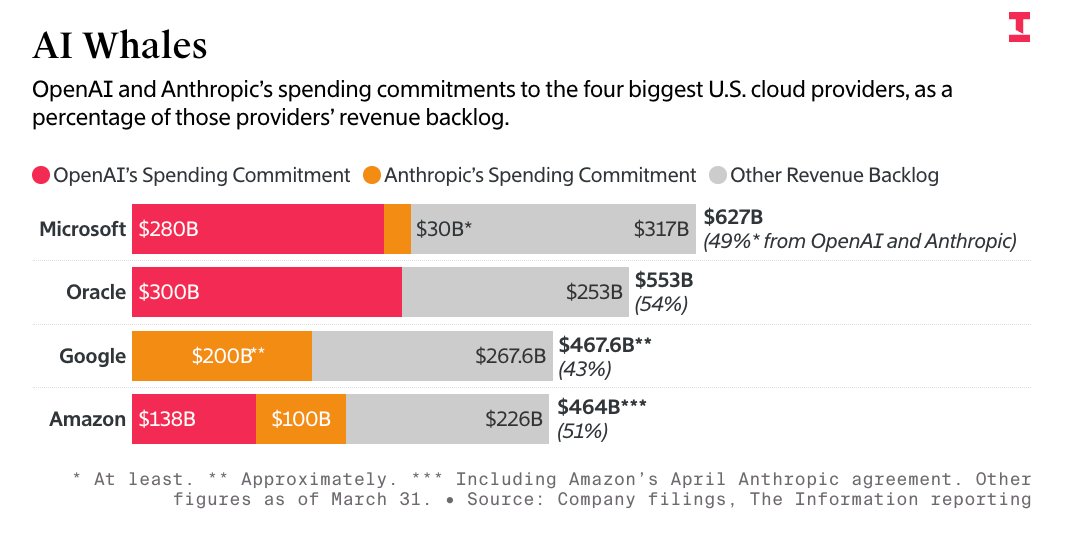
- Anthropic has raised $75 billion in the last six months, with additional commitments of $50 billion from Google and Amazon
These companies collectively need to make or raise over $1.25 trillion in the next four years to meet their obligations, a figure that grows increasingly implausible as actual usage patterns emerge.
Enterprise Adoption: Token Budgets Without ROI
On the enterprise side, organizations are discovering that AI implementation comes with staggering costs and unclear returns. Companies like Uber, ServiceNow, and Zillow are burning through their yearly AI token budgets in mere months.
Zillow provides a particularly instructive case study:
- Projected to spend $7-10 million on AI in 2026
- This represents 20-50% of its 2025 net income
- Engineering resources have remained stable while outputs requiring human review have increased by nearly 50%
- Code deployments and pull requests increased by 39%, but software reviewer load increased by 29,000 hours monthly
The result has been what Zillow workers describe as "AI slop" in their codebase, with increased review burden and questionable productivity gains. This pattern repeats across organizations, where AI adoption metrics are often tied to usage rather than outcomes.
The Transparency Problem
Adding to these challenges is a lack of transparency from AI providers, particularly Anthropic. Unlike established software firms, Anthropic doesn't provide:
- Granular telemetry data showing which users consume which tools
- Detailed usage metrics to help customers predict costs
- Service-level agreements defining performance expectations
This opacity makes it difficult for enterprises to understand their actual AI usage patterns and costs, creating a perfect environment for budget overruns without clear ROI measurement.
Measuring the Immeasurable
Perhaps the most fundamental challenge is measuring AI's actual value. Unlike traditional software metrics, AI token usage is:
- Inconsistent across tasks and even repeated attempts
- Difficult to attribute to specific business outcomes
- Often disconnected from actual productivity improvements
Organizations struggle to establish meaningful KPIs for AI usage, leading to metrics that can be gamed rather than genuinely reflecting value. When employees are evaluated based on AI adoption rather than results, the incentive becomes burning tokens rather than achieving business objectives.
Counter-Perspectives and Optimism
Despite these challenges, AI proponents offer several counterarguments:
Future cost reductions: Many believe that as silicon becomes more efficient and models improve, the cost per token will decrease significantly. However, current evidence suggests the opposite—both Anthropic and OpenAI have seen their gross margins decline as they've scaled.
New revenue streams: Optimists point to entirely new business models and applications that will emerge, creating markets we can't yet imagine. While possible, these would need to be extraordinarily large to justify current investment levels.
Productivity breakthroughs: Some argue that AI will eventually deliver unprecedented productivity gains that will offset current costs. The evidence so far, however, shows that AI often increases the volume of work without necessarily improving quality or efficiency.
The Cultural Dimension
Beyond the financial mathematics, AI's adoption reflects broader cultural dynamics in tech organizations. The article identifies what it calls "Business Idiot" culture—executives and managers so disconnected from actual work that they're easily impressed by AI's ability to mimic productivity.
This cultural phenomenon explains much of the current AI enthusiasm:
- AI never says "no" to unreasonable requests
- It creates the appearance of work without the substance
- It provides managers with tools to feel technically competent
- It creates new metrics that can be gamed to demonstrate progress
The Path Forward
The current AI trajectory appears unsustainable without fundamental changes:
- Cost transparency: AI providers must offer detailed usage analytics and predictable pricing models
- Value measurement: Organizations need better ways to connect AI usage to business outcomes
- Realistic expectations: Stakeholders must acknowledge that AI has limitations and costs that may never be fully recouped
- Cultural reset: Organizations need leadership that understands actual work processes rather than being impressed by technological mimicry
The AI bubble may not pop dramatically but rather deflate slowly as organizations face the reality that current usage patterns and costs don't align with value delivered. The question isn't whether AI has value—it's whether the current economic model can deliver returns that justify the staggering investments being made across the ecosystem.
For organizations navigating this landscape, the lesson is clear: approach AI adoption with the same rigor applied to any other significant business investment, with clear metrics for success and regular evaluation of actual returns against costs.
Comments
Please log in or register to join the discussion