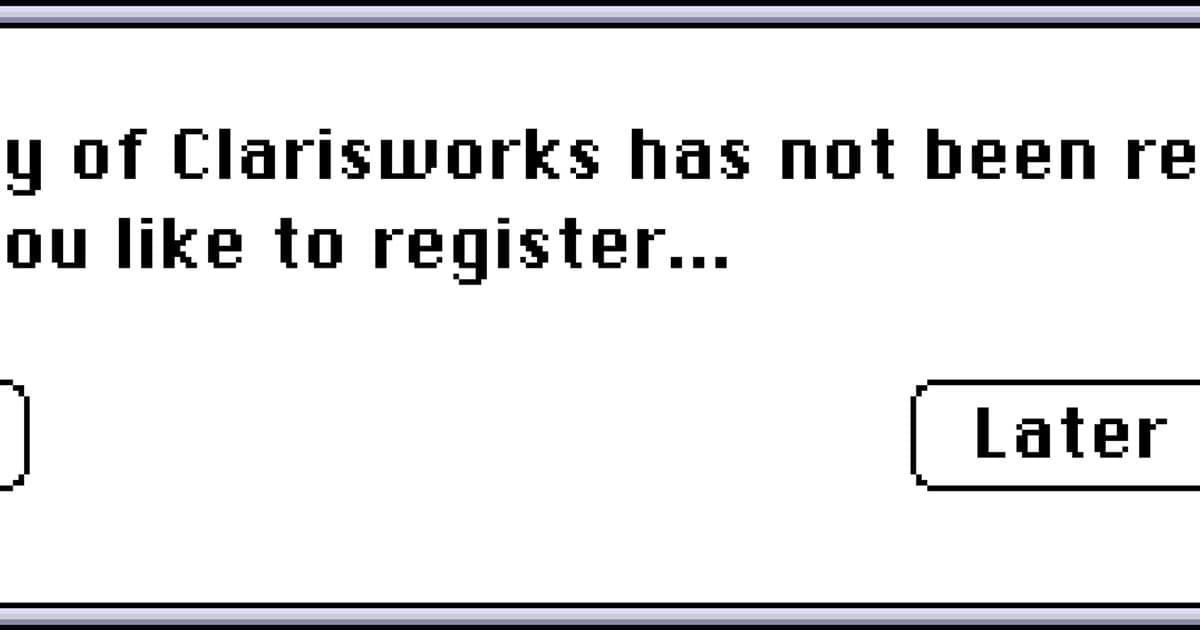
A 1997 ClarisWorks dialog reveals the tension between following interface design rules and creating delightful, context-aware experiences.
Marcin Wichary recently highlighted a fascinating dialog box from ClarisWorks 1997 that perfectly illustrates the tension between systematic design rules and localized design sensitivity. The dialog presents three options: "Now / Later / Never" for registration choices. As Wichary points out, this breaks the well-known rule about button copy being fully comprehensible without reading surrounding context—the "avoid click here" guideline.
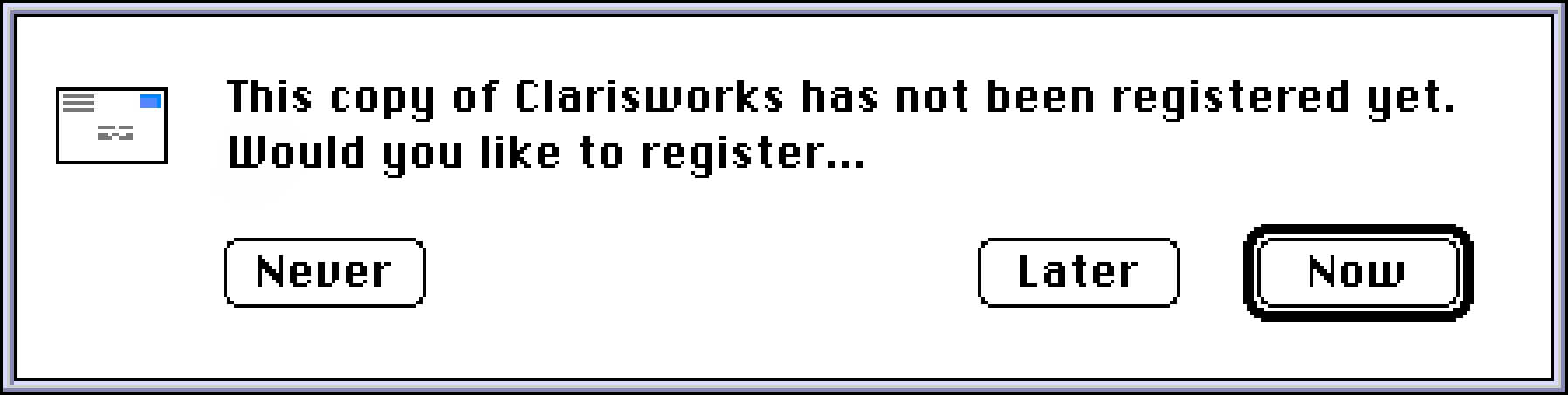
A more rule-compliant version would read "Never Register / Register Later / Register Now." This alternative is technically superior because each button stands alone with complete meaning. You could read any button in isolation and understand exactly what it does. But as Wichary notes, it "wouldn't look so neat."
The elegance of "Now / Later / Never" lies in its brevity and parallel structure. Three words, no filler, perfect symmetry. It's a masterclass in economical language that feels intentional and crafted. The rule exists for good reason—it prevents confusion and ensures accessibility—but here it feels like a constraint that would diminish rather than enhance the experience.
This raises a fundamental question about interface design: when should we bend to fit systematic rules, and when should we exert the peculiarities and context of a specific situation? Rules serve as useful guardrails, especially when you don't want to think deeply about every decision. They provide a baseline of quality and consistency. But thoughtful design can supersede these baselines, creating experiences that feel more human and tailored.
The trade-off is real and persistent. Making decisions on a case-by-case basis allows for highly-tailored solutions that fit the specific context perfectly. Each dialog box, each interaction point can be optimized for its unique circumstances. However, within larger systems, this approach risks losing consistency and coherence. Users might encounter similar situations that are handled differently, creating confusion and cognitive overhead.
Conversely, when systematic rules override localized sensitivities, you risk losing the magic and delight that comes from finding waypoints tailored exclusively to their peculiarities. The interface becomes more predictable but also more bland, more generic, more like every other interface.
As software moves toward scale, systematic rules tend to swallow decision-making because localized exceptions become points of friction. The argument becomes: "We can't require an experienced human give thought and care to the design of every single dialog box." Scale demands automated decision-making that doesn't require skill or expertise—precisely because those things, by definition, don't scale.
But this creates a paradox. When you manufacture upon inhuman lines—when you prioritize consistency, efficiency, and scalability over human judgment and contextual sensitivity—how can you expect humane outcomes? The very qualities that make software feel alive, responsive, and delightful often come from those moments where someone made a conscious choice to break the rules for the sake of better user experience.
The "Now / Later / Never" dialog reminds us that sometimes the most delightful interfaces come from understanding when to follow the rules and when to break them. It's not about abandoning systematic thinking but about knowing when localized sensitivity matters more than global consistency. In a world increasingly dominated by automated, rule-based design systems, perhaps we need more moments where human judgment and contextual awareness take precedence over mechanical consistency.
The best designers understand this balance. They know the rules well enough to know when breaking them serves the user better. They recognize that sometimes the most elegant solution isn't the most rule-compliant one. And they understand that while scale requires systems, humanity requires sensitivity.
Maybe the real skill isn't in following rules perfectly or breaking them recklessly, but in developing the judgment to know which approach serves the user in each specific context. That's the kind of expertise that truly can't be automated away—and perhaps that's exactly what we risk losing as we optimize everything for scale.
Comments
Please log in or register to join the discussion