
A reflection on the industrial decay of the modern web and a philosophical guide to building personal websites as tools for autonomy, creativity, and genuine connection.
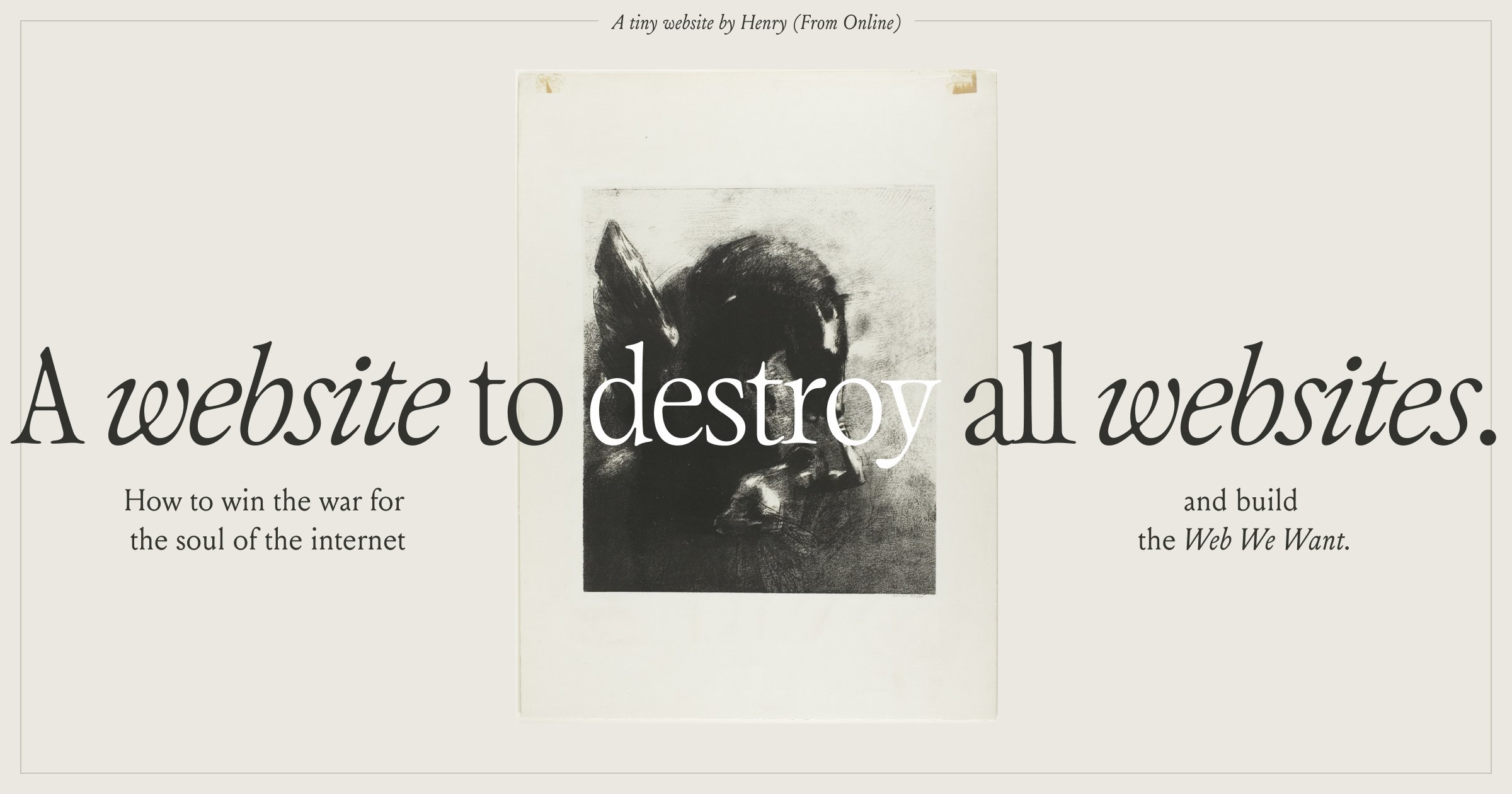
The internet has become a place of extraction rather than creation. What began as a vast, holy realm of self-discovery and community has been systematically industrialized, transformed from a landscape of imagination into a factory of attention. The promise of knowing anything about anything has been replaced by the reality of doom-scrolling brain-rot, algorithmic slop, and the relentless churn of content creation designed not for human flourishing but for shareholder value.
This transformation follows a pattern that technology philosopher Ivan Illich identified in his 1973 book Tools for Conviviality. Illich observed that technological tools typically pass through two critical moments: an optimistic arrival where they enhance human capacities, followed by a deadening industrialization where they begin to extract value and demand societal adaptation. The automobile exemplifies this perfectly—initially a tool for personal liberty, it eventually demanded that societies reorganize themselves around its infrastructure, creating a radical monopoly where participation in modern life became impossible without it.

The web has followed precisely this trajectory. Conceived at CERN in 1989 as a system for universal document linking and collaboration, it promised interoperability and accessibility. Yet its proliferation has spawned the very problems we now recognize: cyberstalking, the instantaneous circulation of harmful content, identity theft, and addiction. More insidiously, the commercialization of the web has created new surfaces for advertisement and new mechanisms for divorcing users from ownership of their own creations.
Consider the markers of this decay across three domains:
Teaching and Learning Monolithic platforms like YouTube, TikTok, Medium, and Substack promise creators monetization and large audiences, but the lack of ownership creates fundamental vulnerabilities. When platforms change rules, pivot catastrophically, or simply disappear, creators and their audiences lose everything. The algorithmic requirements pit creators against their own creative integrity, while paywalls and platform demands fracture communities. The convivial alternative has always existed: blogs. HTML remains free to access by default. RSS has worked for over a century. Combined with webmentions, these technologies enable genuine intellectual exchange where ideas can be read, experimented with, and built upon by others, with ownership retained throughout.
Social Connection Social media has imprisoned us in a content prison where connection requires creating or being vanished by capricious black box algorithms. Everything we create becomes owned by the platform. If Instagram disappears tomorrow, so does your network and your memories. Yet tools like POSSE (Publish On your Own Site, Syndicate Elsewhere), ActivityPub, microformats, and ATProto make it increasingly achievable to generate your own social network, interoperable with platforms like Bluesky or Mastodon. These networks, designed for ownership and decentralization, are durable, built around storytelling rather than engagement metrics, and free from the whims of tech billionaires.
Web Engineering The discipline of web engineering has been industrialized to the point of absurdity. We build the same B2B SaaS website with identical featuresets infinite times, optimizing for production rather than craft. Markup has been penned into JavaScript templates in case a product manager needs JSON somewhere down the line. Style code has been whittled down to mechanisms for deploying border-radius-drop-shadow combinations. This industrial approach to what should be a creative craft understandably leaves many uninspired.

Yet the renaissance of web technologies offers an escape. HTML and CSS have never been more capable, thanks to the tireless work of standards groups and browser implementers. The creative expression possible with basic web tools in a text editor is unbelievable. JavaScript is more progressively enhanceable than ever, enabling interfaces with a rapidly growing number of exciting browser APIs. The current year represents a veritable renaissance of web code, requiring only curiosity and a drive to experiment.
Illich's thesis is clear: technology should serve people by enhancing their freedom, creativity, independence, and will. When distilled to the web through manual code, hand-built social networks, and blogs, this principle points luminously to one answer: personal websites.
Hand-coded, syndicated, and above all personal websites are exemplary convivial tools. They let users be autonomous, experiment, have ownership, learn, share, find purpose. They enable bespoke, endlessly tweaked, eternally redesigned, built-in-public, surprising UI and delightful UX. The personal website is a staunch, undying answer to everything the corporate and industrial web has taken from us.

Building Your Convivial Web Presence
Start Small Let yourself begin with something modest. Have fun trying things that don't work. Document your growth. Publish failed ideas alongside successful ones. Some of the best websites in the world are just HTML, and they belong to their authors. Make friends. Let yourself be inspired by others. Send friendly emails asking to learn new things. Do not demand masterpieces of yourself.
Reduce Friction to Publishing Get the resistance to ship out of your way. Don't get caught up in tooling and frameworks. Just write HTML and get something online. If you're an engineer, delight that you're not beholden to the same standards of quality and rigorous testing that you are at work. Draft some ideas, hit the h1 to p tag combo, and publish. Update and update again; let your ideas grow like gardens, the way they do in your mind. The mutability of the web, often considered its great weakness, is also one of its great strengths.
Don't Worry About Design (Unless You Want To) Don't worry about design unless that's the part that brings you joy. Make friends with designers and trade your work for theirs, or trade tips, trade advice. Get comfortable with being joyfully bad at something. From that soil of humility grows a million questions for those who have learned and are excited to share. Iterate until you've something you're proud of, or iterate so much you've ruined it and have to go back to bald.
Use the IndieWeb Leverage the IndieWeb and its wonderfully thought-out protocols. Use tools like brid.gy to syndicate your ideas out to the wider web, then use Webmentions to bring the ensuing conversations back where the content is. That way, you can publish work where you prefer to, folks on Bluesky can enjoy and discuss it, in the same stroke as folks on Mastodon may, or folks directly on the canonical URL.

The path back to feeling like you have some control over your digital life is to un-spin yourself from the Five Apps of the Apocalypse and reclaim the Internet as a set of tools you use to build something you can own and be proud of. The personal website represents not nostalgia for some imagined better past, but a conscious choice to participate in the web as it was meant to be: a convivial tool that enhances human freedom rather than extracting human attention.
In building our own small corners of the web, we participate in the most fundamental act of resistance against industrialized technology: we assert our autonomy, we reclaim our creativity, and we build spaces where human connection can flourish on our own terms. The web we want is not found in the monolithic platforms that demand our compliance, but in the countless personal websites that, together, form a resilient, human-scale network of genuine expression and connection.
The tools are ready. The protocols exist. The only question is whether we will use them to build something that serves us, or continue to serve the tools that have been built to extract from us.
Comments
Please log in or register to join the discussion