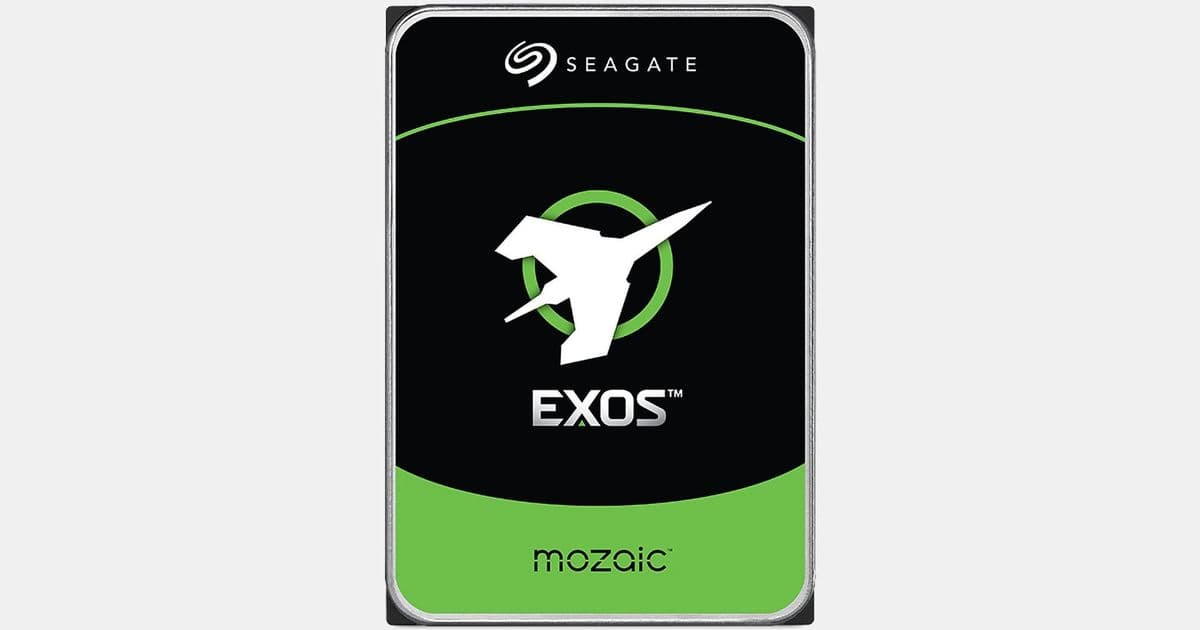
Seagate has begun shipping 44TB hard drives featuring heat-assisted magnetic recording (HAMR) technology to two leading hyperscale cloud service providers, marking a significant milestone in enterprise storage capacity and efficiency.
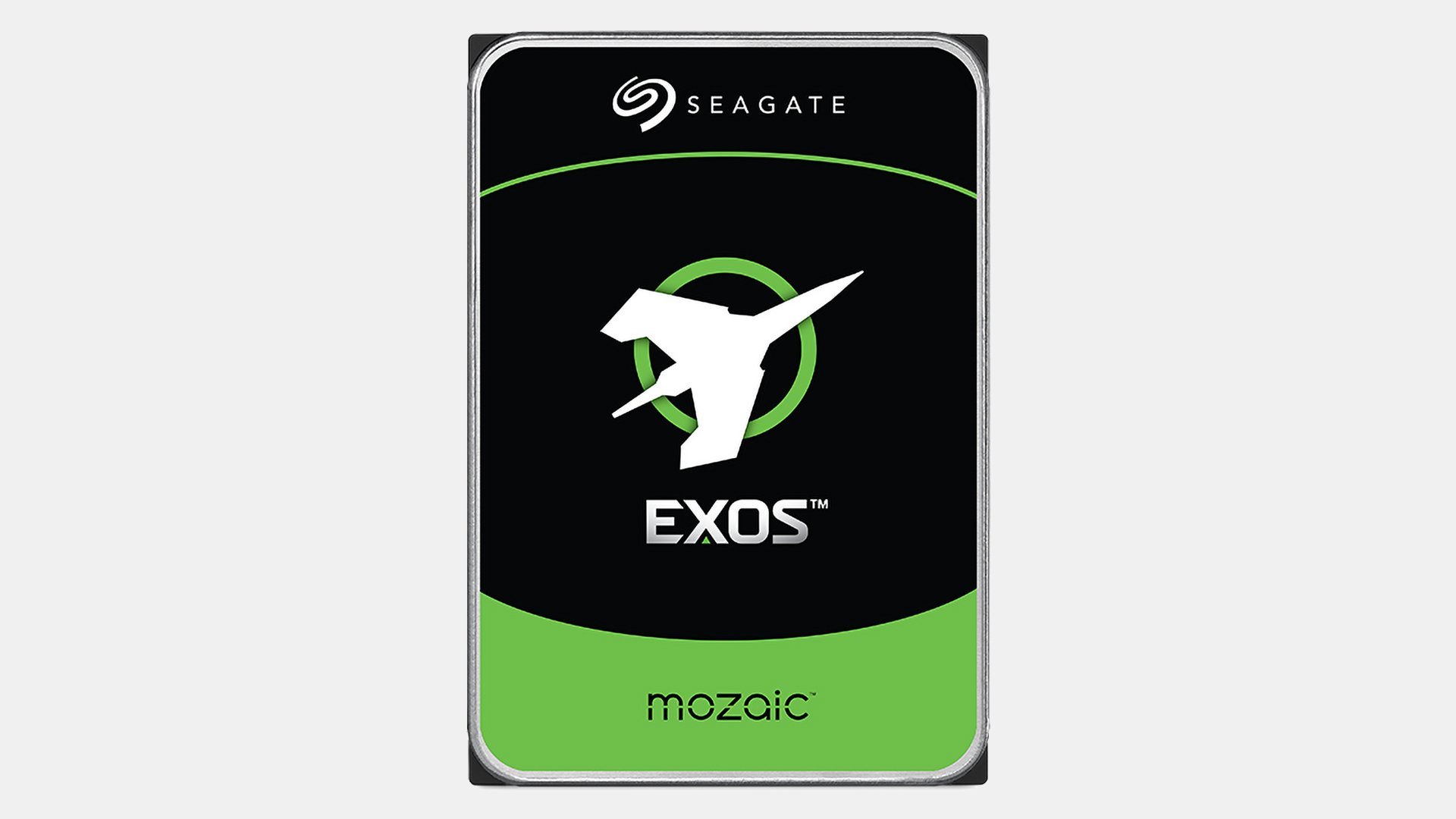
Seagate has officially begun shipments of its 44TB hard disk drives featuring the company's Mozaic 4+ platform to two leading hyperscale cloud service providers (CSPs), marking a significant milestone in enterprise storage technology. The new drives leverage Seagate's heat-assisted magnetic recording (HAMR) technology, which the company has been developing for years as the next evolution beyond traditional perpendicular magnetic recording (PMR).
(Image credit: Seagate)
The Mozaic 4+ platform represents a fundamental shift in hard drive architecture. By utilizing 10 platters with up to 4+ TB capacity per platter, Seagate has achieved the 44TB capacity milestone. This represents a substantial increase from previous generation drives, which typically maxed out at 20-24TB using conventional recording technologies. The drives are believed to feature a 7200 RPM spindle speed and conventional magnetic recording (CMR) architecture, which should provide predictably high performance by HDD standards—sustained data transfer rates of around 300 MB/s, though these specifications remain speculative until formal product announcements.
What makes this announcement particularly noteworthy is Seagate's strategic timing. The company has chosen to formally introduce only its 44TB HDD at this stage, despite the fact that other capacity points using the Mozaic 4+ platform are currently being qualified by large CSPs. This represents a departure from traditional hard drive launch strategies, where manufacturers typically release entire product families across multiple capacity tiers simultaneously.
The timing appears deliberately calculated to counter Western Digital's recent announcement that it plans to ship 40TB hard drives in the second half of this year. While both companies are competing in the ultra-high-capacity enterprise storage market, their technological approaches differ significantly. Western Digital's 40TB drive relies on energy-assisted magnetic recording (EAMR) combined with UltraSMR (Shingled Magnetic Recording) technology. This approach maximizes capacity but comes with the trade-off of slower overwrite performance, making it less suitable for write-intensive workloads.
Seagate's HAMR-based approach, by contrast, maintains conventional CMR recording characteristics while achieving higher areal density through the use of laser heating to temporarily reduce the coercivity of the recording medium during the write process. This allows for smaller magnetic grains and tighter track spacing without sacrificing the overwrite performance that enterprise customers require.
The competitive implications extend beyond simple capacity comparisons. When deployed at hyperscale, the difference between 40TB and 44TB becomes significant when power consumption per terabyte is considered. Seagate claims that its 44TB offering provides a 47% increase in overall system efficiency compared to 30TB drives. This translates to approximately 100 square feet of reduced physical footprint for storage clusters and annual power savings of around 0.8 million kilowatt-hours for large deployments.
These efficiency gains are particularly relevant in today's AI-driven data center landscape, where the exponential growth of training data and inference workloads is driving unprecedented demand for storage capacity. As Dave Mosley, Seagate's chair and chief executive officer, noted: "Data has become one of the most valuable assets for enterprises, fueling business insights, enhancing productivity, and enabling competitive advantage. As the foundation of modern data center infrastructure, data storage solutions are essential to manage ever-increasing data volumes and maximize returns on investments in today's AI driven-world."
The shipment of these drives to actual hyperscale customers represents more than just a technological achievement—it validates HAMR as a commercially viable technology after years of development and speculation. While Seagate has demonstrated HAMR technology in laboratory settings for years, the transition to volume production and customer deployment marks a critical inflection point for the hard drive industry.
For the broader storage ecosystem, this development signals that the hard drive industry still has significant room for capacity growth, even as solid-state drives continue to gain market share in performance-sensitive applications. The ability to continue scaling HDD capacity through technologies like HAMR ensures that hard drives will remain relevant for cold storage, archival, and other capacity-centric workloads for years to come.
The competitive dynamics between Seagate and Western Digital in the ultra-high-capacity market will likely intensify as both companies push toward even higher capacity points. Industry analysts expect to see 50TB+ drives from both manufacturers within the next 2-3 years, though the specific technologies employed may vary based on the trade-offs each company is willing to make between capacity, performance, and manufacturing complexity.
As these 44TB HAMR drives begin rolling out to hyperscale data centers, the industry will be watching closely to see how they perform in real-world deployments and whether they can deliver on the efficiency promises that make them attractive for large-scale infrastructure investments.
Comments
Please log in or register to join the discussion