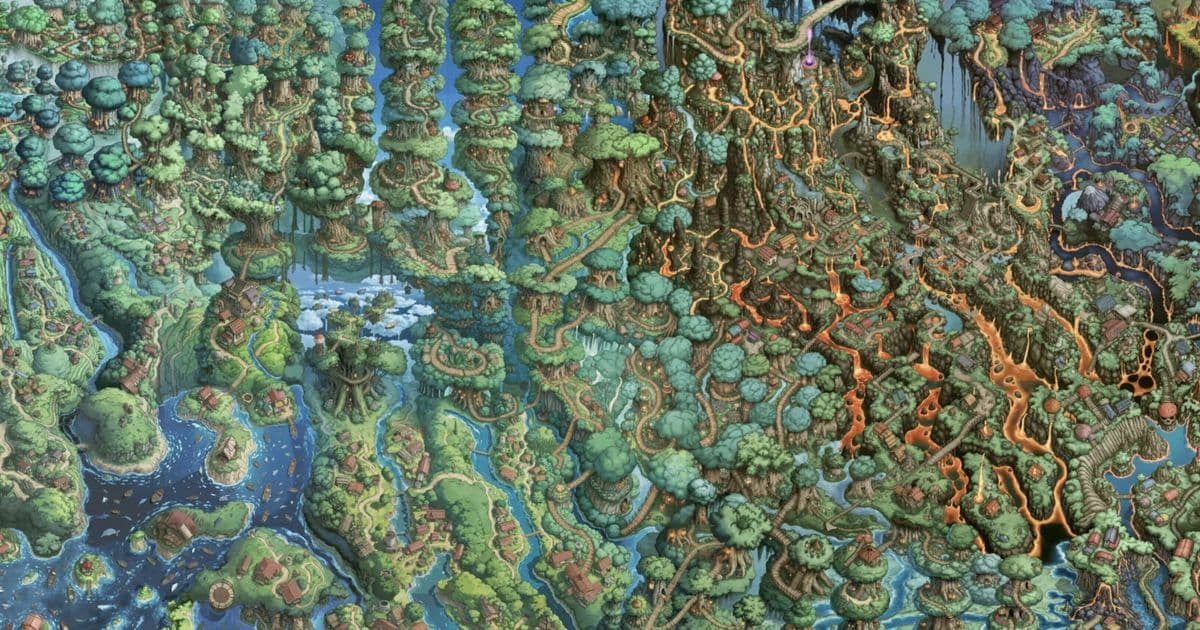
Explore the technical wizardry behind an infinitely expanding AI art canvas where users collaboratively generate landscapes that evolve into digital dementia. Discover how inpainting, biome mapping, and Cloudflare caching create this real-time collaborative experience on a budget.
The Infinite Canvas: Where AI Art Meets Procedural World-Building
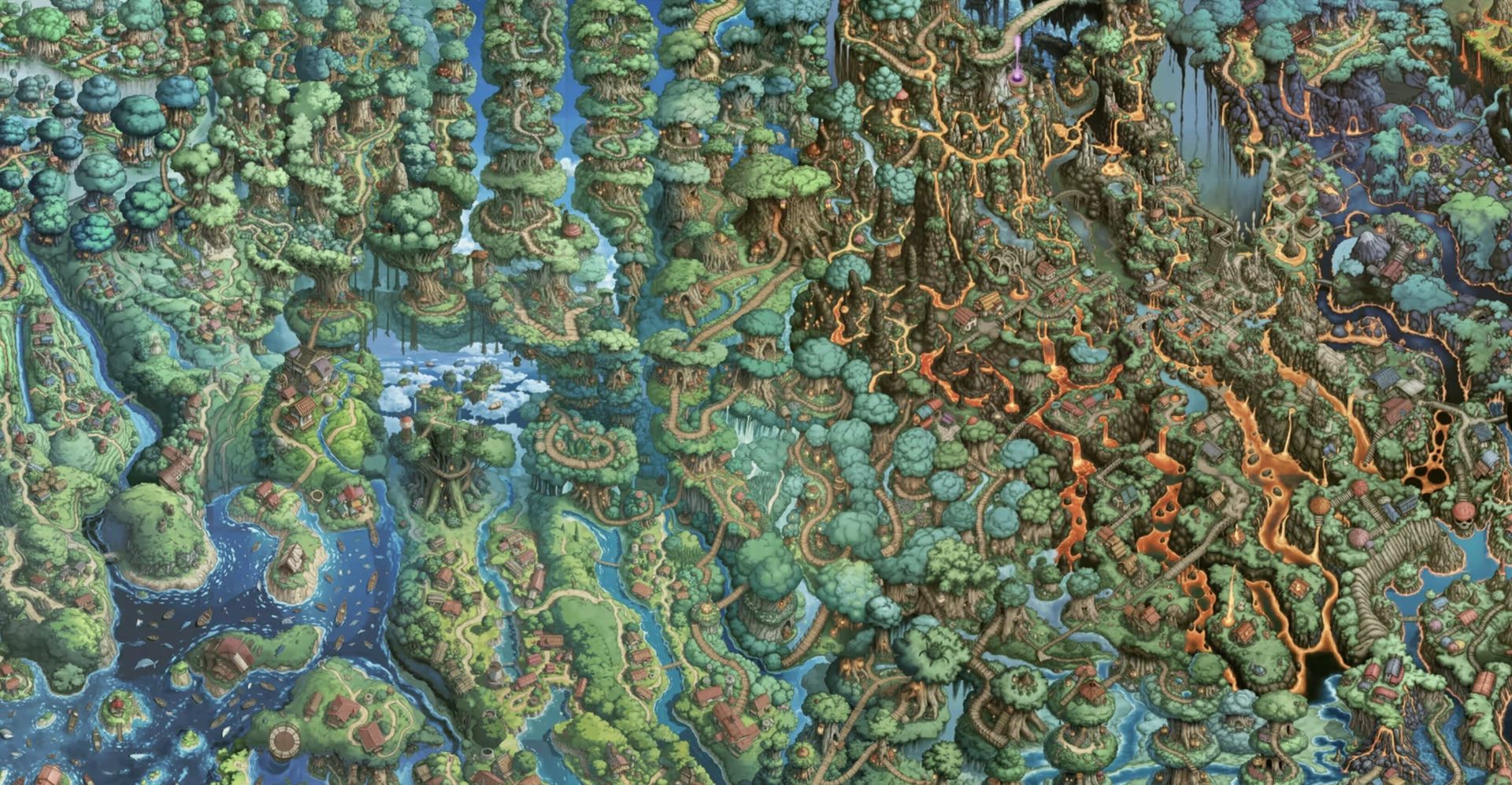
Imagine an art canvas that expands infinitely in all directions, where every edge becomes a gateway to new AI-generated landscapes. This is the vision behind Gabriel Ferraté's Infinite Canvas project, a technical marvel blending generative AI with collaborative exploration. As users push boundaries, they trigger AI inpainting that extends the artwork—but with each generation, subtle distortions accumulate, creating what Ferraté calls "digital dementia": a haunting echo of how memories fragment over time.
The Technical Trifecta: Inpainting, Grids, and Biomes
AI Inpainting: Seamless Boundary Expansion
At the project's core lies AI inpainting—the technique that enables visual continuity. When users reach an edge:
- The system slices a 512px overlapping section from the existing image
- A mask preserves the overlapping area (white) while marking new territory for generation (black)
- The AI generates new content using biome-specific prompts
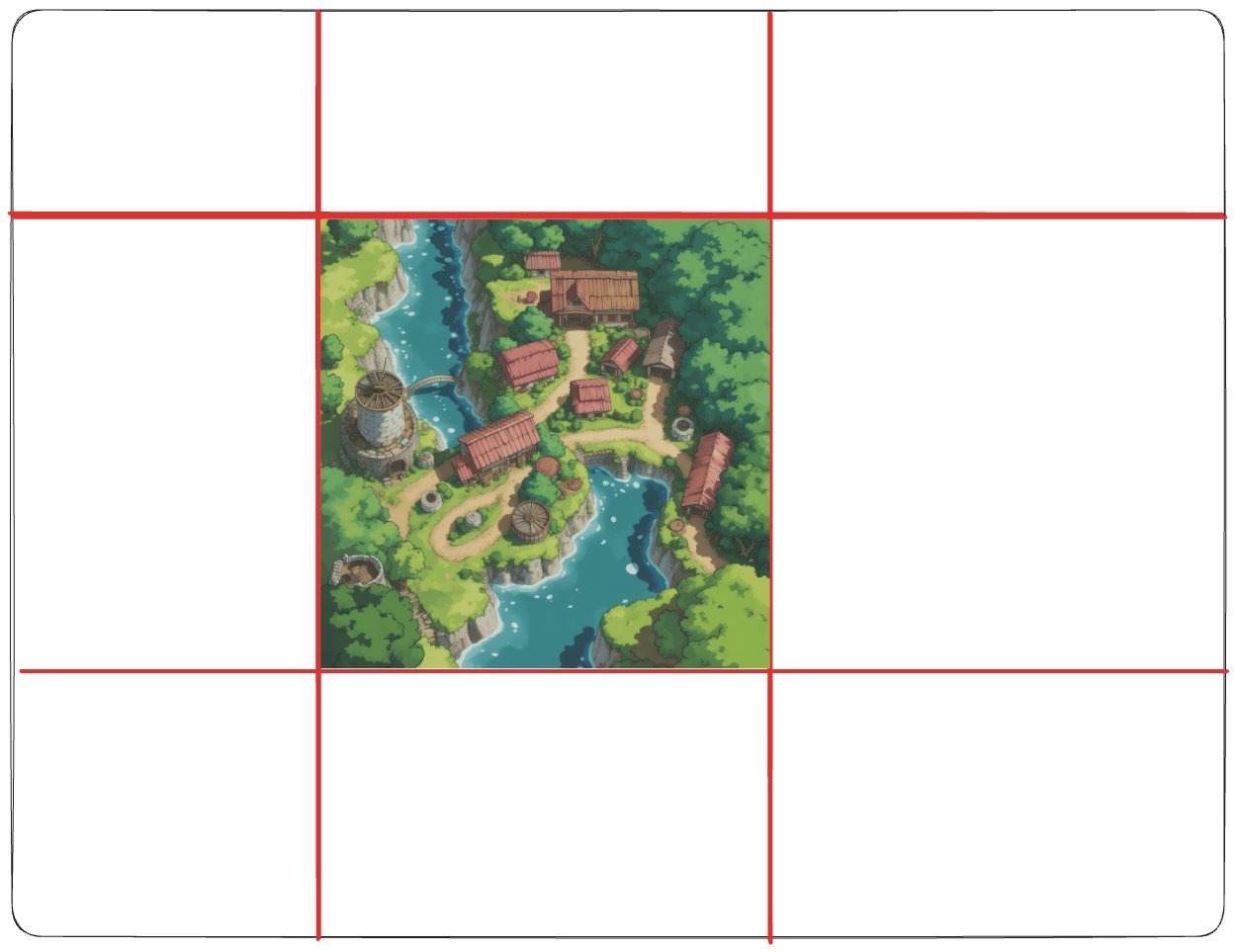 Inpainting process: White areas are preserved, black areas regenerated (Source: Infinite Canvas whitepaper)
The Grid Architecture
"The canvas is essentially a massive coordinate grid," Ferraté explains. Each cell represents a 1024x1024 image tile. Generating adjacent tiles requires precise overlap stitching:
// Simplified tile generation logic
function generateAdjacentTile(baseTile, direction) {
  const overlap = baseTile.sliceOverlap(direction, 512);
  const prompt = getBiomePrompt(baseTile.coordinates);
  return aiInpaint(overlap, prompt);
}
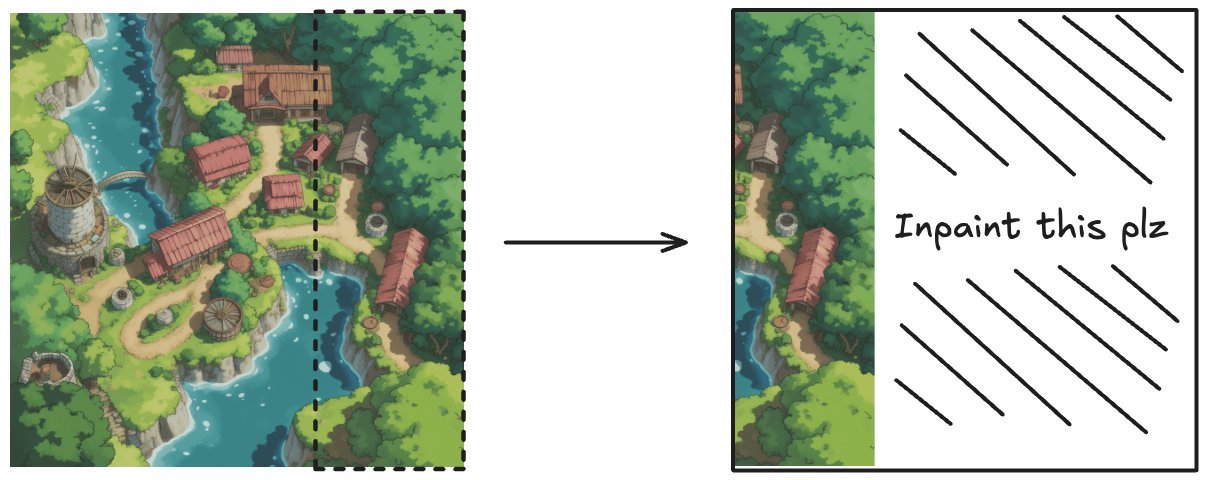 Grid system showing single tile expansion (Source: Infinite Canvas whitepaper)
Procedural Biomes: Minecraft Meets DALL·E
Inspired by Minecraft's terrain generation, Ferraté implemented:
- Biome Map: 1000x1000 Simplex noise texture where colors map to environments (red=volcano, blue=ocean)
- Feature Map: Secondary noise layer adding castles, rivers, or festivals
- Dynamic Prompting:
`Extend existing image as world set in ${biome_prompt}.
${feature_prompt ? 'Prominent feature: ' + feature_prompt : ''}`
This creates permutations like "mystical forest city with fantasy castle town" without manual input.
Scaling the "Infinite": Infrastructure Magic
The $40k Problem
Generating all million possible tiles would cost ~$40k. Ferraté's solution:
- Lazy Loading: Only viewport-visible tiles load
- Smart Caching:
- Cloudflare Cache-Tag headers for instant purging
- Read-after-write consistency via real-time invalidation
- Non-generated cells poll every 10s
- Multi-Resolution Rendering: 1024px/512px/256px versions load based on zoom level
{{IMAGE:5}} Without precise overlap stitching, generated tiles wouldn't align (Source: Infinite Canvas whitepaper)
Budget Engineering
"Cloudflare's free tier is something out of this world," notes Ferraté. The stack leverages:
- Cloudflare Workers for serverless logic
- R2 storage for images (no egress fees)
- $5/month Hetzner VPS for background queues
The Philosophy of Digital Dementia
As the canvas expands, AI's subtle imperfections compound—colors shift, shapes morph, themes blur. This emergent behavior wasn't designed but discovered, echoing artist William Utermohlen's fading self-portraits. The project becomes a meditation on generative entropy: even AI's "perfect" recall degrades through iterative creation.
Ferraté acknowledges the cost challenges, implementing a paywall where contributions directly fund new tile generation. What began as an experiment now evolves collectively—a shared universe where every pixel tells a story of technical ingenuity and artistic serendipity.
"You're not just paying for pixels; you're helping create a community-driven piece of art." — Gabriel Ferraté
Explore the canvas yourself and witness how boundaries between human collaboration and AI generation dissolve into infinite possibility.
Source: Infinite Canvas Whitepaper
Comments
Please log in or register to join the discussion