An analysis of Brian Potter's comprehensive exploration of oil refining technology, examining the complex processes that transform crude oil into the essential products that fuel modern civilization.
In an era increasingly defined by renewable energy ambitions, Brian Potter's article on oil refining serves as a crucial reminder of the industrial infrastructure that continues to underpin modern society. Potter masterfully demystifies the complex world of petroleum processing, revealing both the elegant simplicity and staggering scale of oil refineries that most people never see or contemplate.
The article's central thesis—that oil refineries remain indispensable despite the growth of renewable energy—rests on compelling quantitative foundations. Potter establishes that oil still accounts for 30% of global energy consumption, a figure higher than any other energy source, while an astonishing 90% of chemical feedstocks derive from petroleum. These statistics underscore a fundamental truth: modern civilization cannot simply pivot away from oil without confronting the complete restructuring of chemical manufacturing, plastics production, and transportation systems.
What makes Potter's analysis particularly valuable is his ability to render technically complex processes accessible without oversimplification. The article progresses logically from basic principles to sophisticated operations, beginning with the fundamental chemistry of crude oil—a mixture of thousands of hydrocarbon molecules ranging from simple propane to complex asphaltenes containing thousands of atoms. Potter effectively explains how refineries leverage the physical properties of these molecules, primarily their different boiling points, to separate crude oil into useful fractions through distillation.
The distillation process, Potter explains, forms the backbone of every refinery. By heating crude oil to 650-750°F and introducing the vapor into a distillation column, refineries can separate components based on their condensation temperatures. This elegant physical process creates the basic fractions that undergo further processing: light gases at the top, progressively heavier liquids at lower levels, and residuals at the bottom. Potter then builds upon this foundation to explain more complex processes like catalytic cracking, which uses catalysts to split heavy molecules into lighter, more valuable ones; vacuum distillation, which allows processing of heavy fractions without thermal cracking; and thermal cracking methods like coking, which handles the heaviest molecules that would poison catalysts in other processes.
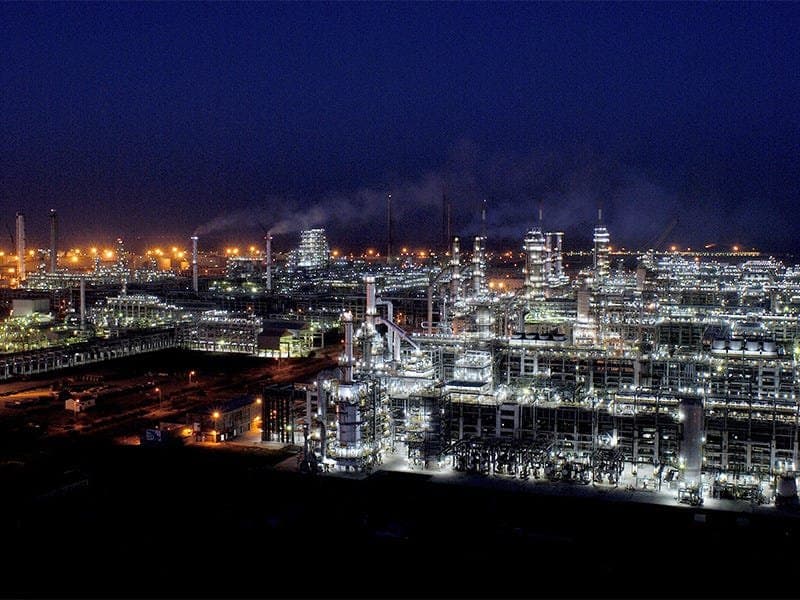
Potter's inclusion of specific refinery examples, particularly Chevron's Richmond facility and India's Jamnagar refinery, grounds the technical explanation in concrete reality. The detailed process flow diagram and capacity statistics for Richmond demonstrate how these theoretical processes are arranged in practice, showing the intricate network of pipes, vessels, and processing units that work in concert to transform crude oil into finished products. The comparison between Richmond's complexity index of 14 and Jamnagar's 21 effectively illustrates how refineries vary in sophistication based on their intended outputs.
What emerges from Potter's analysis is a profound appreciation for the scale of oil refining infrastructure. The fact that it takes 400 Richmond-size refineries to meet global demand, each processing a quarter-million barrels daily, speaks to the industrial metabolism of modern civilization. Potter emphasizes that the expense of refineries stems less from process complexity and more from the sheer volume of material processed—a point that highlights the fundamental challenge of replacing fossil fuels at current consumption levels.
The article implicitly raises several important questions about the future of refining technology. As the world transitions toward lower-carbon energy systems, how will refineries adapt? Will they increasingly focus on producing petrochemical feedstocks rather than transportation fuels? Will carbon capture technologies become standard components of refinery operations? Potter doesn't address these questions directly, but his thorough explanation of current technology provides a necessary foundation for understanding potential future developments.
One limitation of the article is its relative lack of discussion about environmental considerations. While Potter focuses on the technical processes, the environmental impact of refining—air emissions, wastewater discharge, and solid waste generation—represents a significant aspect of refinery operations that influences both design and operation. Similarly, the article doesn't explore how different regulatory frameworks around the world affect refinery design and complexity.
Despite these omissions, Potter's article stands as an excellent example of technical writing that bridges the gap between specialized engineering knowledge and general understanding. By explaining not just how refineries work, but why they work the way they do, Potter provides readers with a deeper appreciation for the industrial infrastructure that enables modern life. In a world increasingly focused on renewable energy, this article serves as an important reminder that understanding current systems is essential for planning meaningful transitions.
For those interested in exploring the technical aspects further, the International Energy Agency provides comprehensive data on global refining capacity and trends, while the American Fuel & Petrochemical Manufacturers offers insights into industry operations. The Nelson-Farrar Refinery Complexity Index represents the industry standard for measuring refinery sophistication that Potter references in his analysis.
Comments
Please log in or register to join the discussion