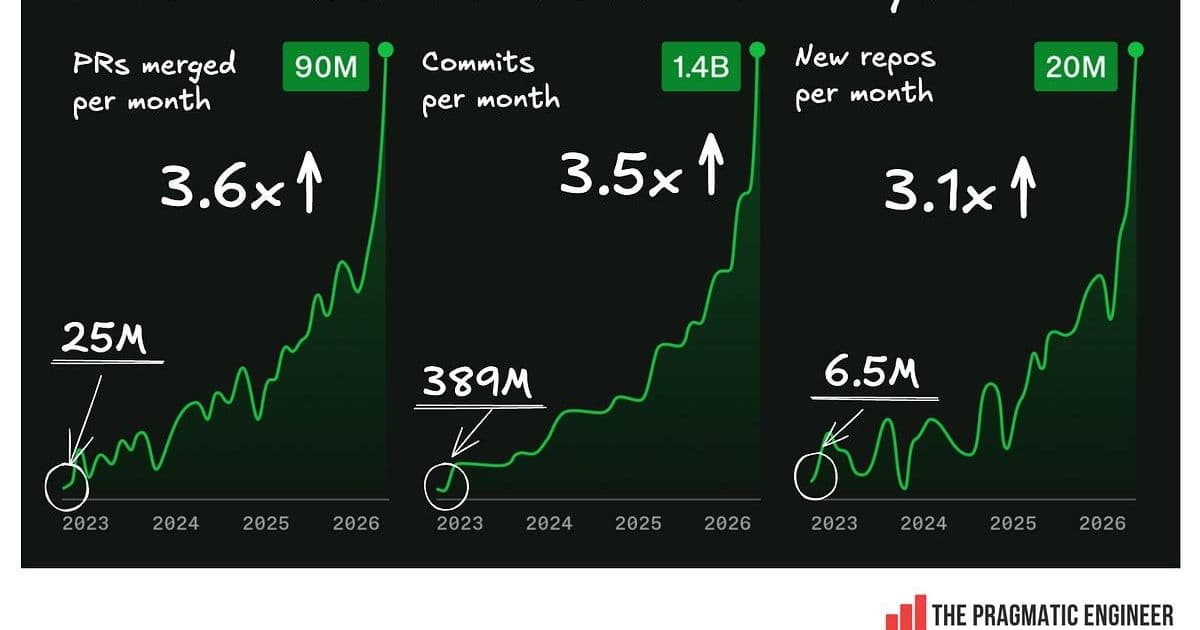
GitHub's reliability has plummeted to unacceptable levels while other platforms handle similar AI loads without issue. We examine the technical reasons behind this divergence and what it means for developers' workflows.
GitHub's reliability crisis has reached a critical point. While the platform once served as the backbone of the open-source and professional development communities, recent performance metrics paint a troubling picture: reliability has dropped from a concerning 90% last month to a mere 86% this month, with a complete failure to maintain even one nine (99.9%) uptime.
This degradation comes at a particularly inconvenient time, as GitHub's leadership attributes the issues to a 3.5x increase in service load driven by AI-powered features. Yet other platforms handling similar AI workloads—GitLab, Bitbucket, and newer entrants like Sourcegraph—have maintained their reliability, raising questions about architectural decisions and technical debt.
The Technical Reality Behind GitHub's Struggles
The most recent incident involved a significant data integrity issue where repository metadata became inconsistent, causing merge conflicts to appear without warning and commit histories to appear corrupted for some users. This wasn't just a temporary outage; it left teams scrambling to verify their codebases' integrity.
GitHub's explanation points to "unprecedented load" from AI features like GitHub Copilot and Copilot Chat. However, this explanation doesn't fully hold water when compared to other platforms experiencing similar traffic spikes without comparable reliability issues.
Several technical factors likely contribute to GitHub's problems:
Legacy Architecture: GitHub's core infrastructure evolved from early Git hosting services, with multiple acquisitions and architectural transitions. This has resulted in a complex monolith with microservices bolted on, rather than a clean, modern architecture designed for scale.
State Management: Unlike competitors who designed their systems with eventual consistency in mind, GitHub's relational database approach creates bottlenecks under high load.
Caching Strategy: GitHub's caching mechanisms appear ineffective for AI-driven workloads, which have different access patterns than traditional version control operations.
Resource Allocation: Reports from former employees suggest GitHub's infrastructure teams have been chronically under-resourced, with decision-making often prioritizing feature velocity over system stability.
Why Other Platforms Handle AI Load Better
GitLab, for example, built their platform on a container-first architecture from the ground up, making it naturally more elastic. Their use of Kubernetes and stateless services allows them to scale horizontally to accommodate unpredictable AI-driven traffic.
Bitbucket, while smaller in scale, benefits from being part of Atlassian's cloud infrastructure, which was designed for multi-tenant workloads from the start.
Newer entrants like Sourcegraph have taken an even more modern approach, building their platform around event-driven architecture and serverless components that can automatically scale based on actual load rather than provisioned capacity.
The Human Impact
The reliability issues have real consequences for development teams. Prolific open-source contributor Mitchell Hashimoto, creator of Terraform, recently announced his departure from GitHub, stating that the platform is "not suited for professional work." This sentiment is increasingly common among experienced developers who remember GitHub's more reliable past.
"When basic operations like cloning repositories, creating pull requests, and viewing code become unreliable, the entire development workflow breaks down," said Hashimoto in a recent blog post. "The platform that once enabled global collaboration now actively hinders it."
Industry-Wide Implications
GitHub's struggles highlight a broader industry challenge: how to maintain reliability while rapidly scaling AI-driven features. The pressure to deliver AI-powered tools has led many companies to prioritize speed over stability.
This trend extends beyond GitHub. Anthropic, once seen as the ethical alternative to OpenAI, has recently faced criticism for silently nerfing Claude Code, banning companies from using their services, and implementing baffling price increases—all while claiming improvements to their models.
"We're seeing a pattern where companies prioritize monetization over user experience," notes industry analyst Sarah Chen. "GitHub's reliability issues and Anthropic's recent changes suggest we're entering an era where 'good enough' is no longer good enough for professional developers."
The Building Block Economy
In related news, Mitchell Hashimoto has been exploring what he calls the "building block economy"—the idea that successful open-source projects can serve as foundational components for larger systems. Ghostty, his terminal emulator project, has gained significant adoption by focusing on being a reliable building block rather than a complete solution.
"The challenge," Hashimoto explains, "is that while open source building blocks can achieve massive adoption, building a sustainable business on top of them has become increasingly difficult. Platforms like GitHub, once enablers of this model, now create friction rather than remove it."
What's Next for GitHub
GitHub has announced several initiatives to address the reliability issues, including:
- Infrastructure investments to handle AI workloads
- A new caching layer specifically designed for AI-assisted development
- Enhanced monitoring and alerting systems
- A dedicated reliability engineering team
However, given the complexity of the issues and the scale of the platform, meaningful improvements will likely take months, if not years, to implement.
For developers, the situation presents a difficult choice: continue dealing with an increasingly unreliable platform or invest time in migrating to alternatives, each with their own trade-offs. As AI becomes more integrated into development workflows, the reliability of these platforms will become even more critical.
GitHub's decline serves as a cautionary tale for all tech companies: as you add new features, never forget that the core functionality must remain reliable. After all, a platform that can't reliably host code isn't much use to developers.
What's your experience with GitHub's reliability issues? Have you considered switching platforms? Share your thoughts in the comments.
Related Resources:
- GitHub Status - Official status page
- GitLab Architecture - Technical overview
- Mitchell Hashimoto on Building Blocks - Original blog post
- Anthropic's Recent Changes - Official announcements
Comments
Please log in or register to join the discussion