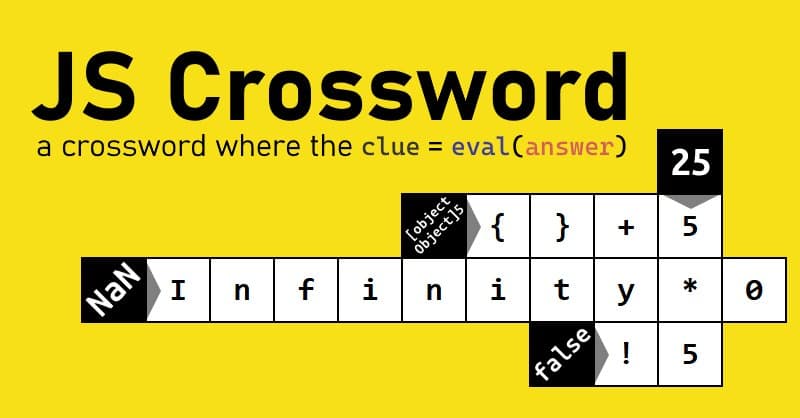
An innovative crossword puzzle that challenges JavaScript developers to solve clues using code expressions that evaluate to the correct answers.
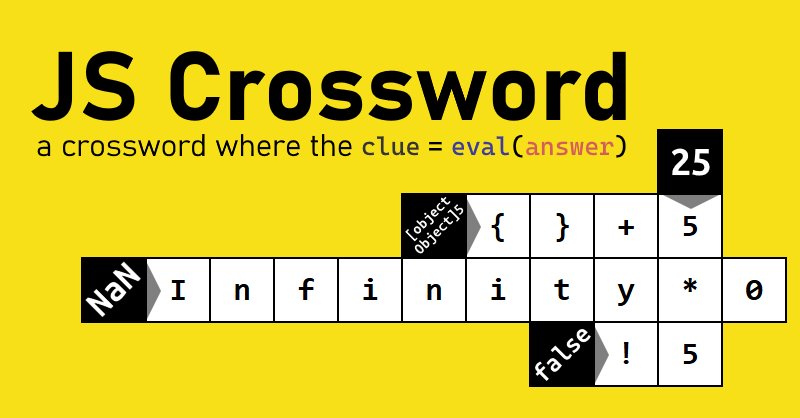
The world of JavaScript puzzles has just welcomed a unique and challenging new entrant: JS Crossword. This innovative crossword reimagines the traditional word puzzle by requiring solvers to write JavaScript code expressions that, when evaluated, produce the correct answers to each clue. It's a fascinating intersection of programming knowledge, language quirkiness, and traditional puzzle-solving that pushes JavaScript enthusiasts to explore the language's more obscure features.
At its core, JS Crossword operates on a simple yet brilliant premise: each clue corresponds to a JavaScript expression that, when passed through eval(), evaluates to the expected answer. For instance, a clue with the number 7 could be solved with expressions like "3+4", "7", "14/2", or even more creative solutions like "10-3". This approach transforms the crossword from a simple vocabulary test into a deep exploration of JavaScript's evaluation mechanics and type coercion behaviors.
The technical constraints of the puzzle add significant complexity. Players are limited to a specific character set: A-Za-z0-9!"()*+-./<=>[]`{}, which excludes spaces, commas, and semicolons—characters that are fundamental to typical JavaScript syntax. This restriction forces solvers to think creatively about how to construct valid expressions without these common delimiters and separators. The case-sensitive nature of the crossword further complicates matters, as "A" and "a" would be considered distinct answers.
What makes JS Crossword particularly challenging is its reliance on "lesser-known and cursed JS features." These might include:
- Type coercion behaviors (like how
[]+{}becomes "[object Object]") - Unary operators and their effects
- Template literal tricks
- Bitwise operations
- Abstract equality comparisons
- Object property access patterns
- Array methods used in unconventional ways
The educational value of such a puzzle cannot be overstated. By requiring developers to construct expressions that evaluate to specific results, the crossword deepens understanding of JavaScript's type system, evaluation order, and coercion rules. It encourages experimentation with the language's edge cases and peculiarities, which often lead to a more robust mental model of how JavaScript works under the hood.
The implementation includes a sandboxed eval environment where players can test their solutions before committing them to the grid. This sandboxed approach is crucial for security, preventing potentially malicious code from executing while still allowing the necessary evaluation of JavaScript expressions. The puzzle also saves progress locally, ensuring that solvers can return to their work without losing their place.
The crossword's design reflects a deep understanding of both JavaScript's peculiarities and the psychology of puzzle-solving. By requiring final answers to be English words (only A-Za-z), it maintains the traditional crossword feel while still allowing the solving process to be entirely code-based. This creates an interesting duality where the method of solution is technical, but the result is linguistic.
From a technical perspective, creating such a crossword presents numerous challenges:
- Designing clues that have multiple valid solutions
- Ensuring the grid layout works with the character constraints
- Creating a robust evaluation system that can handle various edge cases
- Implementing a user interface that supports the unique input requirements
The puzzle also raises interesting questions about JavaScript's design philosophy and the balance between helpful features and potential "gotchas." By leveraging these edge cases in a puzzle format, JS Crossword turns what might be considered language flaws into learning opportunities.
For JavaScript developers, this crossword represents more than just a diversion—it's a chance to engage with the language on a deeper level. The process of finding multiple solutions to a single clue encourages exploration of different approaches and a more nuanced understanding of JavaScript's evaluation model.
The social aspect is also noteworthy, with the puzzle encouraging sharing of thoughts and solutions on various platforms like fedi, bsky, and Twitter. This creates a community around the puzzle where solvers can share insights, celebrate clever solutions, and learn from each other's approaches.
In conclusion, JS Crossword stands as a testament to the creativity that can emerge when traditional puzzle formats meet programming language education. It challenges JavaScript developers to think differently about code evaluation, explore language edge cases, and find elegant solutions within strict constraints. As both a learning tool and entertainment, it occupies a unique space in the JavaScript ecosystem, offering a fresh approach to deepening one's understanding of the language through play and exploration.
For those interested in tackling this unique challenge, the crossword provides an opportunity to test and expand JavaScript knowledge in a fun, engaging format. Whether you're a seasoned JavaScript developer looking to test your knowledge or an intermediate learner wanting to explore the language's quirks, JS Crossword promises a rewarding experience that combines the satisfaction of puzzle-solving with the intellectual stimulation of programming.
Comments
Please log in or register to join the discussion