
A palm-sized universal adapter solving global charging woes. With versions for USB-C purists and legacy device users, this $30 gadget supports over 200 countries' outlets while delivering up to 30W. We test whether its compact design sacrifices utility.
For frequent travelers, bulky power adapters have long been the bane of minimalist packing. Rolling Square's Pocket Travel Charger challenges this paradigm with a remarkably compact design that morphs to fit outlets across 200+ countries. Unlike traditional bricks that dominate luggage space, this device fits in the palm of your hand—a revelation for those prioritizing portability.
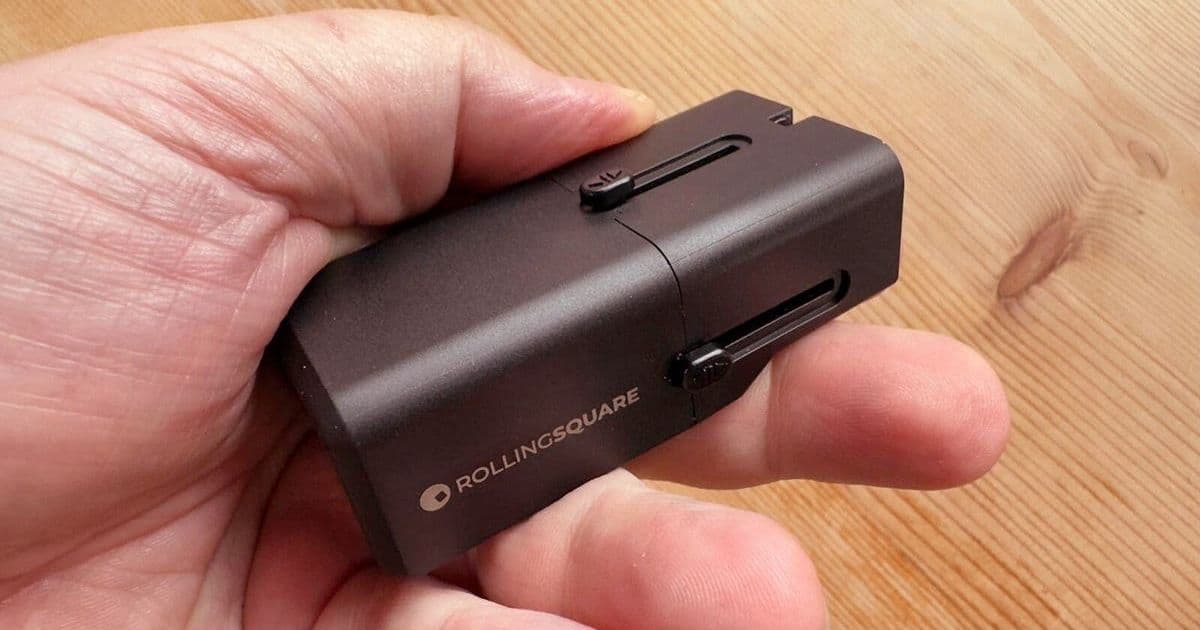
) The Rolling Square Pocket Travel Charger with extended prongs for international sockets (Source: ZDNET)
The Rolling Square Pocket Travel Charger with extended prongs for international sockets (Source: ZDNET)
Technical Specifications & Versions
Available in two configurations:
- 30W USB-C Version: Single-port, optimized for modern devices (8.1 oz)
- 20W Dual-Port Version: USB-C + USB-A, accommodating legacy accessories (7.9 oz)
Both models feature retractable prongs supporting:
- Type A (North America/Japan)
- Type C (Europe)
- Type G (UK)
- Type I (Australia)
Critical voltage compatibility:
Voltage Range: 100V-250V
Frequency: 50Hz/60Hz
Real-World Performance
During rigorous testing across multiple continents, the charger consistently delivered stable power without overheating. The 30W variant efficiently charged smartphones and tablets, though MacBook Pro users will need higher-wattage alternatives. The dual-port model’s 20W output splits to 15W when both ports are active—sufficient for simultaneous phone and earbud charging but not power-hungry devices.
Why This Matters for Tech Professionals
Beyond convenience, the adapter addresses three critical travel pain points:
- Reduced failure points: No detachable components to lose
- Emergency readiness: Fits in pockets for on-the-go charging
- Cost efficiency: At $30, it undercuts premium competitors like Tessan by 40%
While not replacing high-wattage workstations, its 57g weight and robust aluminum casing make it ideal as a backup or minimalist primary charger. As USB-C becomes ubiquitous, such hyper-portable solutions exemplify how hardware innovation aligns with the mobile-first workflows of modern developers and digital nomads.
Source: ZDNET
Comments
Please log in or register to join the discussion