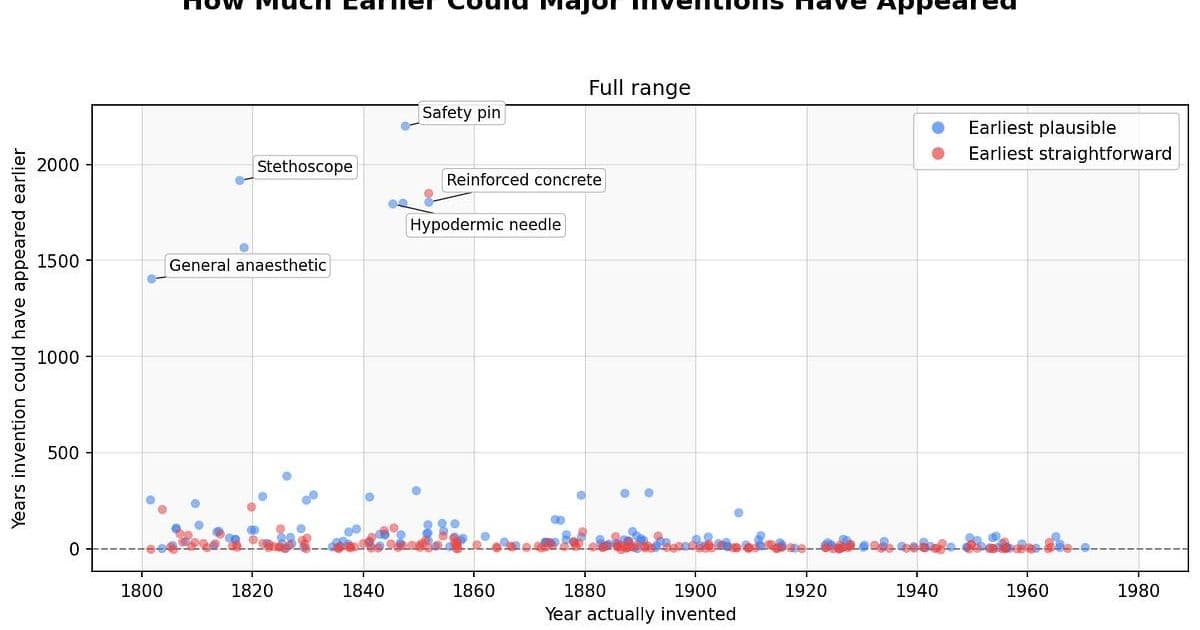
A rigorous analysis of 166 major inventions finds that most technologies emerge within decades of becoming technically feasible, with delays shrinking dramatically in the 20th century, challenging common assumptions about slow technological progress and the role of scientific discovery in driving innovation.
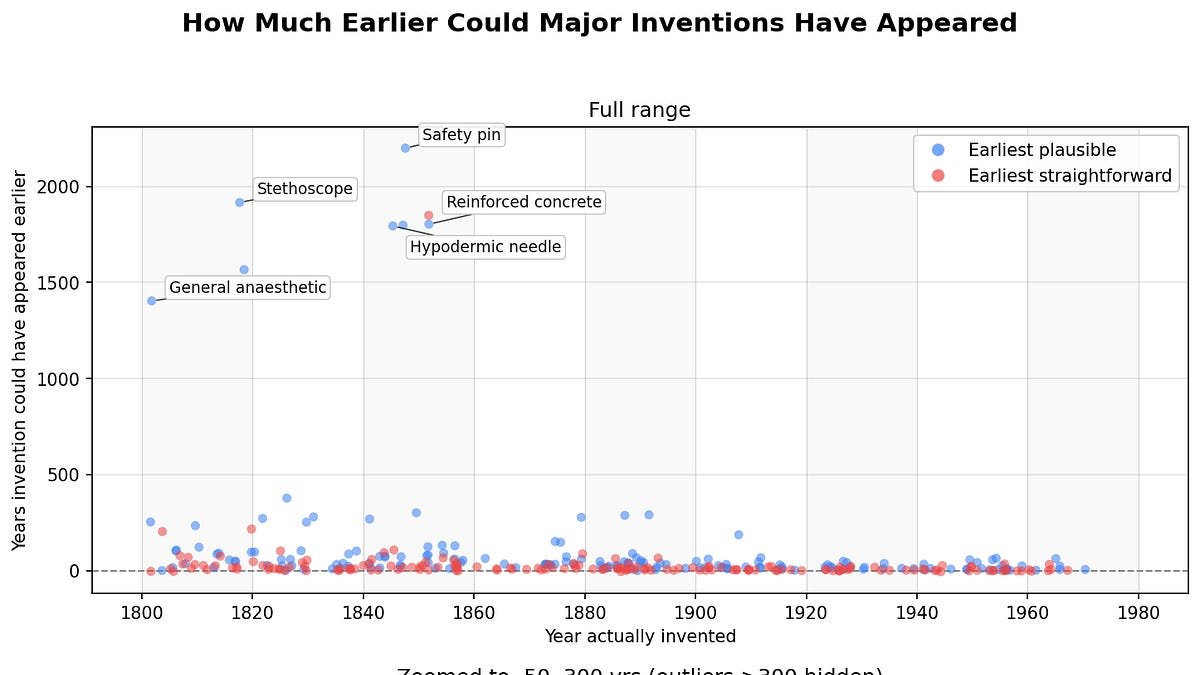
Brian Potter’s recent study published on Construction Physics, his Substack-based publication focused on industrial technology and infrastructure, uses AI-generated historical simulations to map the gap between technical possibility and actual invention for 166 major technologies, arriving at a counterintuitive conclusion that most inventions face relatively short lags between feasibility and emergence, with post-1900 gaps narrowing to less than a decade for three-quarters of technologies. This work challenges pervasive narratives that frame major technological leaps as decades or centuries overdue, instead reframing invention timing as a function of cross-disciplinary knowledge sharing, component technology maturity, and domain-specific risk tolerance, rather than mere scientific discovery, a dynamic illustrated by the maser and laser, which relied on combining decades-old stimulated emission research with engineering oscillator designs once physics and engineering communities began collaborating.
Methodology and Verification
Potter’s analysis begins with a core question: how long after a technology becomes technically possible does it actually appear? To answer this, he used a pre-existing list of 190 major inventions, then prompted Claude Opus 4.7, an AI model developed by Anthropic, to estimate two date ranges for each invention. The first, termed 'earliest plausible,' assumes a well-funded team of skilled engineers working in era-appropriate workshops, with a five-year development window, permission to build one simple precursor technology, and the ability to generate new knowledge through iterative experimentation, but no access to novel scientific frameworks or serendipitous empirical discoveries. The second, 'earliest straightforward,' marks the period when multiple independent teams would likely converge on a working model. Crucially, Potter defined technical possibility as the ability to build a working example, regardless of whether the technology was practical, economically viable, or solving an articulated problem, a choice driven by the difficulty of assessing historical economic demand and the focus of his invention list on first working models rather than commercialized versions.
To validate the AI’s outputs, Potter conducted multiple verification steps. He performed spot checks on verifiable claims, such as confirming that Galvani published research on electric current in 1791 as part of the arc lamp analysis. For 20 inventions, he asked Claude to pair claims with reliable sources, then audited those sources himself, yielding a 97% accuracy rate for verifiable factual claims. A screenshot from one such verification run is included below, showing the detailed audit process.
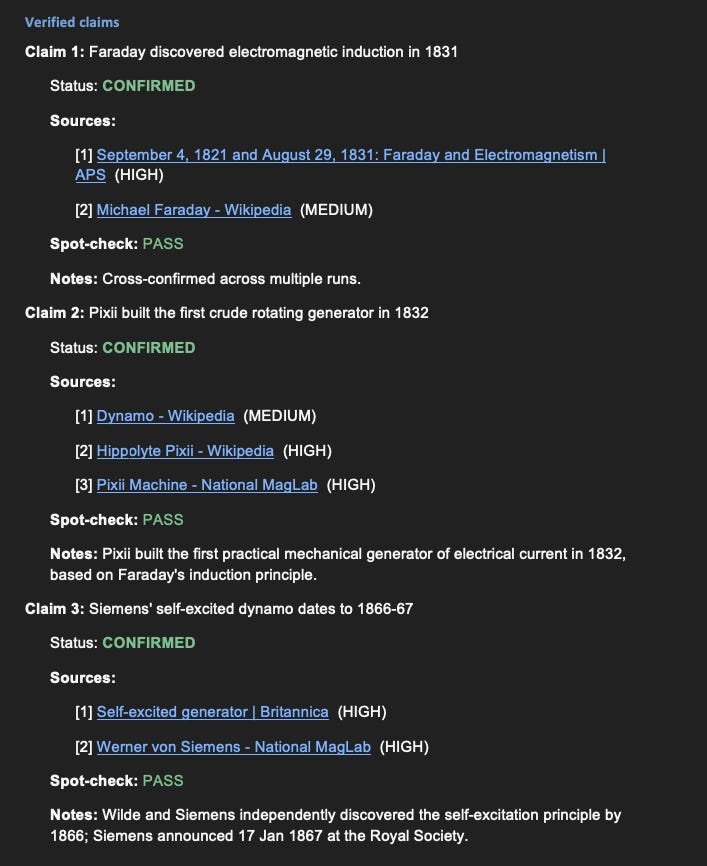
Potter also manually reviewed Claude’s analyses of three technologies he knew well: the Fleming valve, the Wright Flyer, and the turbojet. For the Fleming valve, Claude correctly identified the 1883 Edison effect as the binding constraint, noting that the valve could have been developed shortly after this observation once the use case for radio detectors emerged. For the Wright Flyer, Claude pointed to lightweight internal combustion engines as the key bottleneck, enabled by the 1876 Otto cycle and 1880s refinements, a judgment Potter agreed with, noting that the Wright brothers’ primary challenge was integrated control, not missing technical prerequisites. For the turbojet, Claude identified efficient turbomachinery and high-temperature alloys as gating factors, aligning with Potter’s own knowledge of early 20th-century materials science. These checks gave Potter confidence that the AI’s outputs, while not perfect, were more comprehensive than any single human could produce, given the rarity of experts with deep knowledge of 190 distinct technologies across two centuries.
Key Findings
The results of the simulation defy common assumptions about prolonged invention lags. Of the 166 inventions with estimated date ranges, 64% had an earliest plausible date within 50 years of the actual invention date, and 90% had an earliest straightforward date within 50 years. More than half of all inventions had a straightforward gap of 10 years or less, meaning that for most technologies, multiple teams would have converged on a working model within a decade of technical feasibility. Only 18% of inventions had plausible gaps exceeding 100 years, and just eight had gaps over 1000 years, all but one invented before 1900.
A clear trend emerges when sorting inventions by time period: lags have narrowed dramatically over time. For inventions created after 1900, every straightforward gap was 50 years or less, and 75% were 10 years or less. This suggests that the process of invention has become steadily more efficient, with opportunities identified and exploited faster as industrial infrastructure, cross-disciplinary communication, and organized research and development expanded throughout the 20th century.
The study also reveals significant variation in lag times by technology category. Medical inventions, including the hypodermic needle, general anaesthetic, and stethoscope, had the longest average lags, likely due to heightened risk aversion in medical experimentation, where trial and error can cause serious harm, as seen in Hanaoka Seishu’s work perfecting anaesthetic doses that injured his mother and blinded his wife. Electronic inventions had the shortest lags, reflecting the rapid pace of component development and cross-pollination in electrical engineering. In terms of bottlenecks, technological constraints, such as the availability of lightweight engines for the airplane or efficient compressors for the turbojet, were far more common than scientific constraints, such as the need for band theory to invent the transistor or Hertz’s demonstration of electromagnetic waves for the radio. This aligns with the observation that most inventions require integrating existing scientific knowledge into new configurations, rather than waiting for new scientific breakthroughs.
Not all long lags are explained by technical or scientific bottlenecks. Some inventions, such as the dandy horse (an early bicycle prototype) or the 1888 ballpoint pen, had working models built centuries or decades before practical versions emerged, as the necessary manufacturing capacity or design refinements took longer to develop. Others, such as the elevator safety brake or barbed wire, waited for social or economic demand to materialize, with the former requiring widespread elevator use driven by steam power, and the latter needing large-scale land enclosure for grazing. A small subset of inventions, including the surgical mask and Braille, are gated almost entirely by problem articulation, requiring the germ theory of disease or the need for tactile reading systems for the blind to be defined before the technology makes sense.
Implications for Understanding Technological Progress
Potter’s findings have significant implications for how we conceptualize technological progress. First, they challenge the narrative that major inventions are often “overdue,” such as the common speculation that Roman engineers could have built a steam engine. While a few inventions do face centuries-long lags, these are the exception rather than the rule, especially in the modern era. Second, the prevalence of technological bottlenecks over scientific ones suggests that innovation policy should focus on developing component technologies and fostering cross-disciplinary collaboration, rather than prioritizing basic scientific research alone. For example, accelerating the development of lightweight materials or efficient compressors would have a more direct impact on related inventions than waiting for new physics discoveries.
Third, the narrowing of lags post-1900 points to the value of institutional infrastructure in speeding innovation. The rise of industrial R&D labs, standardized technical education, and professional engineering societies has reduced the friction of sharing knowledge across fields, making it easier for teams to combine ideas from disparate domains, as Charles Townes did when merging stimulated emission and regenerative oscillators to create the maser. The medical lag anomaly also highlights the role of domain-specific risk tolerance, suggesting that reducing regulatory or cultural barriers to experimentation in sensitive fields could shorten invention gaps.
From a philosophical perspective, Potter’s work sits at the intersection of technological determinism and the social shaping of technology. The dominance of technical bottlenecks aligns with determinist views that technical feasibility dictates innovation pace, while the impact of problem articulation, demand, and risk aversion in medicine supports social shaping perspectives that prioritize cultural and economic factors. This suggests that invention timing is a hybrid phenomenon, driven by both the availability of technical components and the social context in which they are developed.
Counter-Perspectives and Limitations
Like all historical simulations, Potter’s study has meaningful limitations. The focus on working examples rather than practical, economically viable technologies understates the lag for inventions that require significant refinement to be useful, such as the ballpoint pen, which had a working model in 1888 but did not become commercially viable until the 1930s, with China struggling to manufacture high-quality versions until the 21st century. The AI’s exclusion of 24 inventions, mostly serendipitous discoveries like Perkin’s mauve dye, means the study misses technologies that rely on chance observations rather than systematic engineering.
The use of AI also introduces potential biases. While factual accuracy was high, the AI’s identification of binding constraints is only as good as its training data, which may underrepresent non-Western inventions or smaller-scale technologies not included in the 190-invention list. Potter also notes that the simulation did not fully account for problem-articulation gates, such as surgical masks, which could be built at any time but only make sense once the underlying problem is defined. Additionally, the study does not address the lag between invention and widespread adoption, which can be far longer than the invention lag itself, as seen in wind power, which Potter has previously analyzed as facing decades-long delays in deployment despite being technically feasible in the 19th century.
Conclusion
Brian Potter’s AI-assisted analysis provides a data-driven counterweight to anecdotal stories of centuries-long invention lags, offering a systematic look at how technical possibility translates into actual invention. While the study’s focus on working models and Western industrial technologies limits its scope, its core finding, that most inventions emerge within decades of feasibility and lags are shrinking over time, reshapes our understanding of technological progress. For policymakers, innovators, and students of technology, the work highlights the importance of component development, cross-disciplinary collaboration, and domain-specific incentives in driving innovation, rather than waiting for breakthrough scientific discoveries. As AI tools become more capable of synthesizing historical technical data, studies like this offer a promising path toward more rigorous, comprehensive analyses of how technology evolves over time.
Comments
Please log in or register to join the discussion