
An exploration of how Nix's declarative approach can tame complex multi-language software ecosystems, using the ambitious quine-relay project as both challenge and proof of concept.
The computational uroboros presented by @mame's quine-relay project represents a fascinating achievement in software craftsmanship—a program that passes through 128 distinct programming languages, only to emerge as precisely the same Ruby code with which it began. Yet, as Noon van der Silk discovered, the challenge of reproducing this marvel reveals more about software ecosystems than about the code itself. The journey of packaging this 128-language relay with Nix becomes a case study in the tension between complexity and simplicity, between monolithic systems and modular approaches, and between the theoretical possibility of reproducible builds and the practical realities of implementation.
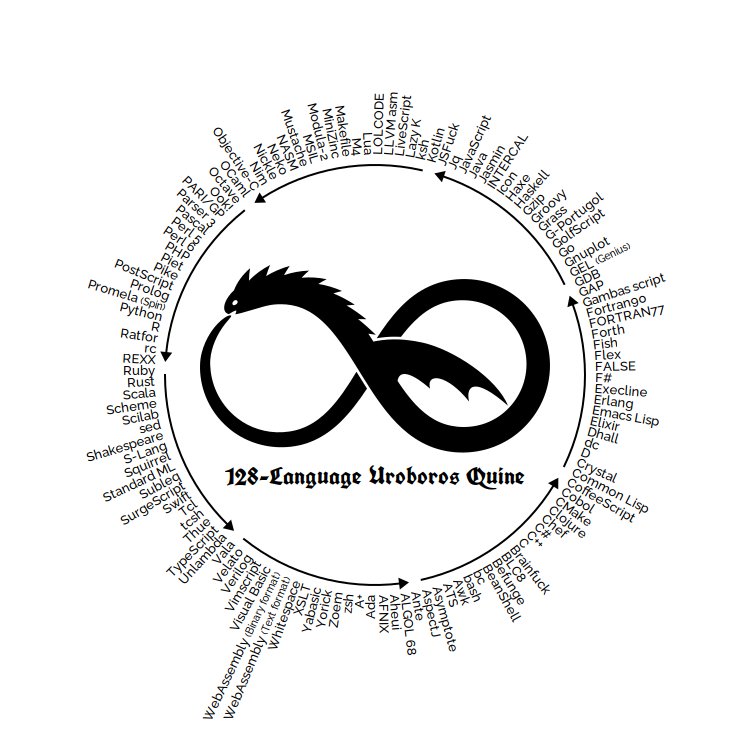
At its core, the quine-relay represents a computational Möbius strip where each language transforms the output of its predecessor into a program in the next language, ultimately completing a full circle back to the original source. This elegant construction serves as an ideal test case for packaging systems, as it demands a comprehensive approach to language support, dependency resolution, and build orchestration. The Docker build's failure, as noted by van der Silk, highlights a fundamental challenge in software distribution: the assumption of a uniform environment that rarely exists in practice.
The premise of the Nix approach rests on a simple yet powerful insight: if a language can be built for Ubuntu, it can be packaged with Nix. This realization transforms what might seem like an insurmountable challenge into a matter of systematic effort. The author's breakdown of the task into languages already present in nixpkgs and those requiring custom packaging demonstrates a pragmatic methodology that acknowledges both the capabilities of existing tooling and the necessity of additional work for specialized components.
What emerges from this investigation is not merely a technical solution but a philosophy of software packaging. The 95 languages already available in nixpkgs represent the low-hanging fruit, requiring only the construction of appropriate derivation expressions that orchestrate the transformation from one language to the next. These expressions, while varying in detail, follow a consistent pattern: take the output of the previous step, apply the current language's compiler or interpreter, and produce input for the next step. This regularity in structure amidst linguistic diversity reveals an important truth about software composition: the boundaries between languages matter less than the transformations between them.
The challenges encountered with gambas3 and modula-2 illuminate deeper truths about software packaging and dependency management. gambas3's reliance on hardcoded paths like /usr/lib/ exposes a fundamental tension in software design: the assumption of a filesystem hierarchy that may not exist in more modern, containerized, or hermetic build environments. The solution—using buildFHSEnv to create a compatibility layer—highlights Nix's flexibility in accommodating legacy software while maintaining its reproducibility guarantees.
The modula-2 saga presents a more complex narrative, one that touches on the philosophy of monorepositories versus modular design. The initial attempt to extract the m2 compiler from gcc's monolithic codebase revealed the hidden costs of such architectural decisions. As van Silk notes, "It's surprisingly hard to just isolate a small part that you want to build, even in an only-moderately complicated codebase, let alone one like gcc." This observation resonates beyond the immediate context, speaking to a broader tension in software engineering between the convenience of unified codebases and the practicality of modular, independently buildable components.
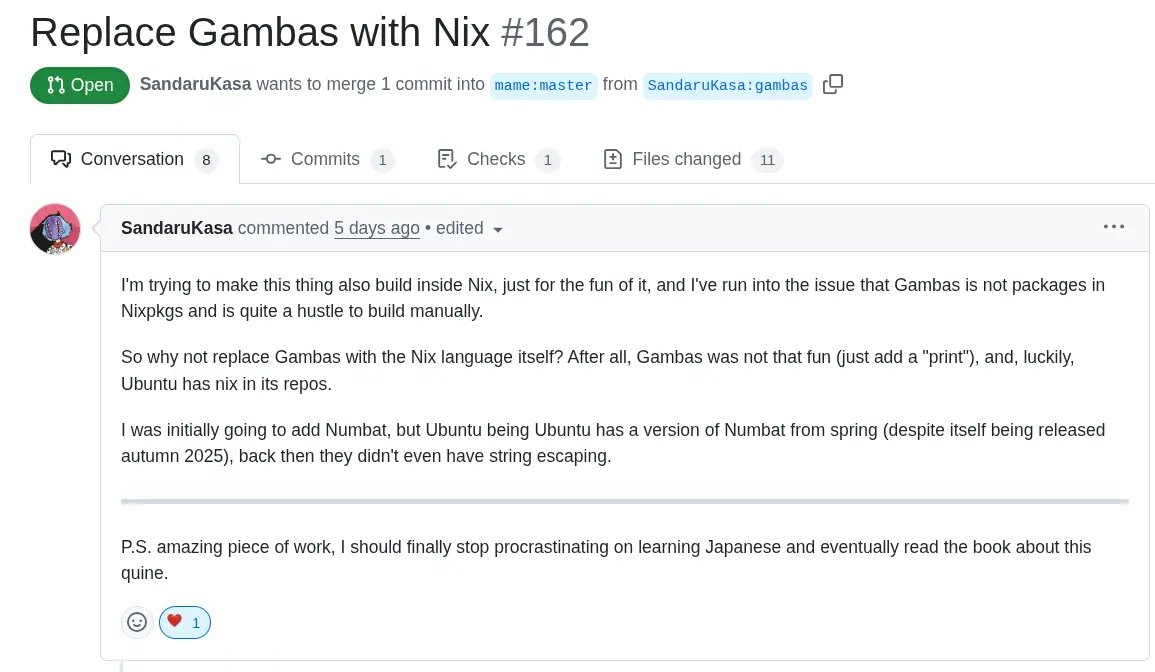
The eventual solution—using overrideAttrs to enable modula-2 support in the existing gcc package—demonstrates both the power and elegance of Nix's override system. This approach, also employed by SandaruKasa in an independent parallel effort, reveals an important aspect of Nix design: the ability to incrementally modify existing derivations without duplicating effort. The convergence of two independent implementations arriving at similar solutions speaks to the naturalness of the approach and the expressiveness of Nix as a packaging language.
The serendipitous discovery of SandaruKasa's parallel implementation raises profound questions about the nature of software development and innovation. In an ecosystem where complex problems can be solved simultaneously by independent actors, we see evidence of what might be called computational convergent evolution—different implementations arriving at similar solutions through different paths. This phenomenon suggests that certain approaches are not merely clever but represent natural solutions to the constraints imposed by the problem domain and the tools available.
The article's appendix offers valuable insights into practical Nix development that extend beyond the immediate quine-relay problem. The lessons about buildFHSEnv, overrideAttrs, version experimentation, parallel builds, patching, and the value of open source collectively paint a picture of Nix as a system that accommodates both pragmatic hacking and principled engineering. The observation about monorepos' frustrations, while perhaps obvious to experienced developers, gains new weight when considered in the context of reproducible builds and hermeticity.
The implications of this work extend far beyond the immediate domain of esoteric programming puzzles. In an era where software supply chain security has become paramount, the ability to reproducibly build complex multi-language projects represents a significant advancement. The demonstrated approach offers a template for managing the increasingly polyglot nature of modern software systems, where projects routinely incorporate components written in multiple languages with complex dependency graphs.
Yet, as the author wisely acknowledges, there remains a distinction between running a compiler and maintaining a development environment. The quine-relay project represents a specific, bounded problem with clear inputs and outputs. Real-world development environments must contend with incremental changes, interactive workflows, and the need for tools that support rather than constrain the development process. This distinction highlights an important frontier for Nix and similar systems: the challenge of providing not just reproducible builds but also productive development experiences.
The convergence of two independent implementations also speaks to the accessibility of Nix as a packaging system. The fact that two developers, working independently, could arrive at similar solutions suggests that the approach represents a natural fit for the problem domain rather than an esoteric technique requiring specialized knowledge. This accessibility stands in contrast to the complexity of some alternative packaging systems, which may require deeper understanding of their internal mechanics to achieve similar results.

Ultimately, the quine-relay packaging exercise demonstrates that Nix's value lies not in eliminating complexity but in managing it through principled design. The system's ability to handle 128 distinct programming languages, each with its own build requirements and idiosyncrasies, reveals a fundamental truth about software engineering: complexity is inevitable, but its management is a matter of appropriate tools and methodologies. The Nix approach, with its emphasis on pure functions, declarative specifications, and reproducible builds, offers one such methodology for taming the inherent complexity of modern software systems.
As we continue to build increasingly complex software systems, the lessons from this exercise become ever more relevant. The ability to package and reproduce multi-language projects isn't merely a technical curiosity but a necessity for maintaining software quality, security, and maintainability in an era where software systems grow ever more intricate. The quine-relay project, with its elegant circularity, serves as both a technical challenge and a metaphor for the circular nature of software development itself—each new build, each new iteration, brings us back to fundamental questions about how we create, manage, and reproduce the complex systems that increasingly define our world.
Comments
Please log in or register to join the discussion