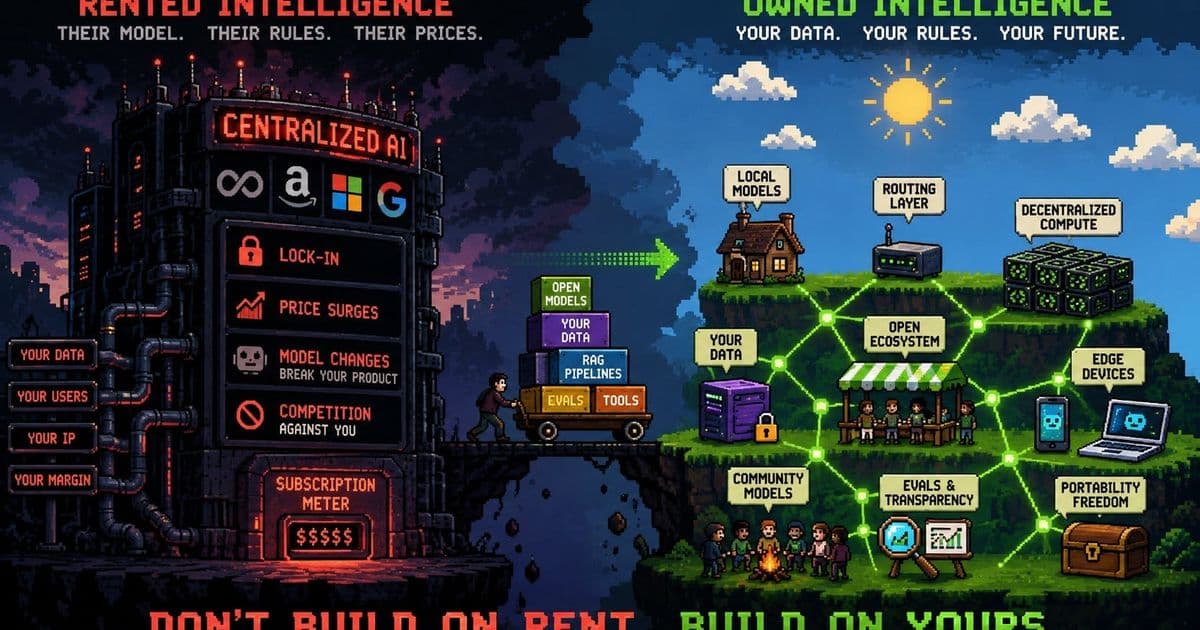
Centralized AI providers are turning model access into a rent‑seeking business, threatening the long‑term viability of startups that rely on proprietary APIs. The article explains the economics behind this trap, highlights open‑weight alternatives like DeepSeek, and offers a concrete roadmap for building a modular, vendor‑agnostic AI stack.
The Rent‑Seeking Trap: Why Your AI Strategy Needs a Hard Fork
{{IMAGE:2}}
You just spent six months integrating a frontier model into your core product. You fine‑tuned a LoRA, optimized a RAG pipeline, and finally reached parity with the competition. Then the model vendor raises prices, flips the model’s “personality”, or ships a feature that makes your entire business model obsolete. In effect, you have built a high‑end rental property on land you don’t own.
The hidden economics of centralized AI
The narrative that only trillion‑dollar firms can conjure "intelligence" masks a much simpler reality: foundational model companies are subsidising your prompts with massive cash burn. Compute, data, talent, and distribution remain expensive, but the subsidy makes inference appear cheap. The result is a market where a startup’s moat is a rented service that can disappear overnight.
Why the moat is illusory
- Model ownership vs. distribution – The same company that owns the model also controls the cloud, the API surface, the enterprise relationship, and the default UI. Competing on performance alone is impossible when a rival can under‑price you simply by throwing more capital at the stack.
- Talent concentration – The brightest researchers gravitate to the few firms that can afford the largest H100 clusters and the longest runway of irrational subsidy. This creates a feedback loop that further entrenches the incumbents.
- Inference subsidies – Venture capital is being used to make "magic feel cheap". When the subsidies end, the underlying economics re‑assert themselves, and the rent‑seeker’s profit margins collapse.
Invention versus ownership
The invention layer – the actual breakthroughs in model architecture – still looks like a startup: small teams, whiteboards, and nimble compute clusters. Ownership, however, is a completely different beast. The best researchers go where the compute budgets are, not because the architecture is inherently superior.
Open‑weight models as a pressure valve
Open‑weight projects such as DeepSeek‑V3 demonstrate that competitive performance can be achieved without a single corporate gatekeeper. DeepSeek reported training on 14.8 T tokens using 2.664 M H800 GPU‑hours for pre‑training and an additional 0.1 M hours for later stages. While total operational costs were not disclosed, the model scores in the high 80s on MMLU, comparable to closed‑source offerings.
Current open‑weight leaderboards (e.g., the March 2026 Onyx report) list more than 20 models – Llama 4 Maverick, Gemma 3, Qwen 3.5 – all achieving near‑state‑of‑the‑art results. The point where GPT‑3.5 served as a moat has passed; it is now a historical marker.
Building the anti‑monopoly stack
The solution is not a single open model that replaces every vendor. It is a bazaar of models, hosts, and routing protocols that keep the user in control.
| Layer | Practical approach |
|---|---|
| Model routing | Use a protocol (e.g., LiteLLM) that dynamically selects the cheapest‑good‑enough model for each request instead of hard‑coding a single API. |
| Edge inference | Deploy privacy‑sensitive or high‑frequency tasks on local hardware (e.g., Ollama, LM Studio) to cut latency and data exposure. |
| Open evals | Rely on public benchmarks and community‑maintained leaderboards to avoid marketing‑driven metric laundering. |
| Domain‑specific RAG | Keep your unique institutional knowledge in a private vector store and let the model act as a generic reasoning engine. |
| Decentralized compute | Tap into GPU marketplaces such as Nosana or Render to avoid vendor lock‑in for training and fine‑tuning. |
Treat AI as infrastructure, not an oracle
Your company’s support tickets, source code, and proprietary data are raw leverage. If you pour them into a centralized platform, that platform learns your business and eventually sells a version of your intelligence back to you under a usage cap. The goal is to make the AI layer swappable like a database.
- Keep copies of prompts and outputs.
- Separate your knowledge base from the model vendor.
- Design APIs that abstract the model behind a thin service layer so you can replace the backend without rewriting business logic.
Open questions and trade‑offs
- Decentralized compute at frontier scale – Coordinating checkpoint sharding for a 10 T+ parameter model without massive interconnects remains a technical hurdle.
- Versioning hell – A fragmented ecosystem could make safety guardrails and RLHF alignment harder to maintain consistently.
- User experience – A bazaar of models may never match the polished UX of a walled‑garden product, meaning you trade some efficiency for independence.
The 2030 vision: intelligence as plumbing
Imagine a world where AI is as invisible as electricity. Your laptop runs a private model tuned to your writing style. Your company hosts its own models that parse customer data without ever leaving the premises. Phones route tiny tasks to tiny models, heavy reasoning to frontier models, and sensitive work to local models – all without you caring which vendor performed the computation.
The winners will be builders who treat intelligence as modular hardware, not as a proprietary service.
Practical next steps
For CTOs and engineering leaders
- Build a multi‑model evaluation framework – benchmark internal tasks against at least three architectures (local, hosted API, open‑weight).
- Run a low‑risk POC – migrate a non‑critical internal service to a self‑hosted open‑weight model (e.g., Llama 4) and measure latency, cost‑per‑token, and operational overhead.
For developers and ML engineers
- Use LiteLLM for model‑agnostic API calls.
- Fine‑tune with Axolotl and serve with vLLM for high‑throughput inference.
- Keep your codebase agnostic to the underlying model – never hard‑code a specific endpoint.
For curious learners
- Follow Hugging Face Spaces for leaderboard updates, but also download weights and run them locally with Ollama or LM Studio.
- Read the original papers behind the models; the numbers alone don’t tell the whole story.
Conclusion
Centralized AI is not a technical inevitability; it is an economic capture strategy. By embracing open‑weight models, decentralized compute, and a modular stack, startups can reclaim ownership of their intelligence and avoid the rent‑seeking trap. The transition will require engineering effort and higher technical literacy, but the long‑term payoff is a resilient, vendor‑agnostic AI foundation that can evolve as the market does.
This post is part of the DecentralizeAI Hackathon, made possible by Nosana (decentralized GPU compute), Arweave (permanent decentralized storage), and HackerNoon.
Comments
Please log in or register to join the discussion