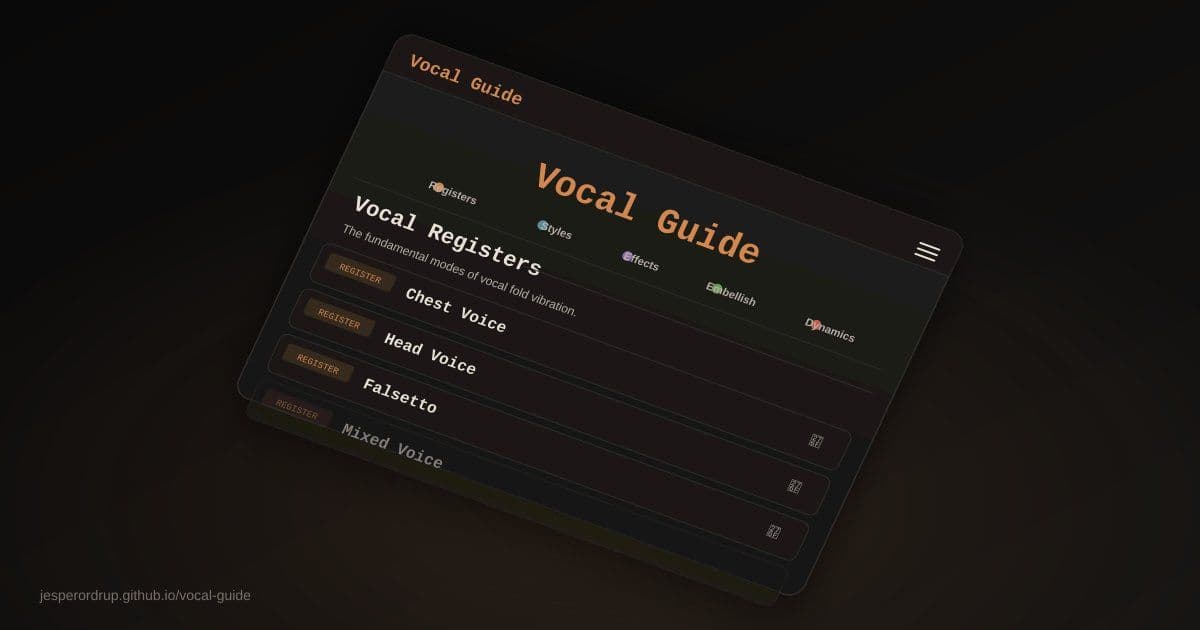
Jesper Ordrup's Vocal Guide represents a new wave of hyper-detailed technical references democratizing vocal pedagogy through structured registers, effects, and physiology explanations.
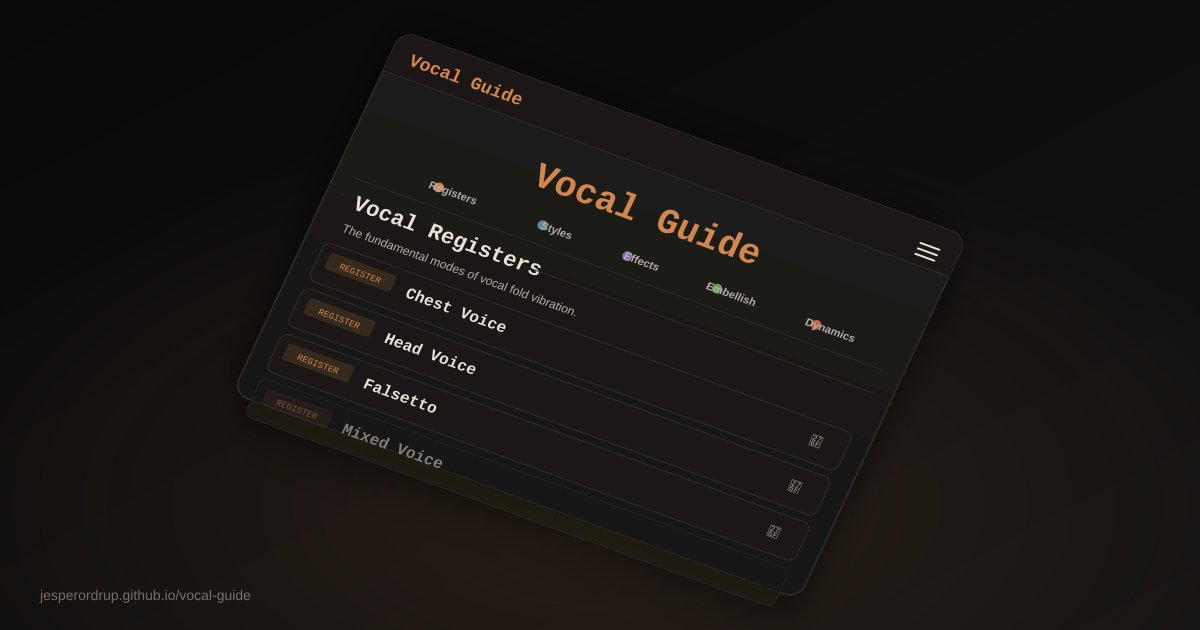
The landscape of vocal education is undergoing a quiet revolution as comprehensive technical guides like Jesper Ordrup's Vocal Guide gain traction among singers and coaches. This meticulously structured reference moves beyond superficial singing tips to dissect vocal mechanics with scientific precision—a trend reflecting musicians’ growing appetite for anatomical understanding alongside artistic technique.
At its core, Vocal Guide systematically categorizes the instrument's capabilities into five physiological registers: chest voice (thick fold vibration), falsetto (partial closure), mixed voice (blended resonance), vocal fry (loose fold bubbling), and whistle register (edge vibration). Each entry includes tactile exercises (“place hand on chest and speak”), famous practitioner examples (Johnny Cash for chest voice, Ariana Grande for whistle register), and crucially, physiological explanations of vocal fold behavior. This granular approach transforms abstract concepts like “mixed voice”—often mystified in traditional pedagogy—into tangible mechanical processes.
The guide extends into vocal styles (belting, twang), effects (grit, distortion), and embellishments (vibrato, runs), each mapped to muscle engagement strategies. Particularly noteworthy are its safety disclaimers: warnings against pushing whistle register without coaching, distinctions between healthy grit (false fold engagement) versus dangerous throat squeezing, and repeated emphasis on pain as a stop signal. Ordrup anchors everything to breath mechanics, framing diaphragmatic support as “the engine behind every sound” with Farinelli breathing exercises.
Adoption signals emerge from its practical utility. Theater performers leverage vowel modification charts (“AH” → “UH” ascending) to avoid strain, while rock vocalists apply kargyraa-inspired distortion techniques. The guide’s GitHub-hosted structure allows continuous updates, with current version 3.7.0 adding dynamic control exercises like messa di voce.
Counter-perspectives question whether such detail risks information overload. Some pedagogues argue vocal coordination develops through mimicry and sensory feedback, not intellectualization. Others note potential misuse—self-diagnosing register transitions without professional feedback could reinforce harmful habits. As one vocal therapist cautioned, “Anatomy diagrams don’t substitute for real-time auditory monitoring.”
Nevertheless, Vocal Guide’s success highlights a broader shift: musicians increasingly demand evidence-based frameworks. Its open-access model contrasts with guarded studio techniques, offering transparent knowledge previously reserved for conservatory curricula. As voice science advances, such repositories may redefine artistic development—not as mystical talent, but as trainable biomechanics.
Explore the full guide at Vocal Guide or reference specific sections like Mixed Voice Exercises.
Comments
Please log in or register to join the discussion