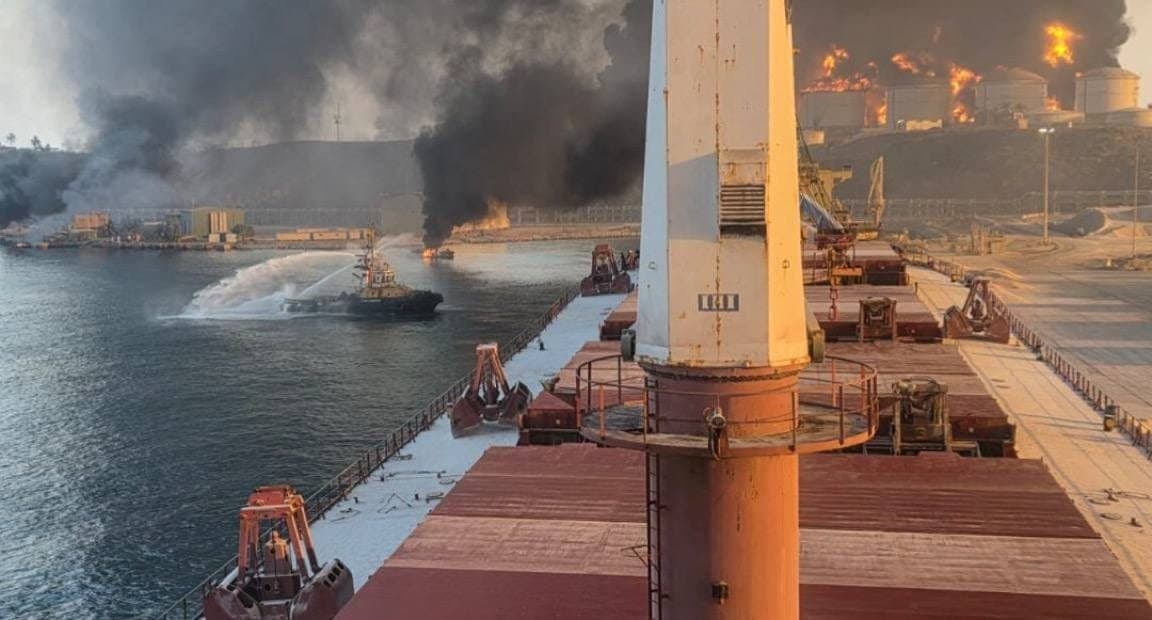
The closure of the Strait of Hormuz following Iranian drone attacks has triggered cascading effects across global energy markets, supply chains, and infrastructure systems, revealing the extreme vulnerability of modern industrial civilization to disruptions in critical chokepoints.
The closure of the Strait of Hormuz following Iranian drone attacks has triggered cascading effects across global energy markets, supply chains, and infrastructure systems, revealing the extreme vulnerability of modern industrial civilization to disruptions in critical chokepoints.
The Strait of Hormuz: A Single Point of Failure
Roughly 20% of the world's oil—around 20 million barrels per day—passes through the Strait of Hormuz. When Iran began attacking ships in this narrow waterway, the immediate effect wasn't just the physical damage to vessels, but the withdrawal of insurance coverage that effectively shut down traffic. Seven of the twelve International Group Protection and Indemnity clubs that collectively insure roughly 90% of the world's ocean-going tonnage executed identical cancellation notices for war-risk coverage across the Persian Gulf, the Gulf of Oman, and Iranian territorial waters.
These insurers didn't act because a government ordered them to, or because a naval commander declared a blockade. They withdrew because their London treaty reinsurers, confronting unlimited tail exposure in an active combat zone, could no longer satisfy the 99.5% Value-at-Risk capital charges mandated by the European Union's Solvency II directive. The reinsurers pulled capacity, and the clubs, which operate as mutuals whose losses fall directly on member shipowners, had no mathematical alternative.
Oil Price Volatility and Economic Contagion
Oil prices spiked to $119 a barrel, their highest level since 2022, though they dropped again before the market closed. If supply disruptions are prolonged, prices could rise further until the recessionary effect of higher energy costs destroys demand. The disruption affects not just gas prices but the cost of countless products that depend on petroleum derivatives.
Crude oil, gasoline, diesel, jet fuel, natural gas, petrochemicals, power, and fertilizer prices have all risen sharply since the conflict began. Various companies are declaring force majeure—extreme circumstances that free them from liability for breaking contracts.
The Jones Act Suspension: A Temporary Fix
To try and reduce oil prices, the Trump Administration plans to suspend the Jones Act, which requires goods carried between US ports to be carried on US-built ships. The 30-day exemption, still being developed, would apply broadly to vessels moving oil, gasoline, diesel, liquefied natural gas, and fertilizer among US ports. This would enable generally cheaper foreign tankers to move those goods—including Gulf Coast oil to refineries on the US East Coast and fuel from the region to more populous areas.
Japan also plans to release part of its strategic petroleum reserve. These emergency measures highlight how quickly governments must respond when critical infrastructure fails.
Fertilizer Markets: The Second-Order Effects
Oil isn't the only thing that passes through the Strait of Hormuz. The Middle East is responsible for a large share of fertilizer exports because fertilizer production uses natural gas as both a chemical feedstock and a source of cheap energy. A large chunk of the world's fertilizer passes through the Strait, and prices have spiked.
Deprived of their natural gas supplies from Qatar, fertilizer firms in India, Bangladesh, and Pakistan have had to shut down production. This creates a second-order effect: fertilizer producers elsewhere lack key ingredients. Gulf countries are important producers of nitrogen fertilizers, which depend primarily on natural gas burned at high pressure in the presence of hydrogen to synthesize ammonia.
Water Infrastructure Under Threat
The war has already brought fighting close to key desalination infrastructure. On March 2, Iranian strikes on Dubai's Jebel Ali port landed some 12 miles from one of the world's largest desalination plants, which produces much of the city's drinking water.
Attacks on Tehran's oil facilities have created a poisonous "black rain." Since the US-Israeli attacks on Iran began on February 28, we have confirmed strikes on at least four oil facilities around the capital. Residents report smog and pollution have blocked out the Sun and left a strong smell of burning in parts of the city, while experts warn the scale of some of the pollutants released could be "unprecedented."
The spike in air pollution appears to focus near the damaged oil sites around the capital—a city with a population of nearly 10 million, with millions more in the surrounding areas.
The Hidden Architecture of Global Trade
This crisis reveals the hidden architecture of global trade. The Strait of Hormuz handles about 3000 ships per month in normal times, including a large number of oil tankers. The fact that insurance companies can effectively shut down this entire artery with a few cancellation notices demonstrates how modern commerce depends on complex, fragile financial instruments layered atop physical infrastructure.
When reinsurers in London withdraw capacity due to EU capital requirements, ships stop moving halfway around the world. This isn't a failure of military strategy or diplomatic relations—it's a failure of risk modeling in a world where combat zones create exposures that no financial instrument can adequately price.
Infrastructure Vulnerability in the Modern Era
The Strait of Hormuz closure is a stark reminder that our industrial civilization rests on surprisingly few critical nodes. A single shipping channel, a handful of reinsurance companies, a few key ports, and the entire global economy can be brought to its knees. The fact that we've built such a system speaks to both the efficiency of specialization and the terrifying fragility of our interconnected world.
As the conflict continues, the question isn't just how to restore normal shipping through the Strait, but how to redesign our global infrastructure to be less vulnerable to single points of failure. The current system works beautifully until it doesn't—and when it fails, the effects cascade through energy markets, food production, water supplies, and every product that depends on these basic inputs.
The closure of the Strait of Hormuz isn't just a geopolitical crisis; it's a stress test of our industrial civilization's architecture, and the results so far suggest we have far more work to do to build resilience into the systems that sustain modern life.
Comments
Please log in or register to join the discussion